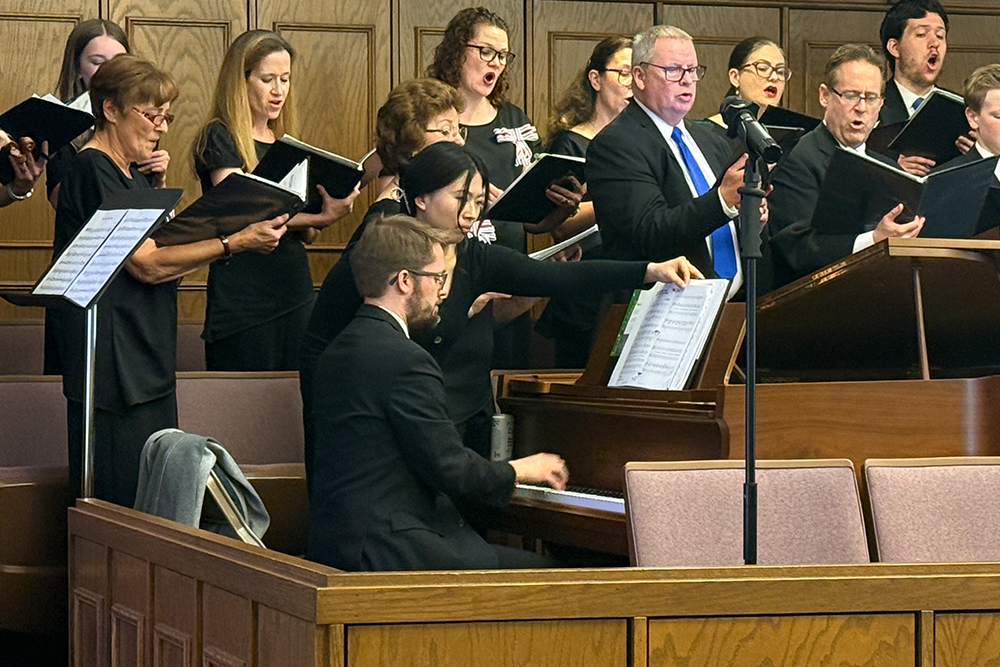
On many Saturday mornings, rising OUWB third-year medical student Drew Lewis heads to a Detroit chapel and focuses on something other than studying, lectures, exams, and becoming a doctor.
Rather, he gets lost in the feeling of his fingers gliding across piano keys as the sounds of the instrument accompanied by a choir fill the room with song.
That’s because Lewis has spent the last two semesters volunteering as a pianist with The Church of Jesus Christ of Latter-day Saints in Detroit. It recently culminated with a performance for the church by Lewis and the choir.
For Lewis, it’s a reminder of the importance of staying true to himself outside the demanding rigors of medical education.
“It’s kind of a fun way to end my week and relax a little bit before starting a weekend of studying,” Lewis said. “It’s something else to do to keep myself engaged mentally in other ways.”
Music has been woven into Lewis’ life since childhood. Growing up in Northville, Michigan, he first became interested in piano at 6 years old after seeing an old family piano his father had inherited from his grandmother. What began as lessons quickly became a lifelong passion.
“I grew to love it,” Lewis said. “Playing piano is an awesome experience for me. It’s a great way to de-stress.”
That love for music expanded beyond piano. At Northville High School, Lewis played trumpet in marching band and symphony band, while also participating in drama club productions. Music, however, was never just an individual hobby in the Lewis household, it was part of the family culture.
His father sings tenor, his mother loves singing and dance, and all five siblings grew up surrounded by music. Family gatherings often turned into impromptu performances, with relatives harmonizing together or preparing musical numbers for church services.
“We’ll just randomly start singing songs as a family sometimes,” Lewis said. “It’s kind of a big part of how we relate to each other.”
Those experiences left lasting memories for Lewis, not only because of the performances themselves, but because of the collaboration behind them.
“There were happy moments and frustrating moments when people couldn’t figure out the music,” he said with a laugh. “But it’s fun in the end to work toward something together and then see the fruits of those efforts.”
Now studying medicine after completing his undergraduate degree at Brigham Young University, Lewis faces the same challenge many medical students encounter: balancing academic intensity with personal well-being. Though he is leaning toward a future career in anesthesiology, he believes maintaining hobbies and passions outside medicine is essential.
For Lewis, music provides that balance. It serves as both an emotional outlet and a grounding force amid the pressures of medical education. Rather than viewing music as a distraction from his studies, he sees it as something that strengthens his mental and emotional health.
“Doing something different, even just to shake up the routine, can be highly beneficial mentally and emotionally,” he said.
When Lewis performs, he describes entering a state where technical practice fades into instinct and emotion takes over.
“Once your fingers know what to do, you can add in the rest of yourself,” he explained. “You really get into the spirit of the song rather than focusing on what your fingers are doing.”
That feeling, the ability to fully immerse himself in music, is what keeps him returning to the piano week after week, even amid the long hours and heavy workload of medical school.
Lewis’ story highlights an important lesson for students in demanding professional programs: success is not only built through discipline and hard work, but also through maintaining the passions that make life meaningful.
By continuing to nurture his musical talents, Lewis is preserving a part of himself that existed long before medical school, and one he hopes will remain long after it.
“You can keep studying and studying until the end of time,” Lewis said. “But if you don’t do something that makes you happy in the meantime, it’s easy to lose sight of why you’re doing medicine in the first place.”
More from OUWB
OUWB cohort visits The Zekelman Holocaust Center, preps for Study Trip to Auschwitz
Nutrition Focused Physical Exam session added to OUWB curriculum
Birthing simulation event provides valuable learning experiences for OUWB medical students
For more information, contact Andrew Dietderich, senior marketing specialist, OUWB, at adietderich@oakland.edu.
To request an interview, visit the OUWB Communications & Marketing webpage.
This work is licensed under a Creative Commons Attribution-NonCommercial 4.0 International License.