Oakland University William Beaumont School of Medicine
586 Pioneer Drive
Rochester, MI 48309
(248) 370-3634


Oakland University William Beaumont School of Medicine
The Holocaust, Medicine, and Becoming a Physician: OUWB Study Trip to Auschwitz
In 2022, Oakland University William Beaumont School of Medicine began offering a new transformative learning opportunity to its medical students through the OUWB Holocaust and Medicine program.
Part of the program -- the OUWB Study Trip to Auschwitz -- is designed to prompt students to delve into this distinctive and tragic era in the history of medicine and critically reflect on its implications for one’s own personal and professional development within the medical profession.
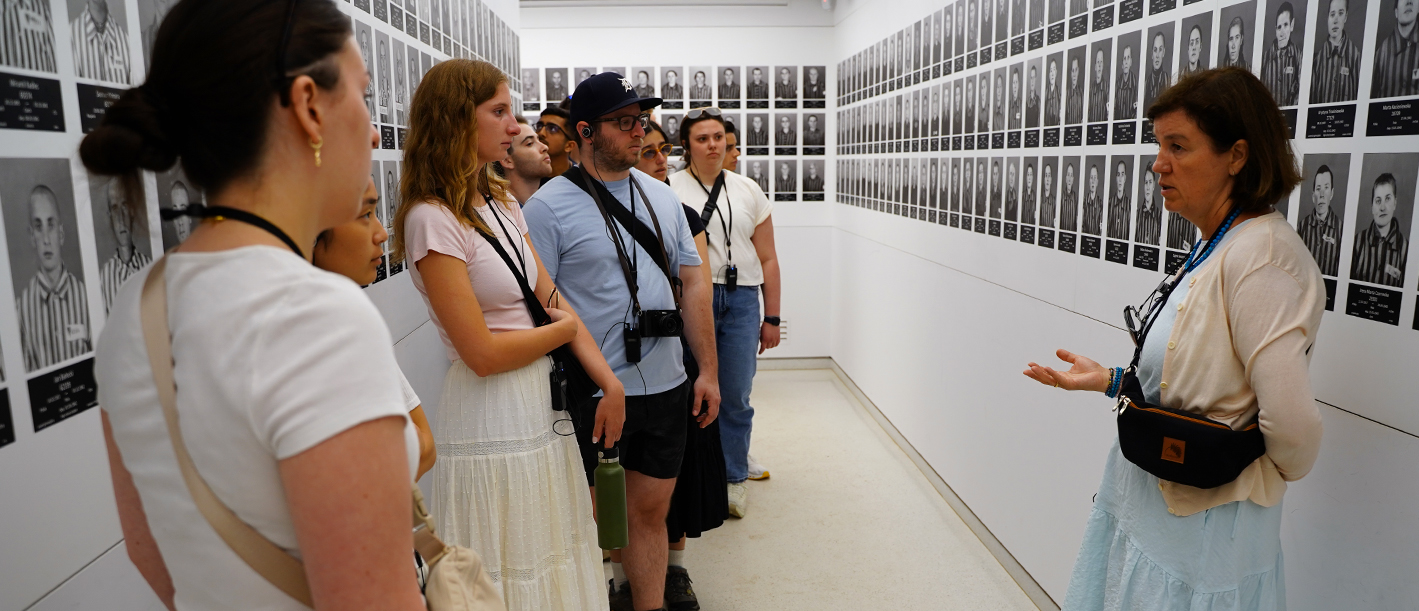
The inaugural trip was June 13-20, 2022. The seven-day trip centered on guided tours in Krakow, Poland, as well as the sites of the former Auschwitz 1 and Auschwitz-Birkenau concentration camps. Special lectures, and interactive workshops also were part of the trip.
Here is a brief overview:
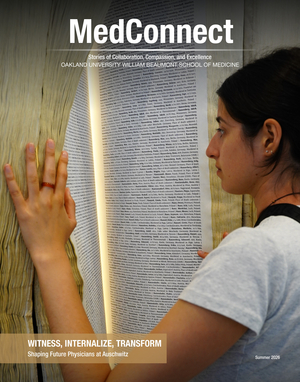
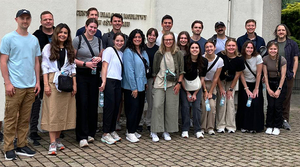
(Note: Photo at top of page is of the OUWB cohort that travelled to Poland for the Study Trip to Auschwitz in 2026.)
More About the Program
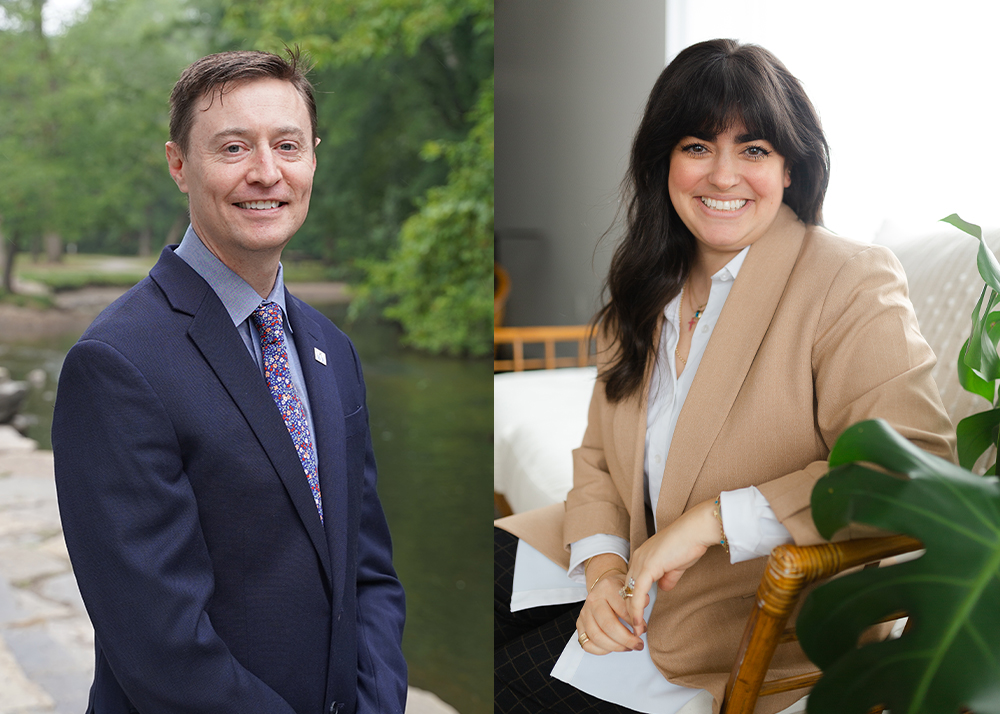
Students who attend the Study Trip to Auschwitz complete a project following the trip to share their experiences and insight with our community, thereby expanding the impact of the program. These projects involve papers, poems, presentations, videos, and more.
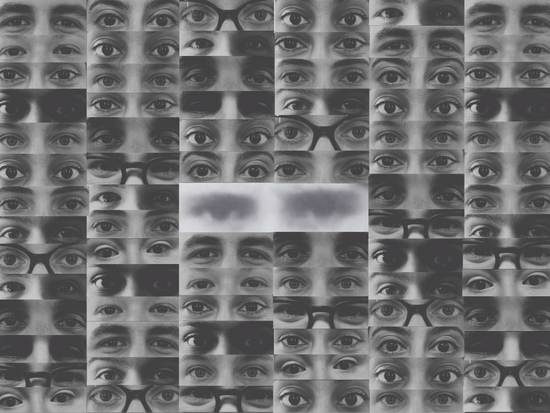
This digital artwork centers on the powerful eyes associated with the Auschwitz-Birkenau Memorial logo, symbolizing the humanity of victims whose identities were systematically stripped away during the Holocaust. Surrounding these eyes are those of the Poland Cohort Class of 2027, representing a new generation committed to bearing witness, preserving memory, and ensuring that the stories of the victims continue to be seen, remembered, and shared.
- Shreya Desai, student, OUWB
When I returned from Poland after the OUWB Holocaust and Medicine program, I struggled to find the words to explain the profound impact the experience had on me to my family, friends, and classmates. Instead, I found myself sharing the photographs I had taken throughout the trip. Putting some of my pictures together into this video allowed me to process my experience, and hopefully offers others a glimpse into the incredible responsibility that comes with a career in medicine, and the depth of moral courage required to uphold our oath as physicians.
- Emily Tenniswood, student, OUWB
This project highlights the evolution of medical language and the moral responsibility behind changing eponyms associated with the Holocaust.
- Gabrielle Abdelmessih, student, OUWB
2026 OUWB Study Trip to Auschwitz - Daily Journal

The cohort of 20 OUWB medical students who are part of the school’s 2026 Study Trip to Auschwitz spent the first full day of its journey in the Poland capital city of Warsaw.
This year marked the first time the study trip has included a stop in Warsaw.
“One way of engaging in professional and ethical formation is to study history, narrative, and moral exemplars,” said Abram Brummett, Ph.D., assistant professor, Department of Foundational Medical Studies.
“By adding Warsaw, we hope to expose the students to more stories, heroes, and sources of inspiration to incorporate into their reflections throughout the trip,” he added.
The first half of the beautiful clear and warm day consisted of a walking/bus tour of the area where the Warsaw Ghetto was located during World War II and the Holocaust.
Not only was the area the largest ghetto set up by Nazis, but it was the site of the 1943 Warsaw Ghetto Uprising.
Tour guide Karolina Paczynska, who has provided tours of Warsaw for about 30 years, led the group.
Overall, she provided a historical overview of the Warsaw Ghetto (size, population, overcrowding, evolution), and the lead‑up to its liquidation and uprising.
The tour included stops at several historical sites.
One of the locations was where part of the ghetto wall still stands at 62 Złota Street. The preserved wall marked the area of what is commonly referred to as the “small ghetto”, i.e. the original area of the Jewish quarter between 1940 and 1941. It contains, among other things, a commemorative plaque, as well as a plan of the Warsaw Ghetto, unveiled in 2022 in connection with the 82nd anniversary of the closing of the ghetto gates.
The group then walked about a block to the future location of the Warsaw Ghetto Museum, which is being built at the site of the former Bersohn and Bauman Children’s Hospital. Hannah Kurncz and Nicolette Patsarikas were teamed to read a testimonial and prepare a reflection of Dr. Adina Blady-Szwajger. The doctor worked at Bersohn and Bauman and treated young patients suffering from conditions like starvation, typhus, and tuberculosis. As deportations intensified in 1942–43, Blady-Szwajger described giving fatal doses of morphine to terminally ill children to spare them from deportation to extermination camps. Ultimately, she escaped and joined the Polish resistance movement.

Kurncz recounted Blady-Szwajger’s experiences mere feet from where they took place.
“It was so special,” she said afterwards. “I feel so lucky to have this experience to continue to learn about history and incorporate that with our bioethics class all year.”
“There’s just another aspect when you’re staring at the site of the former children’s hospital, reading a reflection of the actions that doctors had to take during that time.”
Patsarikas provided a reflection as a current medical student considering pediatrics as a specialty.
“Reflecting on the testimonial with people around me who are here to learn about this experience and historical event made me feel a lot more connected to this person,” she said.
The group next stopped at the Umschlagplatz Memorial, the spot at which hundreds of thousands of Jews were deported from the ghetto to concentration camps. The cohort then visited an archaeological site of a former underground bunker, where excavators uncovered the remains of tenement cellars and more than 3,000 items belonging to their inhabitants.
They also spent time at the Anielewicz Mound, which is a memorial site located at the former headquarters of the Jewish resistance group during the war and Holocaust.
The day concluded with a two-hour guided tour of the Museum of the History of Polish Jews, which provided a deep dive into Jewish life in Poland throughout history.
Katie Chaka Parks, Ph.D., director, Education, The Zekelman Holocaust Center, and trip co-leader, explained the importance of visiting Warsaw before the group heads to Krakow tomorrow and then Oswiecim, where the former Auschwitz concentration camps are located.
“We’re not starting with a bunch of graphic imagery or starting in the middle of the Auschwitz Memorial,” she said. “We’re starting in a place that’s very must still lived in by Polish people today and yet you see marks of history all around you of what used to be here.”
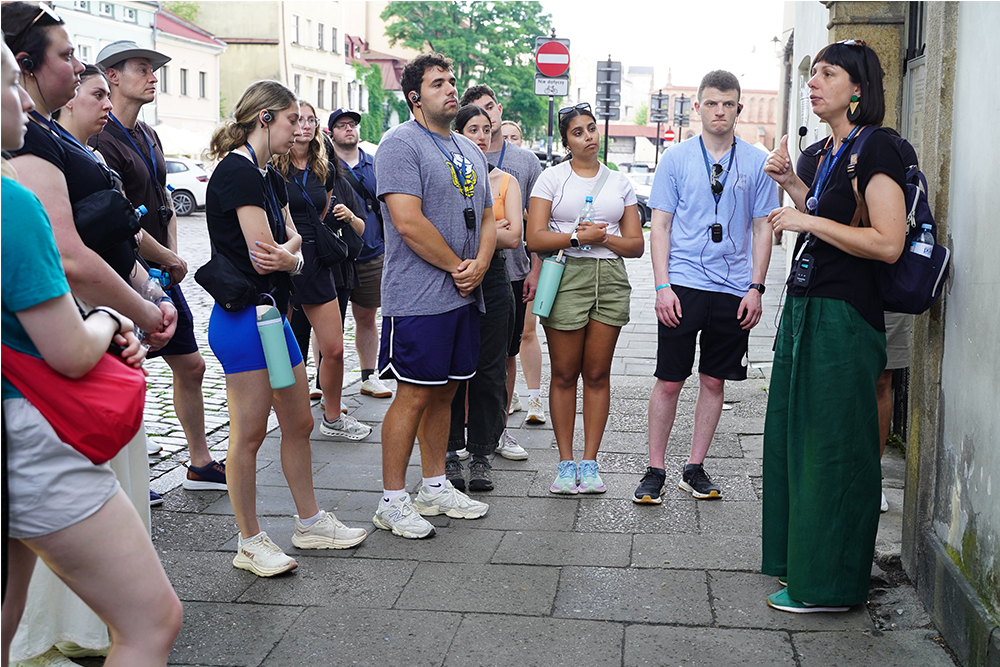
The group of OUWB students traveling in Poland for the 2026 OUWB Study Trip to Auschwitz spent today in Krakow, where they continued a deep dive into Jewish history and culture.
On Monday, the cohort will visit Plaszow Concentration Camp memorial site before heading to Oswiecim, where the Auschwitz memorial sites are located and they will spend the rest of the trip.
The time spent in Warsaw and Krakow so far will be critical to having the most effective learning experience for the rest of the study trip, said Harry Smith, senior education program manager, The Zekelman Center, and one of the facilitators of this year’s study trip.
“It’s important when learning about the Holocaust in any structure and any perspective to first understand that it is the genocide of the Jewish people, and in order to understand and unpack that, you have to understand who the Jewish people are,” he said.
“There is a lot of experience that can be gained from seeing the footprint or lack of footprint of not only the Holocaust and how it played out in Warsaw and Krakow, but also the Jewish community, and what it was and what it may still be,” he added.
The day began with a 3.5-hour bus trip from Warsaw. Several trip participants compared driving through Poland to rural northern Michigan.
Following a short lunch, a familiar face greeted the group - Aleksandra Szuba, a Krakow tour guide who has worked with OUWB students visiting the city since 2022.
“It’s a great pleasure to see how important the visit is for the medical students,” she said. “They are always prepared.”
Szuba noted that she is particularly impressed by the testimonials students read while visiting Poland. On Sunday, Quinn Abate read a testimonial of Dr. Abrahim Weinreb, Eric Becker addressed Jewish ghetto physicians, and Rebecca Bienstock covered Taduesz Pankiewicz.
“That tells me they are personally involved and that the stories they prepare are important to them … and I think that is especially important for these future doctors,” she said.
Szuba took the group first to the Galicia Jewish Museum. The OUWB cohort was led on a guided tour of an exhibit called “Traces of Memory: A Contemporary Look at the Jewish Past in Poland.”
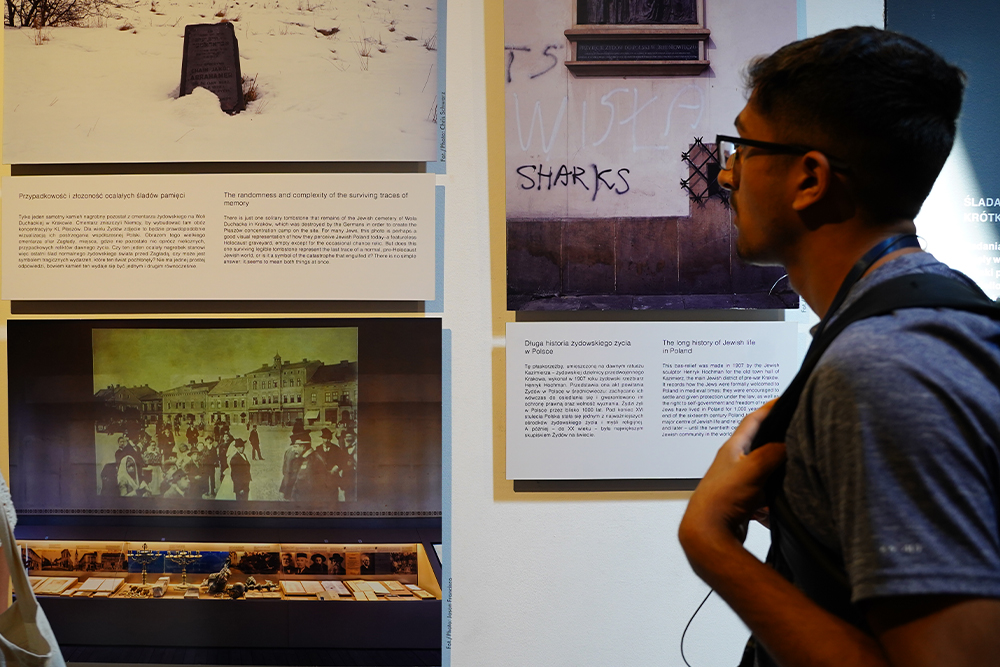
The exhibition features photographs by the late Chris Schwarz and texts by Jonathan Webber (UNESCO Committee Chair for Jewish and Interdenominational Studies at the University of Birmingham, and Professor at the Institute for European Studies at Jagiellonian University in Kraków).
Over a course of 12 years, they worked together to gather material that offers a unique and new way of looking at the Jewish past that was destroyed in Poland. The exhibition pieces together a picture of the relics of Jewish life and culture in the region that can still be seen today, interpreting these traces in a manner designed to be informative, accessible, and thought-provoking.
The exhibition is divided into five sections: Jewish Life in Ruins; Jewish Culture as it Once Was; Sites of Massacre and Destruction; How the Past is Being Remembered; and People Making Memory Today.
Visiting the museum had a big impact on students.
“This exhibit tells a chronological story, which makes it easier to understand how things happened over time,” said Matthew Rochlen. “From the pictures, you can begin to understand a little bit more the scale at which things occurred.”
Aren Shah shared similar thoughts.
“It was really great to see photos representing the beginning to the end,” he said. “I read a lot of the descriptions of the photos and it was interesting to see the progression.”
After the Galicia, Szuba took the group on a walking tour through Kazimierz, the historic Jewish district of Krakow, and explained the 1,000-year history of Jews in Krakow, the Holocaust, and the post-war legacy, with references to Schindler’s List (filmed partially in the area) and present-day Jewish life.
The tour carried on despite torrential rain and continued at the Eagle Pharmacy before the group wrapped up the day with dinner at a restaurant in Krakow’s bustling and picturesque Main Square.
“I hope that the students take with them today a recognition of the humanity of people, the vibrancy of culture and community, and the destruction that can happen when dehumanization is not only normalized, but acted on,” said Smith. “And I hope that they understand that in its connection to Jewish people.”
From chatting to laughter, sounds of some sorts have generally filled the various buses used by the group of 20 medical students on the 2026 OUWB Study Trip to Auschwitz — until Monday.
It was when the cohort got its first glimpse of Auschwitz 1, the memorial site of a former concentration camp located in Oswiecim, Poland.
And though the students only saw it from a bus — and the group will get a much closer look tomorrow — one could not only hear a pin drop, but feel the study trip essentially switch to its second phase at that exact moment.
“That tells me they are sensitive and attuned to the experience they’re having,” said Abe Brummett, Ph.D., assistant professor, Department of Foundational Medical Studies, and this year’s program director.
“And when you come face-to-face with Auschwitz for the first time, even if you’re just driving by it on the road, it can feel surreal,” he added.
It was just one of many impactful moments on Monday as the group made its way from Krakow to Oswiecim, which took about 90 minutes by bus.
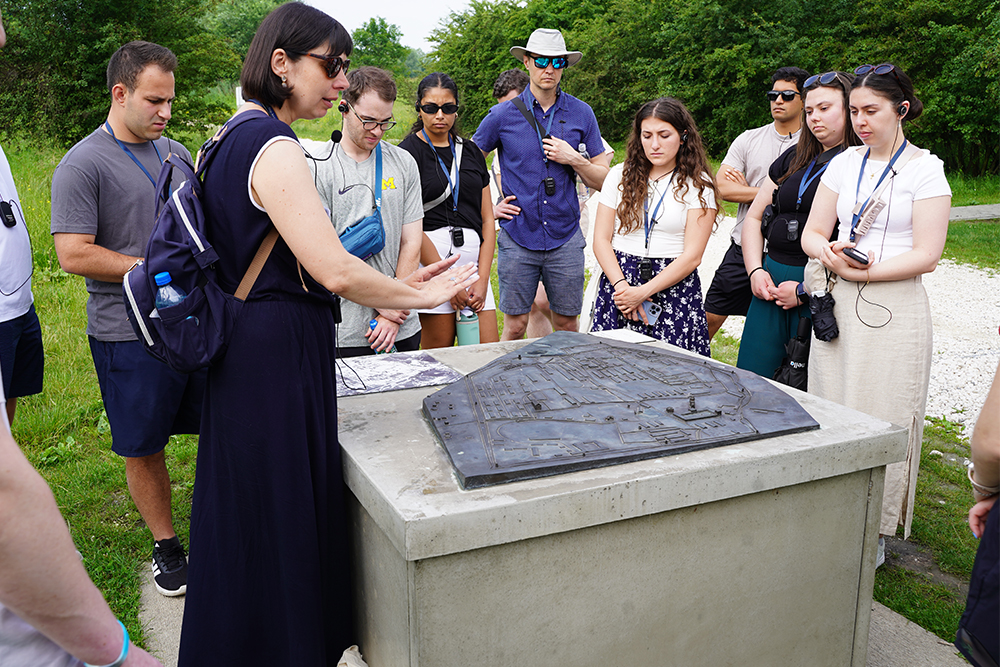
Before leaving Krakow, the students spent about an hour at the KL Plaszow Memorial Site.
Infamous for its brutal conditions and commander Amon Goeth, it held about 35,000 prisoners—mostly Polish Jews—and was the central setting of the film Schindler's List.
At its maximum size in 1944, the camp spanned about 200 acres. The camp perimeter was enclosed by roughly 2.5 miles of electrified barbed-wire fencing.
Today, it’s a protected memorial and war cemetery, featuring open green spaces, the towering Monument to the Victims of Fascism, and several smaller memorials.
OUWB students Rani Randell and Anjali Desai presented a testimonial and reflection on the camp on the exact site where it was located.
“It felt unexpectedly serene and I think it’s a testament to the fact that there’s so many things that we walk around in our life and we don’t know where people came from or what they’ve gone through,” said Desai. “It exemplified that in a physical way … just walking through the site without knowing the history, you would never know what happened here and how many people were impacted.”
Brummett said he views the OUWB stop at Plaszow as “the end of the first phase” of the study trip because it essentially sets the stage for more intense visits to the Auschwitz memorial sites on Tuesday and Wednesday.
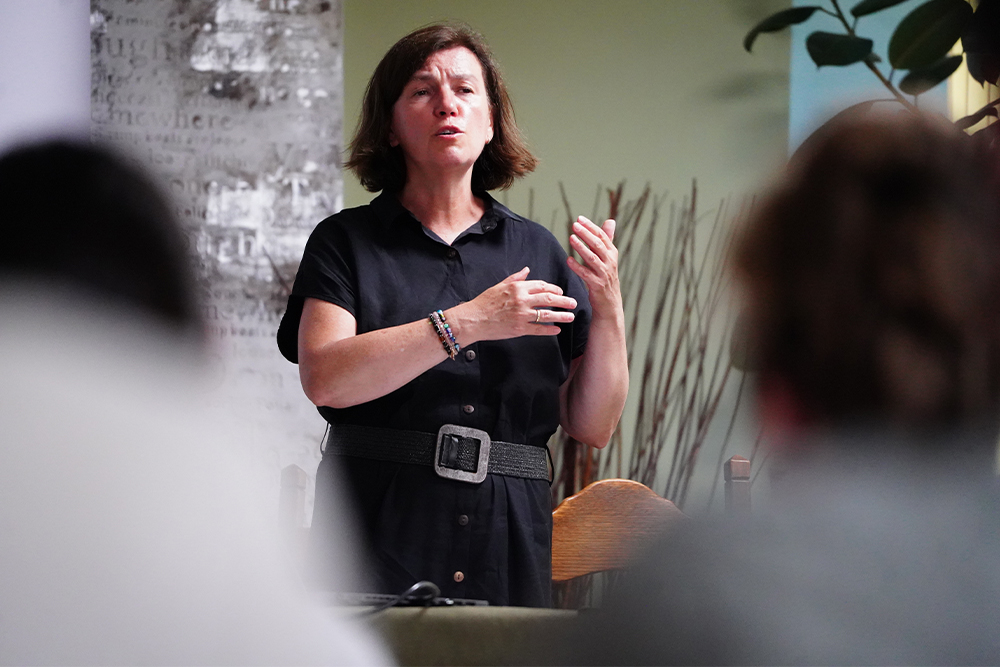
Concurrently, he pointed to a lecture received by the group later in the day as “the first step into Auschwitz.” (The lecture followed a brief tour of the only surviving Jewish house of prayer in Oświęcim, the historic Chevra Lomdei Mishnayot synagogue.)
“Medicine in Auschwitz” was delivered by Teresa Wontor-Cichy, Ph.D., a curator from the Auschwitz Memorial and Museum’s Research Center.
The expert explained how a place meant for imprisonment and forced labor also became a central site of medicalized mass murder. She explained the structure of Auschwitz I, Auschwitz-Birkenau, and the subcamps; the groups deported there; and how medicine—through hospital blocks, selections, and death certificates—was integrated into the camp system.
Particular focus was placed on German doctors and experiments who used prisoners for racial, military, and academic research without consent.
She will be one of the guides when the group visits the Auschwitz sites.
Monday also saw the students participate in their first reflective writing session.
Led by Andrea Eisenberg, M.D., an OB-Gyn who is serving as one of the trip facilitators—and has family members who died during the Holocaust as well as survived—students reflected on what stood out to them, what surprised them, and what left them unsettled from the trip thus far. (Thoughts and feelings provided by students during the reflective writing sessions are being kept private.)
“I liked how they participated and wanted a place to discuss their feelings and reactions,” she said. “I think some people are surprised that they’ve had the reactions they did.”
Earlier in the day, Randell shared some insight into how she is processing everything.
“It’s given me the utmost gratitude for every single thing that we have,” she said. “Even to be able to learn and experience this all together.”
Comments like that have Brummett feeling immense pride in the students.
“I just keep thinking about how proud I am of our students,” he said. “We try to put together a really professionally forming experience for the students and they volunteer to come here.”
“I’m just very grateful…they’ve studied hard all year and then take a week out of their summer to come and do this,” he added. “I just have so much respect for all of them for doing that.”
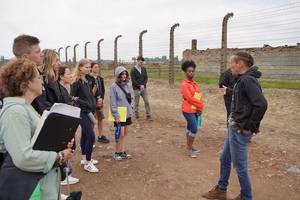
Twenty OUWB medical students visited the memorial site of the former Auschwitz 1 concentration camp on Tuesday.
“It’s the first day that the students are steeped in the history of it all … walking through the front gate of Auschwitz, through the barracks, where the “research experiments” took place, where people were exterminated, murdered,” said Abe Brummett, Ph.D., assistant professor, Department of Foundational Medical Studies, and this year’s program director.
“It’s the most confrontational day…when all the stories become more tangible,” he added.
The cohort spent about four hours at the site under mostly sunny skies with temps in the upper 70s.
They split into two groups, with each led by a tour guide from the memorial and museum. Each person had a headset so they could hear the tour guide who spoke into a microphone.
They started by following the guides through the entrance of the memorial and through the gates.
Students listened intently as they moved in, out, and through various buildings, which are referred to as “blocks.”
They started in Blocks 4 and 5, which feature exhibitions focused on extermination.
In Blocks 8 and 9, OUWB medical students learned about the individual, human experiences of registered camp prisoners.
In Block 11, they learned why it’s known as the “death block.”
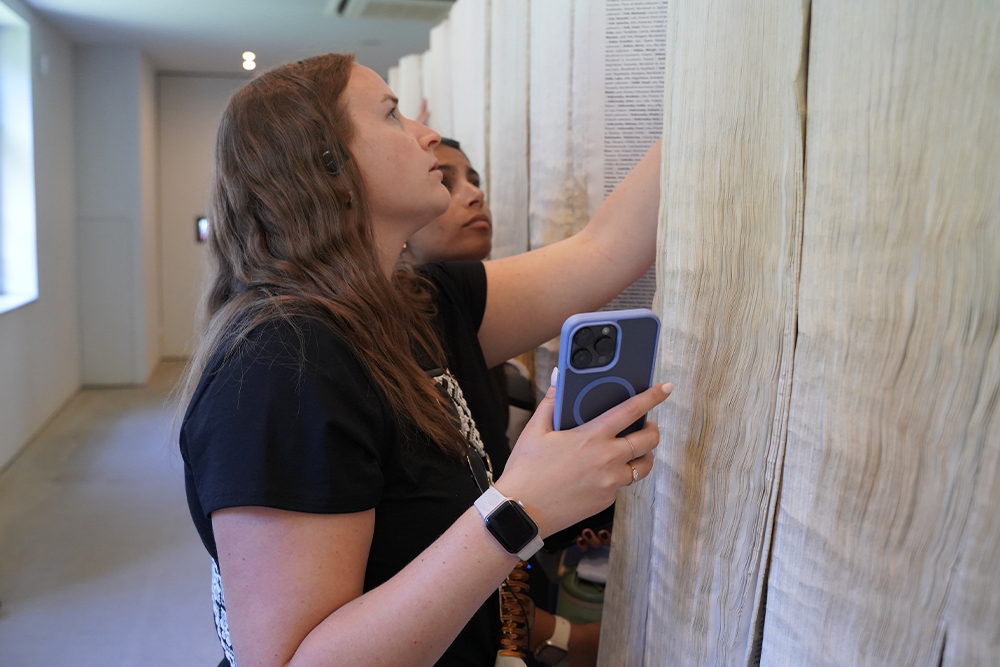
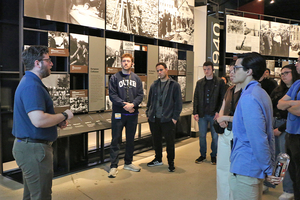
In Block 27 students viewed the central Holocaust (Shoah) exhibition prepared by the Yad Vashem Institute. Opened in 2013, it focuses on Jewish victims. It is composed of several poignant galleries:
- The Book of Names: A monumental, physical and digital record containing the names of all known Jewish victims of the Holocaust.
- Children's Drawings: A dedicated room featuring projections and authentic sketches and drawings made by children during the Holocaust.
- Pre-War Jewish Life: A gallery illustrating the rich culture of Jewish communities across Europe before their destruction.
Student Emily Feldman found several people in the Book of Names that were her ancestors.
“It’s almost not even fathomable to me,” she said. “I can’t even put it into words how it made me feel knowing that I share DNA or blood with people who were victims of this atrocity.”
Following lunch, the group went to The International Center for Education about Auschwitz and the Holocaust for another lecture from Teresa Wontor-Cichy, Ph.D., a curator from the Auschwitz Memorial and Museum’s Research Center.
The lecture centered on Auschwitz’s Block 10, where Nazi doctors conducted medical experiments—especially sterilization—on prisoners, primarily women. The group then toured the building that is only opened in special situations.
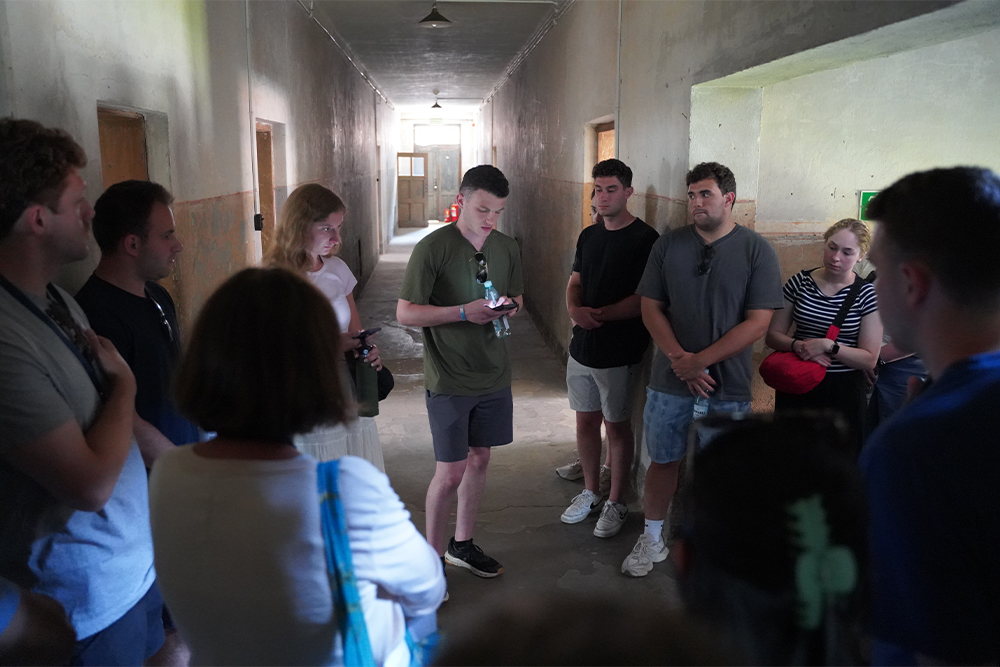
Brummett said the emphasis on what happened in Block 10 was intentional for the medical students.
“There were a lot of physicians doing things to Jewish prisoners in the camps that really epitomize the medical profession being co-opted to harm rather than heal,” said Brummett. “Things that aim to benefit people who are not the patient, right? And it’s at the hands of physicians, which is what’s so disturbing about it.”
He stressed the importance of today’s future physicians being aware of "goods internal to the practice of medicine,” or the intrinsic goals, values, and moral outcomes of the medical profession, such as healing, comforting, and restoring health. These contrast with external goods like financial wealth, prestige, or administrative metrics.
“There will always be these attempts to co-op medicine for other reasons, beyond healing,” he said. “We want to make future physicians aware of what can happen when physicians lose sight of goods internal to the practice of medicine.”
That’s why student Eli Grey was asked to read a testimonial of Herta Oberheuser, a German Nazi physician and convicted war criminal who performed medical atrocities on prisoners. (Student Hannah Kumcz provided a reflection.)
“It’s another example of something that happened that was just so unimaginable,” said Grey later in the day. “On the one hand, there’s the bravery that some of these physicians took in caring for their patients despite the innumerable negative consequences they could have gotten for it.”
“On the other hand, there are the awful acts that physicians (like Oberheuser) did every day and acted like it was nothing,” he added. “Seeing that parallel is quite profound.”
At the end of the day, students like Brad Zousmer said they were still obviously in the early stages of processing what they experienced Tuesday – and grateful for the opportunity.
“It’s definitely a lot of emotions and some that I can’t describe … and some I don’t think I’ve really ever felt in my life,” he said. “It’s just overwhelming knowing that each step I took today was a step taken by thousands of people who were killed just because of who they were…it’s mind boggling.”
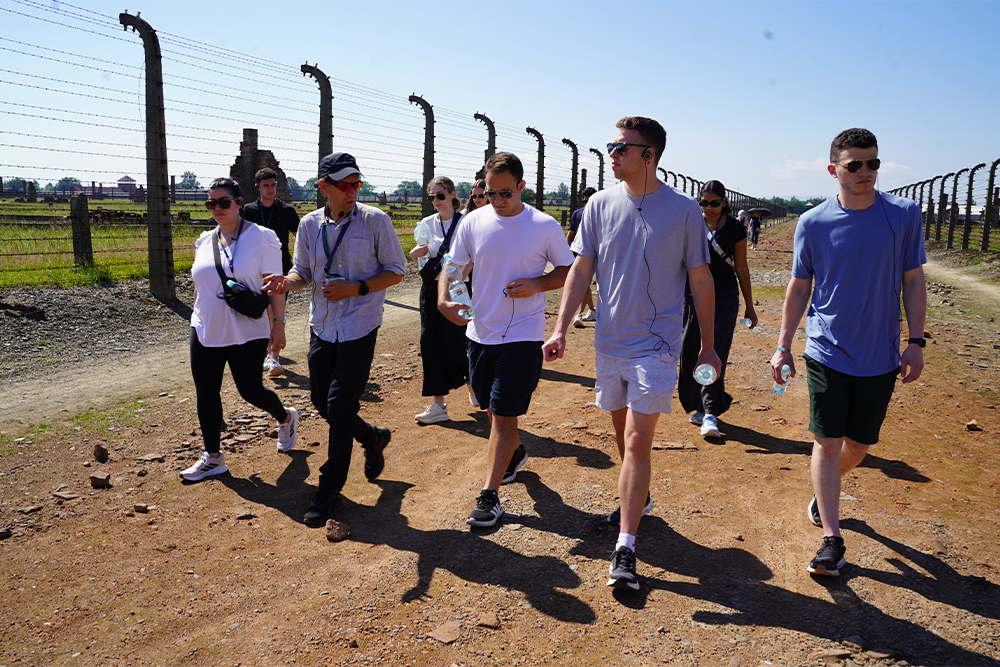
The 20 OUWB students studying the Holocaust and medicine in Poland this week spent the final day of the trip on Wednesday at the sprawling Auschwitz-Birkenau memorial site.
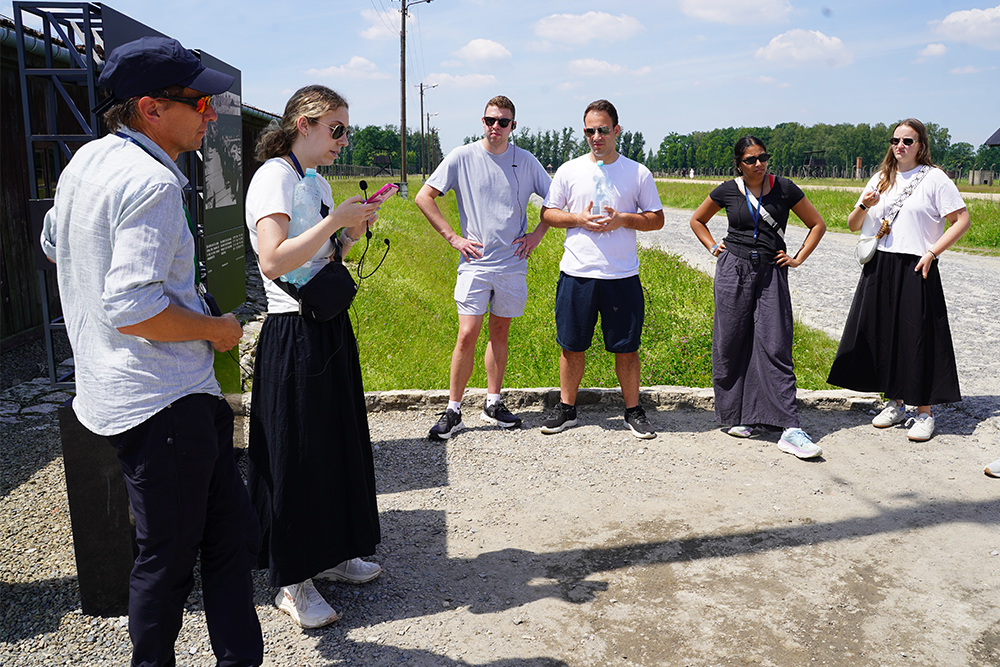
Led by two guides (one for each group of 10), students toured much of the site, which is more than 400 acres. (Based on a step counting app, students walked about 4 miles.) The day was sunny with temps in the upper 70s.
Students learned how the camp complex was created and expanded, how mass murder was organized and carried out, and what life and survival looked like for victims. They also read testimonials generally related to the Holocaust and medicine.
And they were consistently reminded that the whole area is effectively a mass grave; ashes of Holocaust victims were used by Nazis to stabilize roads, for example.
“The scale of the site makes is so much more horrifying to experience,” said Sameep Gawaskar.
Students all had moments that were particularly impactful. Gawaskar, for example, said it was seeing the "Gate of Death,” which is the main entrance gate. The imposing brick structure, which includes a central watchtower and guard quarters, serves as one of the most recognizable and haunting symbols of the Holocaust.
“Seeing the building that we’ve seen so many times in movies and pictures … that affected me a lot,” he said.
Becca Bienstock said she had a similar reaction.
“And you see the train tracks that lead through the Gate of Death and think, ‘If I was on those train tracks 80 years ago, I would be going through selection,’” she said. “It’s a weird realization.”
For Sam Carlin, the most impactful moment happened near the remains of Gas Chamber and Crematorium No. 5, where it’s estimated 2,000 people could be murdered at a time. Images illegally taken by prisoners and now on display at the site show bodies being burned in a relatively small field behind the building site.
“That was the only time I teared up on this trip,” he said. “The picture of kids sitting in the forest, waiting to be taken to the gas chamber. I was envisioning me and my buddies at camp, sitting like that and playing cards.”
Krzysztof Antonczyk, head of Auschwitz’s digital archive and tour guide for one of the groups, highlighted the importance of such moments, despite the difficulty.
“We can take incredible power from the tragic site,” he said at the end of the tour. “I believe that now it’s a place concentrating the goodwill of people who come here to not only remember the past, but change the world.”
Following the nearly five hours spent at Auschwitz-Birkenau, the group ate a quick lunch and returned to The International Center for Education about Auschwitz and the Holocaust. There, they listened to a lecture from Piotr Setkiewicz, Ph.D., director of Centre for Research at the Auschwitz-Birkenau State Museum. The nearly two-hour lecture focused on the role of Nazi doctors in the euthanasia campaign at Auschwitz.
Afterwards, several members of the OUWB cohort took advantage of a two-hour block of free time to return to Auschwitz 1 (where they were yesterday) to explore on their own.
At dinner, students shared their thoughts on Holocaust-related books they had been assigned to read prior to the trip.
Then, the day – and trip – ended with a final session where students reflected on key turning points on the study trip, how what they learned will influence their current life, values and future actions as physicians, educators, or advocates, and where they found unexpected moments of kindness. (Reflections shared during the session are being kept private.)
It came to a close with a final thought from Abe Brummett, Ph.D., assistant professor, Department of Foundational Medical Studies, and this year’s program director.
I keep thinking about a question (student Rani Randell) asked: “How do people learn about something like this and not think about it all the time?”
I think the best we can do is aspire to live well, to celebrate life, and respond to indignities with defiance.
Sometimes, that could look like the lives of the many heroes we learned about this week. Other times, that could look like using a patient’s name rather than a number, looking them in the eyes, and sitting with them when you listen and speak.
But here’s a hard truth many of you probably won’t like to hear, you’re going to fail at this, you won’t be perfect. But who needs perfection?
The Nazis wanted perfection. A perfect body, a perfect state, a perfect race.
I do not know how to learn about the Holocaust and not think about it all the time.
But maybe we can defy it by rejecting this deeply dehumanizing pursuit of perfection.
Instead of perfection, what if we aimed at beauty by more fully embracing this bumbling, fumbling, absurdly flawed experience we call “being human?”
And what if we had physicians who fiercely defended this beauty against any ideology that tries sorting their patients into those who are deserving of care, respect, and dignity from those who are not?
More Program Coverage
(June 19, 2025)
(Jan. 27, 2023)
(June 9, 2022)