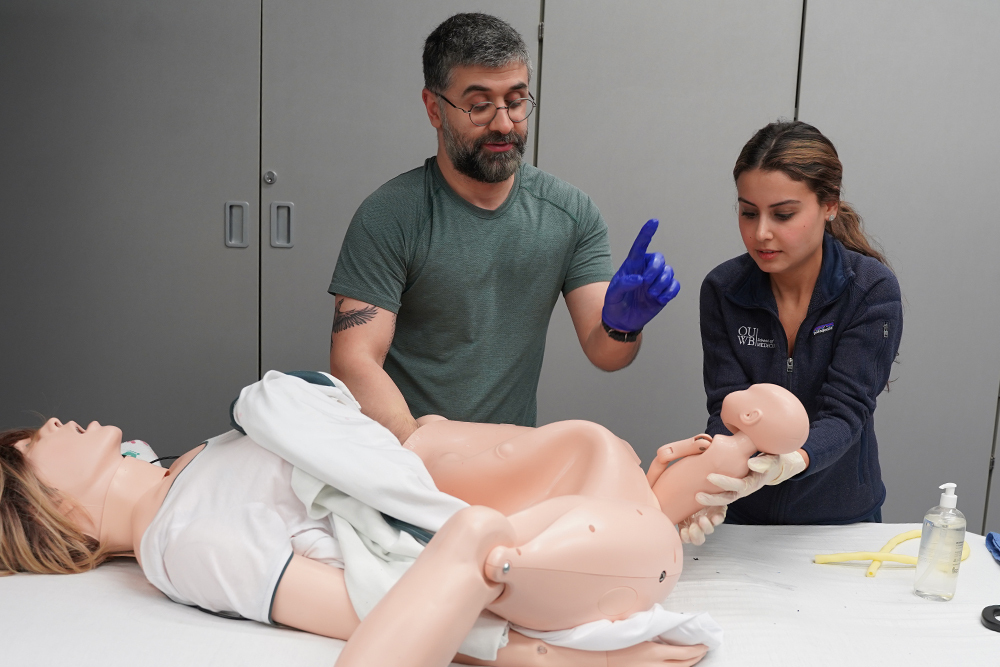
Oakland University William Beaumont School of Medicine students practiced their hands-on obstetrics skills during a recent birthing simulation held at Corewell Health William Beaumont University Hospital in Royal Oak.
Hosted by the OB/GYN Interest Group (OGIG) at the Applebaum Simulation Learning Center, students had the opportunity to rotate through four stations and practice skills in a clinical setting designed to reflect real labor and delivery scenarios.
Betty Judah, M2 and president of OGIG, said the student-led organization hosted the event to promote obstetrics and gynecology and provide students with direct exposure to the specialty through hands-on learning.
“Our student-led organization is dedicated to promoting interest and exposure to the field of Obstetrics and Gynecology by providing meaningful opportunities for students to engage with different aspects of the specialty,” she said. “By hosting an event like this, where OB-GYN residents at Corewell Health teach OUWB students hands-on skills used in various types of deliveries, we hope to create an environment where students can learn directly from physicians who were once in their shoes and feel inspired to explore the field further.”
The simulation event highlighted the close relationship between OUWB and Corewell Health. By providing students with access to hospital simulation facilities, instruction and demonstrations from resident physicians, participants were able to move beyond classroom learning and apply their education in real-world settings.
“Hands-on experiences like these give students an early and realistic glimpse into what these procedures look and feel like in a clinical setting,” said Judah. “Creating a space for early exposure allows us to explore our interests, build confidence, and be better physicians in the future.”
This year marked OGIG’s fourth year hosting a birthing simulation at the Simulation Learning Institute, according to Judah. Twenty-five students attended the event, along with eight OB/GYN physicians and residents who guided students through each station and explained the reasoning behind each procedure.
Throughout the simulation, physicians and residents demonstrated procedures, decision-making and patient care in obstetrics. The simulation emphasized not only technical training but also teamwork and communication in high-pressure clinical situations.
One of the stations focused on cesarean sections (C-section). During this session, residents explained the most common medical reasons why a C-section may be performed, including placenta previa, breech presentation, preeclampsia, fetal heart tracing concerns as well as other emergency situations.
Students also reviewed the anatomy involved in a C-section, including the skin, fascia, rectus muscle and peritoneum. Instructors discussed how each layer is approached during surgery and the importance of proper closure techniques and patient safety.
In addition to cesarean delivery training, students were also exposed to various vaginal birth scenarios during the event. Students were guided through operative vaginal delivery and practiced skills like forceps, vacuum-assisted birth and repair techniques using simulation materials.
Nedi Affas, M2, and OGIG secretary, said the event gave students a chance to apply what they learned in lectures in a more interactive way.
“It is one thing to study a 2D image, but it is completely different to practice hands-on skills with guidance from residents and attendings, especially for techniques such as instrument-assisted delivery,” she said.
Affas emphasized how rewarding the event was and how learning alongside her classmates in a supportive environment made the experience even more valuable.
“Attendings and residents were patient and encouraging as we rotated through the different stations. I also really appreciated seeing the strong sense of teamwork among them, which created a welcoming environment where we felt comfortable asking questions.”
Affa’s favorite experience occurred at the vaginal delivery station, where she practiced delivering a model baby. It reinforced her interest in the field.
For Judah, the event provided her an opportunity to be a student leader who created a meaningful experience for her classmates.
“Oftentimes, events like this can play a pivotal role in shaping a student’s journey toward finding the specialty that resonates most with them,” said Judah. “As a student-led initiative, it’s especially exciting to create an opportunity that brings our peers together, fosters curiosity, and provides a supportive environment to explore a field in such a hands-on and engaging way.”
She added that activities such as the birthing simulation enhances student knowledge in the specialty while contributing to their understanding of patient care.
“Experiences like this not only help us become better students, but they also set the foundation for being better doctors for our future patients.”
More from OUWB
International opportunities for OUWB medical students take center stage at event
Victor-Joseph receives 2026 OUWB Leonard Tow Humanism Award
Medical Education Week keynote at OUWB centers on patient care, features expert from Stanford
For more information, contact Andrew Dietderich, senior marketing specialist, OUWB, at adietderich@oakland.edu.
To request an interview, visit the OUWB Communications & Marketing webpage.
This work is licensed under a Creative Commons Attribution-NonCommercial 4.0 International License.