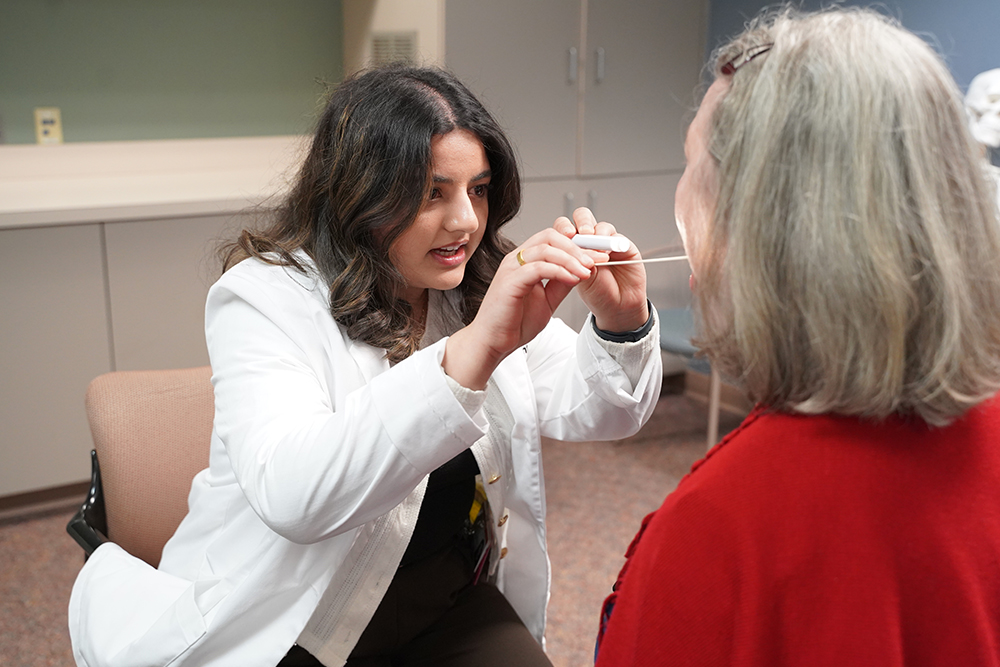
Being able to identify malnutrition, micronutrient deficiencies, and other nutrition-related issues is a regular part of being a doctor — and the focus of a new skills session offered by OUWB.
“Nutrition Focused Physical Exam” is a new part of the school’s Art & Practice of Medicine (APM) curriculum. The first session took place in April.
Held at OUWB’s Clinical Skills Training & Simulation Center at Corewell Health Beaumont Troy Hospital, the session provides medical students with opportunities to practice nutrition-focused exams on standardized patients and each other.
In short, the session takes information students already learned to the next level, said Virginia Uhley, Ph.D., associate professor, Department of Foundational Medical Studies.
“Our medical students learn about micronutrients, vitamins, mineral deficiencies, protein, energy, malnutrition in the classroom … this (hands-on skills session) is after they’ve already been taught all of that information,” said Uhley. “This is about seeing it … understanding the skills for it.”
Why now?
Uhley co-led the session with Ida Rubino, M.D., associate professor, Department of Family Medicine, and course director, APM 1.
As the team explained, the Liaison Committee on Medical Education (LCME) recently updated the “Functions and Structure of a Medical School” standards as part of an overall effort to boost nutrition training in medical schools.
It included updating the section that pertains to health promotion and health maintenance with new language that stipulates that medical education curriculum “includes content focused on factors that affect the ability to promote and maintain health across the life cycle. This content includes the role of nutrition in preventing and managing chronic disease, and other challenges to wellness associated with common societal problems.”
LCME doesn’t specify exactly how much time should be spent on the topic, but in 2025, the U.S. Department of Health and Human Services (DHHS) encouraged medical schools to commit to a minimum of 40 hours of required nutrition education across all four years (or a minimum 40-hour competency equivalent).
Further, Uhley said, DHHS developed a list of 10 domains encompassing 71 competencies that were informed by the 2024 JAMA Consensus Statement as well as from additional competencies identified by experts at DHHS.
Competency no. 23 (under Domain 2: Nutrition Assessment and Diagnosis) is “comprehensive nutrition-focused physical examination” – which is exactly what Uhley and Rubino led for the medical students who have already learned the foundations of biochemistry, histology, and more.
“Which is awesome,” said Rubino during the session. “I never learned nutrition in medical school … I’ve learned it on my own.”
“And you will use this daily if you’re in a field where you interact with patients in a clinical setting.”
Head-to-toe exam
According to the Journal of Academy of Nutrition and Dietetics, it’s estimated that at least one-third of patients arrive at the hospital malnourished and if left untreated, many of those patients will continue to decline nutritionally. This can adversely affect their recovery and increase risk of complications and readmission.
The session essentially moved head-to-toe with Uhley and Rubino helping students along the way as they practiced doing exams on each other and standardized patients.
For example, students were taught how to look at the hair and scalp to identify texture changes, hair loss, patches, and pigment changes, and more.
They learned how to properly examine eyes to identify conditions like sclera, conjunctival pallor, and lipid-related findings.
Further, they learned how to examine the oral cavity, nails, skin, and how to effectively assess fat and muscle to identify potential underlying issues.
Throughout the session, Uhley and Rubino emphasized the importance of documenting findings, using that same information to guide lab tests, and how critical it is to communicate and code malnutrition appropriately.
“We see malnutrition in hospitalized patients with chronic disease … and we also see it in the outpatient setting,” Rubino told the students. “It’s important to look at things like muscle mass, subcutaneous fat, edema, as well as functional status.”
Uhley emphasized the importance of learning about malnutrition in a skills session.
“This has to be hands on,” she said. “If they don’t know what to look for or don’t feel comfortable looking for these things, it won’t be part of what they do in clinical practice.”
More from OUWB
Birthing simulation event provides valuable learning experiences for OUWB medical students
International opportunities for OUWB medical students take center stage at event
For more information, contact Andrew Dietderich, senior marketing specialist, OUWB, at adietderich@oakland.edu.
To request an interview, visit the OUWB Communications & Marketing webpage.
This work is licensed under a Creative Commons Attribution-NonCommercial 4.0 International License.