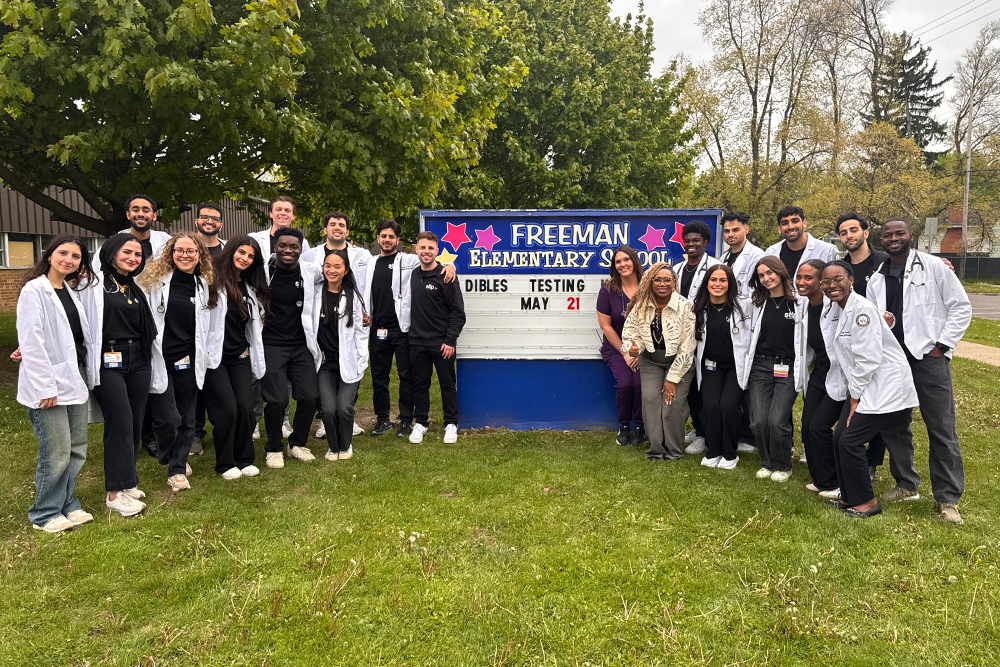
Future physicians from Oakland University William Beaumont School of Medicine stepped out of their classrooms and into an elementary school in Flint recently, spending a day teaching students about hygiene, health, and careers in medicine while offering something equally important: inspiration.
The student-led initiative, known as a “Day of Action,” brought a group of medical students to Freeman Elementary School, where they spent several hours interacting with youths in grades K-5.
Organized by rising second-year medical student Omar Elnour and supported by classmates, community partners, and OUWB leadership, the event was designed to provide health education while exposing young students to future career possibilities.
Rising M2 Karam Hadid said the experience carried special meaning. In a LinkedIn post following the event, he reflected on growing up in Syria and feeling as though a career in medicine was out of reach.
“Growing up in Syria, becoming a doctor never felt like something that was truly possible for someone like me,” wrote Hadid. “Sometimes all it takes is meeting someone who came from circumstances that feel familiar to realize that your future does not have to be limited by where you started.”
That message became the driving force behind the day’s activities.
Tonya Bailey, Ph.D., associate dean, Diversity & Inclusion and Community Engagement, said the project was months in the making. Medical students spent nearly 90 days planning the event, working closely with school administrators and teachers to understand the needs of Freeman Elementary and develop lessons that would resonate with younger students.
“The students strategized extensively on how to take such a big, high-level topic to elementary-age learning,” said Bailey. “They thought about what would be fun, what would be engaging and how they could keep every room they entered involved in the topic.”
Students were divided into small teams and assigned classrooms throughout the school. Each group created age-appropriate presentations focused on health, hygiene, and careers in medicine. Lessons varied depending on grade level, with younger students learning about handwashing, brushing teeth, and general cleanliness, while older students discussed personal hygiene and healthy habits in greater detail.
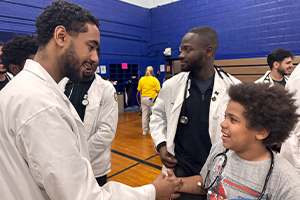
The presentations were designed to be interactive rather than lecture based. Medical students incorporated games, coloring activities, demonstrations, and hands-on learning opportunities to keep students engaged. They also anticipated questions and developed activities that would encourage participation throughout the sessions.
“Their preparation was phenomenal,” said Bailey. “They came prepared with games, activities, and different ways to engage students while making sure the information was easy to understand.”
Every classroom received a stethoscope as a gift, while hygiene supplies and resource kits were donated to teachers and counselors. Rather than sending the items home with students, organizers worked with school staff to ensure the supplies would remain available in classrooms for students to use all year long.
Throughout the day, the young students asked a wide range of questions. Some wanted to know what it takes to become a doctor, while others sought advice about hygiene practices and healthy habits. A few of them even shared personal challenges, including concerns about access to hygiene resources at home.
The conversations expanded beyond health topics as medical students fielded questions about their favorite music, hobbies, and what life is like in medical school. According to Bailey, those personal interactions helped make the future physicians feel relatable.
“I think they could identify with and see themselves in our medical students,” said Bailey. “They were adults, but they were fun adults. They laughed with them, played games with them, and showed them that you can pursue a career in medicine and still be yourself.”
The day concluded with a school-wide gathering in the gymnasium, where everyone participated in relay races, group activities, and photo opportunities. Bailey said the excitement was impossible to miss.
“You would have thought you were at a rock concert,” she said. “The students were taking pictures with our medical students and hugging them. They didn’t want them to leave.”
While the event was designed to serve Freeman Elementary students, Bailey believes the medical students gained just as much from the experience. She said many volunteers left feeling inspired and reminded of the purpose behind their pursuit of medicine.
“Our medical students wanted to give back to communities outside the classroom,” said Bailey. “They wanted to share knowledge, provide inspiration, and make a difference. In return, they walked away inspired too.”
The success of the Day of Action has already sparked conversations about returning in the fall and potentially expanding the program to other schools. Bailey hopes the initiative becomes a blueprint for future outreach efforts.
For the students at Freeman Elementary, the visit provided more than lessons on hygiene and health. It offered a glimpse of what their futures could look like. For one day, future doctors became teachers, mentors, and role models, in anticipation that this single interaction will make a lifelong difference.
More from OUWB
Electric bike safety focus of campaign involving OUWB student
Student at OUWB says playing piano helps with his medical education
OUWB cohort visits The Zekelman Holocaust Center, preps for Study Trip to Auschwitz
For more information, contact Andrew Dietderich, senior marketing specialist, OUWB, at adietderich@oakland.edu.
To request an interview, visit the OUWB Communications & Marketing webpage.
This work is licensed under a Creative Commons Attribution-NonCommercial 4.0 International License.