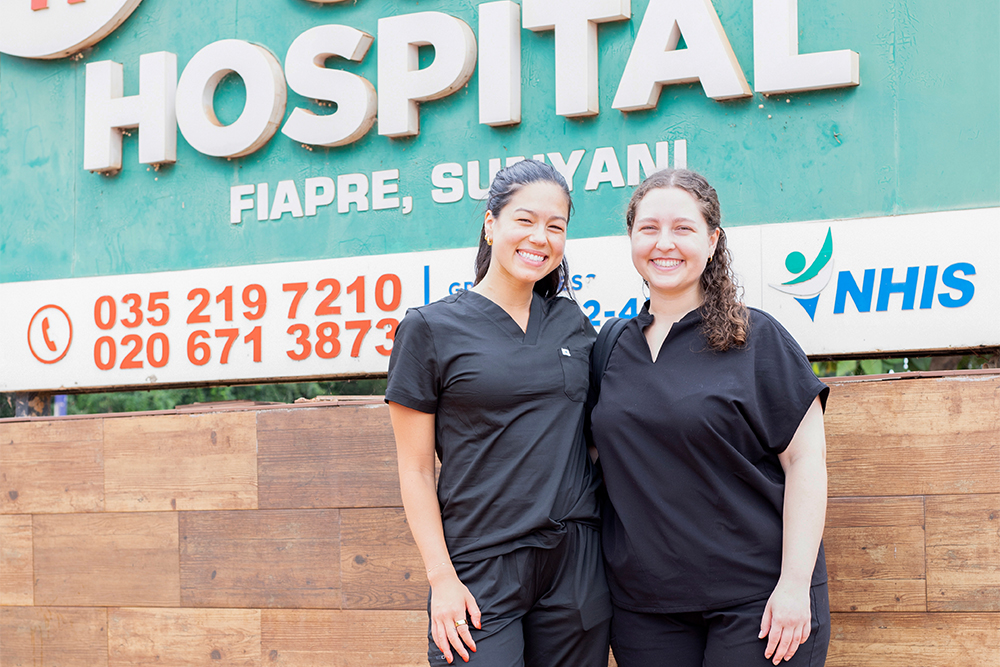
Two OUWB medical students recently spent three weeks in Ghana through a program that shaped their empathy, global health perspective, and how they eventually will practice medicine.
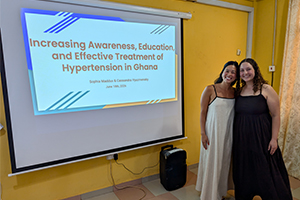
Sophia Maddux and Cassandra Vyazmensky, both M2s, participated in Oakland University’s 2026 Public Health in Ghana program.
The two OUWB students joined others from OU’s School of Health Sciences and College of Arts and Sciences. While in Ghana, the cohort participated in community public health programs, observed at a hospital, and visited historical and cultural sites – experiences that led students to reflect on their roles as future health care providers.
“It’s really nice that OU has this opportunity because you get to see so much diversity within the world … in fact, part of the draw for me to OU was these kinds of opportunities,” said Vyazmensky.
“I think this experience will make me a better physician, but day-to-day it will make me a better person, too,” said Maddux.
‘Akwaba’
In 2022, Kwame Sakyi, Ph.D., MSPH, associate professor of public health in the School of Health Sciences, launched the international study abroad program at Oakland University. Five years later, the program continues to thrive.
“People don’t tend to think of Africa as an opportunity for student learning, development and discovery,” said Sakyi in this SHS story. “But I’ve always thought that if you bring them in contact with a place, they come away transformed because they see that it’s more than what they have heard. I want to help students see the world beyond just where they live.”
For 2026, the three-week program occurred June 4-27. The academic course began with a 17-hour journey from Detroit to Accra, which is the capital city of Ghana.
Representatives of an Accra-based nonprofit Center for Learning and Childhood Development Ghana welcomed the OU students. Maddux and Vyazmensky were immediately struck by how warm and welcoming Ghanaians were to the group.
It would continue throughout the entire program. In fact, whether visiting a local farm or working in a clinical setting, the OU group quickly learned the meaning of the word “akwaba” that translates to “you are welcome.”
“Every time we walked into a room and introduced ourselves, this was the first thing that people said,” said Vyazmensky. “This contributed greatly to the welcoming atmosphere we continued to feel throughout the experience. It was really nice to see how people took their time to learn who you are and then welcome you to the new environment you were in.”
After about 48 hours in Accra, the group traveled to the smaller city of Sunyani. Though it’s only 300 miles from Accra, the trip took about 15 hours by van due to traffic, weather, and road conditions.
They would spend the next two weeks in Sunyani shadowing at Seventh-Day Adventist Hospital (SDA), a faith-based general hospital. Vyazmensky and Maddux were able to observe all the different specialties in the various wards throughout the hospital. One day they might observe an abdominal hysterectomy or C-section. Another day might be spent in the NICU. Still another day would see the students helping with a well-baby clinic.
“Parents would bring their children under the age of 5 to the hospital and staff would take the baby’s height, weight, and age and give them any vaccines they needed,” said Vyazmensky. “Being able to meet people from the community was another way we were exposed to the culture and learned more about how locals perceive medicine.”
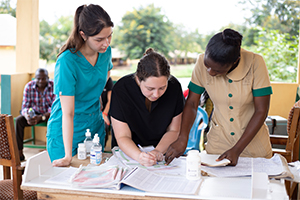
Vyazmensky and Maddux each had their own share of stand out moments.
For Maddux, one was observing a hernia repair surgery on a young boy. Having been administered spinal anesthesia, the boy was awake throughout. Maddux also heard the way the physicians spoke to the boy.
“After that surgery I reflected a lot about what patients go through when they’re on the table, and especially when they (the patients) can hear every conversation,” she said.
Vyazmensky said she was particularly struck by the way physicians would talk to patients about treatment options. Mostly, she said, because payment is required prior to treatment.
“I would do pediatric rounds and listen to how they talked to families to understand where they’re at (financially),” she said. “Balancing that aspect of medicine is important … I appreciated seeing it in practice.”
She also learned another important lesson when visiting a mobile clinic in Accra. The mobile clinic provides physical therapy treatments to children with cerebral palsy at a special school just for them.
“We saw the importance of meeting people where they’re at and how that can improve outcomes,” said Vyazmensky. “It’s what you have to do (in Ghana) and it is something the physicians all seem to keep in mind.”
Cultural understandings
The group also had plenty of opportunities to take in the history and culture of Ghana.
They visited a weaving facility where they learned about and made traditional Kente cloth. They went to a museum about the Ashanti Kingdom, where they learned how historic rulers, warrior kings, and conflicts shaped Ghana’s political and cultural development.
They spent time in Accra’s massive Makola Market where many Ghanaians shop. The students also visited an art studio and market filled with locally made bags, clothing, jewelry, and crafts.
One of the days was spent traveling to the Cape Coast Castle, which was used in the transatlantic slave trade. To provide context and greater understanding, students took part in a roundtable discussion on the history of slavery.
“It was really valuable to have a discussion surrounding such a sensitive topic from multiple perspectives,” said Maddux.
The group also visited Kwame Nkrumah Memorial Park and learned more about Ghana’s history and role as one of the first African countries to gain independence.
“Learning more about the cultural background and history of Ghana makes you understand their current culture and population,” said Vyazmensky.
And both Vyazmensky and Maddux said that seeing the overall resilience, resourcefulness, and strong community bonds in Ghana will make them more open, less judgmental, and more attentive when they start caring for their own patients in a relatively short amount of time.
“For me, it was the cultural understandings,” said Vyazmensky. “That will improve the way I can practice and respond to patients who might not have the same cultural background that I have.”
Maddux shared similar feelings.
“It helped me understand the importance of putting in the time to understand why people do things a certain way,” she said. “If we take the time to understand the barriers that patients face and help them overcome those barriers…our own society here can be more of a community.”
More from OUWB
Six medical students from OUWB recognized as outstanding for 2025-26
Holocaust historians anchor first humanities and bioethics class for OUWB's newest students
'Your time is now:' OUWB Class of 2030 participates in White Coat Ceremony
For more information, contact Andrew Dietderich, senior marketing specialist, OUWB, at adietderich@oakland.edu.
To request an interview, visit the OUWB Communications & Marketing webpage.