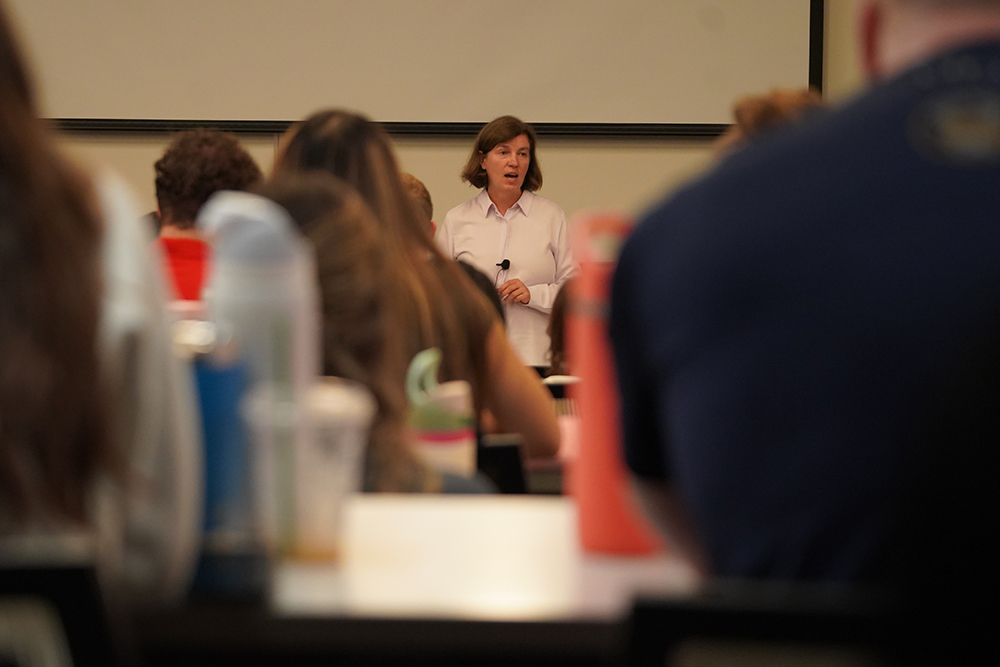
Holocaust experts from near and far were part of the first Medical Humanities and Clinical Bioethics (MHCB) class held for new medical students at Oakland University William Beaumont School of Medicine.
The Aug. 13 session was called “Medicine in the Holocaust.”
One featured lecturer was Teresa Wontor-Cichy, Ph.D., a historian from the research center at the Auschwitz-Birkenau State Museum in Poland. Wontor-Cichy also is a tour guide and delivers lectures for OUWB students who annually travel to Poland for the Study Trip to Auschwitz.
The other was Katie Chaka Parks, Ph.D, director, Education, The Zekelman Holocaust Center, which is in Farmington Hills, Michigan. Parks also serves as a co-leader of the study trip.
Abe Brummett, Ph.D, associate professor, Department of Foundational Medical Studies, led the class.
“The reason why I wanted to move this to the very first class is because I want the students to have a stronger historical understanding of why we talk about bioethics and medical humanities at OUWB so much in the first place,” he said. “A lot of people will say bioethics was sort of born in the Holocaust.”
Parks spoke first and talked about the historical background of “Medicine in the Holocaust.” Specifically, she provided understanding on why so many physicians willingly joined the Nazi party, common physician roles in the Holocaust, and one way Nazi physicians took inspiration from the eugenics movement in the U.S.
“As Dr. Brummett says, these students have a calling to be a physician,” she said. “To encounter and confront these difficult concepts and ideologies on the very first day (of MHCB) sets the stage for the rest of their education … already they’re thinking about what kind of physician they want to be and maybe more importantly, what kind of person they want to be.”
Wontor-Cichy addressed medical complicity and resistance during the Holocaust, providing case studies as examples. She stressed the importance of the future physicians reflecting on how otherwise ordinary professionals can gradually betray their values.
“We are not talking about people who were lunatics with some crazy ideas,” she said. “We are talking about a historical situation that was accepted by the state, and by society.”
Brummett tied everything together by talking about the key tenets of Nazi medical ethics, how many ideologies can lead to dehumanization, distinguished “goods internal to the practice of medicine” from corrupting external pressures, and introduced key moral principles articulated in the Nuremberg Code.
He also described the key concept of “ordinariness” as introduced by Robert Jay Lifton in “The Nazi Doctors: Medical Killing and the Psychology of Genocide.” (The concept essentially asserts that the doctors who orchestrated mass murders were psychologically normal, ordinary men as opposed to psychopaths or monsters.)
Brummett said introducing these ideas to students from the get-go plants the seeds for other concepts that will soon be discussed in the class. These include human rights, autonomy, the importance of listening to patients, and having them be part of the decision-making process regarding their own care.
Having Parks and Wontor-Cichy deliver part of the lecture helped provide important context.
“It really impresses on the students how much there is to know about this,” he said. “These are experts who spend their whole careers studying these things, and they’re able to present the information in a way that I never could.”
The guest experts fully embraced the opportunity to address the medical students.
Wontor-Cichy arrived in southeast Michigan after traveling from Poland just one day before addressing the class. (She also spoke at the Study Trip to Auschwitz Reflection Dinner later in the day.) She called speaking to the class a “privilege.”
She said she hopes that students remember where they stand ethically and historically and stay aware of that as they practice medicine.
“These medical students have a long path ahead of them as professionals … these lessons serve as a kind of warning that they must always remember their values and morals,” she said.
Parks, who earned a bachelor’s degree and master’s from Oakland University, called the opportunity “so special.” Her hope was to provide a clearer picture of humanity.
“I hope they understand that the Holocaust doesn’t start with boxcars and camps,” she said.
“It starts with people turning on their neighbors … with interpersonal dehumanization.”
More from OUWB
'Your time is now:' OUWB Class of 2030 participates in White Coat Ceremony
Orientation begins for the OUWB Class of 2030
Medical Student Government president seeks to ‘open doors’ for all OUWB students
For more information, contact Andrew Dietderich, senior marketing specialist, OUWB, at adietderich@oakland.edu.
To request an interview, visit the OUWB Communications & Marketing webpage.