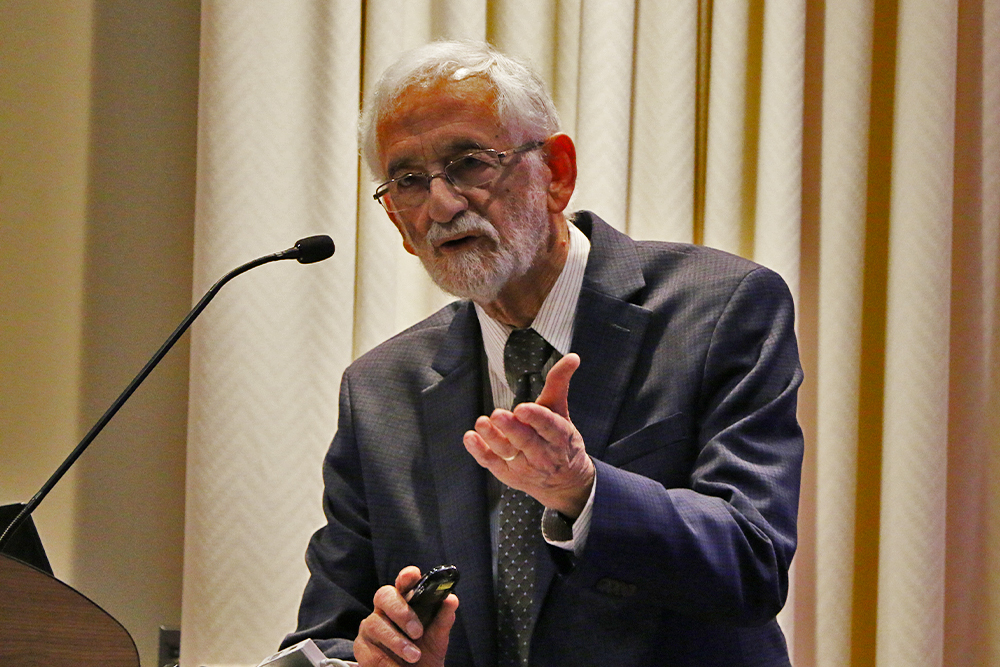
A Stanford University educator recently spoke at an event hosted by Oakland University William Beaumont School of Medicine and reminded audience members about the importance of connection, one conversation at a time.
“The White Coat in Action: Clinical Teaching and Patient Care” was the title of a keynote presented by Kelley Skeff, M.D., Ph.D., George DeForest Barnett Professor, Department of Internal Medicine, Stanford University, and co-director, Stanford Faculty Development Center. He spoke May 13 as part of OUWB’s Medical Education Week.
Skeff critiqued how contemporary systems and documentation demands undermine relations with patients, colleagues, and trainees. He offered practical frameworks to restore connection, reflection, and true team-based care.
And he challenged the clinicians and educators in attendance to embody the values of generosity, curiosity, and deep commitment to learners demonstrated by the late Sandor Shoichet, M.D., former program director, Internal Medicine Residency and medical director, Outpatient Clinics, Corewell Health William Beaumont University Hospital, and associate professor, OUWB.
Shoichet also was instrumental in shaping the annual OUWB Medical Education Week in his role as co-chair of the planning committee. He passed away in June 2025.
“I hope attendees look at their own work and think about new ways that they can make it better,” Skeff said after the keynote. “And also to (understand) who (Shoichet) was (and) just how deeply he cared about other people.”
The Cole-Shoichet Model
Skeff leveled multiple criticisms at modern systems and paperwork demands.
He said “system-based practice” has effectively turned into “doing whatever the system asks,” even when it undermines care and learning. He called out documentation demands for driving burnout and impeding care and teaching. Further, he said documentation is increasingly being used punitively rather than collaboratively.
“We have created a system because of how we’ve trained each other, where the system doesn’t know that it has impeded us from delivering care,” he said. “It has impeded us from talking to each other.”
To counter the issues he identified, Skeff drew largely from a book he co-authored called “The Clinical Interview for Relationship-Centered Care.” The other authors are Steven Cole, M.D., Richard Frankel, Ph.D., and Julian Bird.
The book centers on a three-function approach to communication — connect, co-construct, and collaborate — and uses it to analyze interactions between clinicians, patients, and institutions.
Connection, co-construction, and collaboration could all be supported in large part, he said, by thinking differently about documenting a patient’s History of Present Illness (HPI).
Two specific problems with the traditional method of preparing histories is that they often consist of dense prose that pushes readers to skip the patient’s stories and encourages writers to leave out what they don’t understand.
A better approach, said Skeff, is to limit HPIs to shorter, more concise entries.
These entries would generally be limited to the chronology and ecology of the illness along with patient strengths and resources.
The chronology allows clinicians to more clearly “see” the evolution of illness and forces clearer thinking, exposes omitted details, and supports better diagnostic reasoning.
The ecology portion of an HPI should show the context of the illness, document a patient’s hopes, note what the patient thinks is happening, and explain how the patient has been impacted by it.
Assessing a patient’s strengths and resources can open the door for clinicians to partner better with the individual. For example, a patient who is houseless may have extraordinary survival and organizational skills while a physician-patient might know more details about their condition than the treating doctor.
And Skeff tied much of what he talked about to Shoichet, a friend for more than 20 years and someone with whom he shared a bond with as they were both program directors of internal medicine residency programs.
“These three things, the chronology, the ecology, and that patient strengths, can help us do what (Shoichet) did automatically — connect, co-construct, collaborate in what I’ll call now the Cole-Shoichet Model,” said Skeff.
‘Really proud of his legacy’
Medical Education Week exists in large part because of the late William Davidson, a successful businessman and founder of Palace Sports and Entertainment. In the late 2000s, Davidson donated $1 million to legacy Beaumont Health with the express direction that the money be used to support medical education under the direction of Shoichet, who was Davidson’s doctor and friend.
This allowed for a permanent endowment that is dedicated to faculty development, an area that many institutions recognize as important to an educational endeavor’s ongoing success, though one that often lacks adequate resources.
One of the ways the endowment accomplishes its mission is by sponsoring a nationally esteemed medical educator like Skeff to be the week’s distinguished speaker in Davidson’s name.
Immediately before Skeff spoke, it was announced that the name of the annual keynote will now be the Davidson-Shoichet Lecture.
Moments like that, along with the way Shoichet was featured throughout Skeff’s keynote, had the late doctor’s daughter feeling emotional at times.
Catherine Shoichet, a Washington, D.C.-based senior writer covering immigration and demographics for CNN Digital, said it was a priority for her to attend the keynote that meant so much to her father.
“My dad always showed up for me, he always showed up for his patients, and for his residents, so I wanted to be here to show up for him,” she said.
“This place means a lot to me because it was a kind of home for my dad for so many years,” she added. “I will forever deal with the grief of losing my father, but I also feel really proud of his legacy here and it meant a lot to hear Dr. Skeff talk about what an amazing teacher and physician he was.”
|
More from OUWB OUWB Anatomy Memorial held, attended by families of donors for first time Commencement held for OUWB Class of 2026 OUWB 2026 Honors Convocation celebrates outstanding achievements |
For more information, contact Andrew Dietderich, senior marketing specialist, OUWB, at adietderich@oakland.edu.
To request an interview, visit the OUWB Communications & Marketing webpage.
This work is licensed under a Creative Commons Attribution-NonCommercial 4.0 International License.