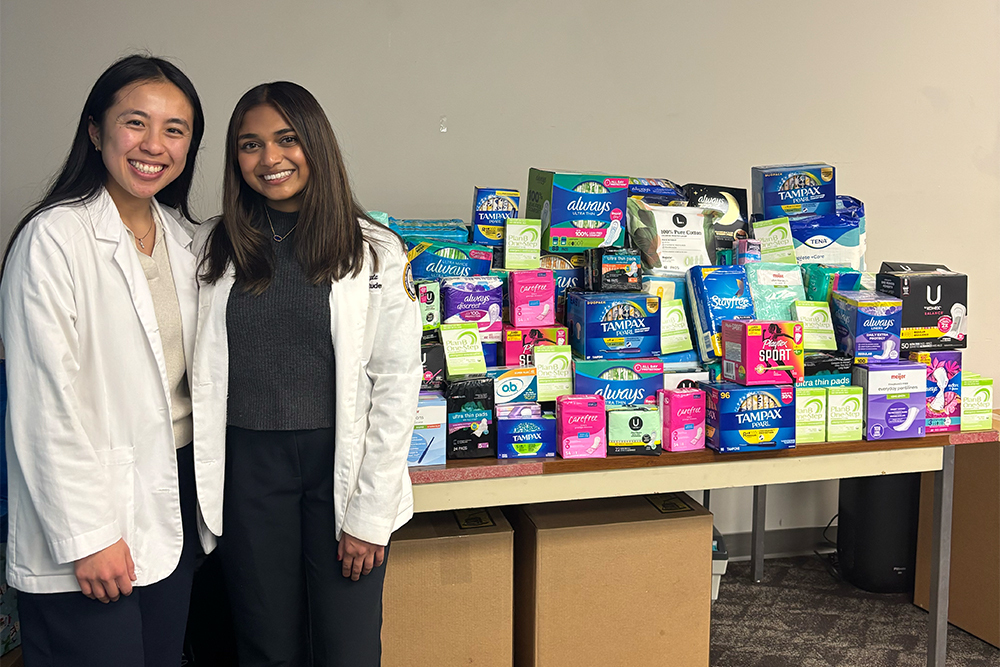
Students from Oakland University William Beaumont School of Medicine recently partnered with a local nonprofit to collect more than 16,000 feminine hygiene products to benefit the local community.
Held from Dec. 1 through Dec. 31, the drive was a collaboration between the OUWB Student-Run Free Clinics (SRFCs) and the Detroit chapter of I Support the Girls (ISG).
The effort yielded 9,414 pads, 6,585 tampons, 120 bras, and 340 pairs of underwear. Donation boxes were placed at 15 locations across Detroit and Oakland County to encourage participation and community involvement during the holidays.
Half of the items will remain at SRFCs with the rest set for ISG’s distribution via local libraries, food pantries, and other community outreach centers across Detroit and Oakland County.
“This really helps promote health equity and increases access to basic needs, such as these feminine hygiene products. It’s just a big public health and women's health issue in general. It's really important to help alleviate those financial burdens,” said Hillary Le, M2, co-director of SRFC.
Now in its seventh year, the initiative has sustained a partnership that has reached incredible milestones. According to Catherine Pokropek, M.D., assistant professor and OB-GYN at Corewell Health William Beaumont University Hospital and Mission OB-GYN, nearly 100,000 essential items have been collected and distributed since the drive began.
Le and Riya Gupta, M2, co-director of the SRFC, said that the drive supports an overlooked public health issue, period poverty. Period poverty refers to the lack of access to products such as pads or tampons due to unaffordability.
According to Women in International Security, many young children may miss school or drop out altogether because of their lack of access to period products. Individuals who don’t have access to the proper products feel they can’t leave their homes, fearing they will bleed through their clothes.
“When a person has to choose between a meal and a box of tampons, they are forced into unsafe alternatives like using rags or newspapers, which can lead to significant health risks and a profound loss of dignity. As an OB-GYN, I see this as a fundamental matter of public health and gender equity,” said Pokropek.
ISG is a national organization that “collects essential items, including bras, underwear and menstrual products,” providing individuals facing financial barriers with access to these products and other essentials.
SRFC operates in partnership with the Gary Burnstein Community Clinic in Pontiac. The clinic offers family medicine, gynecology and dermatology services each month, allowing OUWB students to work alongside licensed physicians to deliver care to uninsured or underinsured patients who may otherwise lack access to medical care.
Through clinics like the Gary Burnstein Community Health Clinic, students gain hands-on experience working with patients while also addressing the social determinants of health.
“It's really nice to engage directly with patients, whether by talking to them or even just shadowing. Medicine is definitely a lifelong learning process, whether from a textbook or from our patients,” said Le.
“Joining the student-run free clinic is what drew me to OUWB; it was something I really wanted to get involved with from the start. Being part of this organization and working alongside the local community to improve patient health and equity is really important as medical students to engage in service in ways the community needs. And this partnership is like a reflection of that,” said Gupta.
Pokropek emphasized the drive’s impact, helping ensure that individuals across metro Detroit have access to essential hygiene products and the dignity that comes with them.
“We aren't just providing products; we are delivering comfort and dignity to our metro Detroit neighbors in the places they need it most. These donations aren't just boxes in a hallway—they are a lifeline,” said Pokropek.
To request an interview, visit the OUWB Communications & Marketing webpage.
This work is licensed under a Creative Commons Attribution-NonCommercial 4.0 International License.