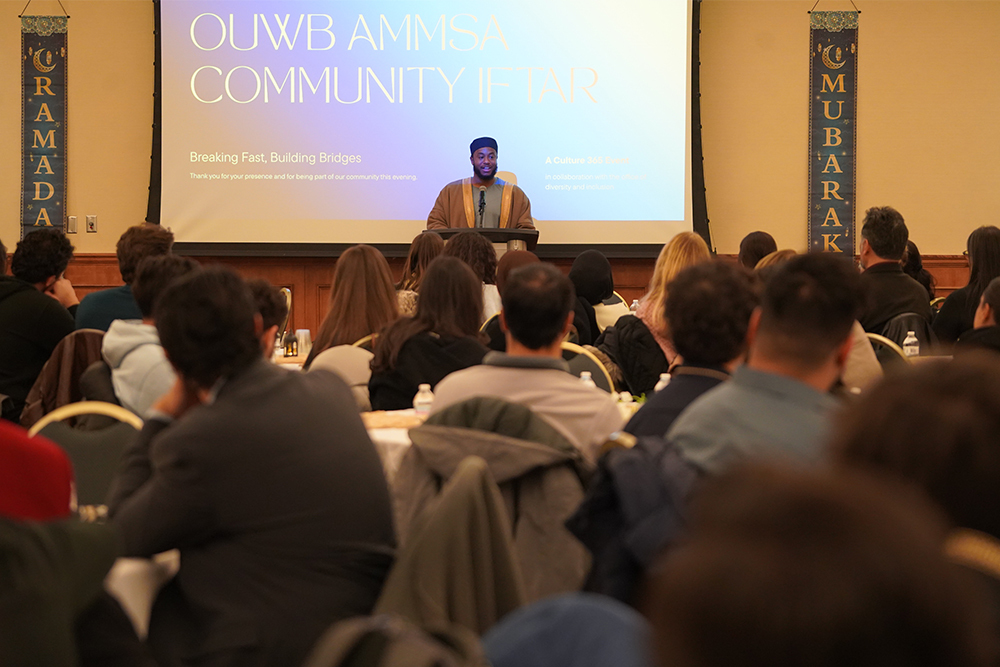
Nearly 200 students, faculty, and others from the OUWB community participated in a Ramadan event hosted Monday by the American Muslim Medical Student Association (AMMSA) in support of OUWB Culture 365.
Held at Oakland University’s Oakland Center, “Breaking Fast, Building Understanding: OUWB Fast-a-thon & Community Iftar” featured a Quran recitation, educational speakers, prayers, socializing, and dinner.
Funding was provided by a Culture 365 grant and private donations. Culture 365 represents OUWB’s year-round commitment to honoring the richness of diverse identities and experiences
Student organizers of the event said they had several goals: bring Muslims and non-Muslims together; provide better understanding of Ramadan and Islam; promote empathy and awareness of those less fortunate; and deliver education to future physicians who are likely to treat patients who are Muslim.
“This is our attempt to bring everybody together, (and) show people what we’re really about,” said Yzen Al-Marrawi, M2, one of the organizers. “We want to give people the opportunity to ask questions while breaking bread and hopefully address some misunderstandings they might have.”
Ramadan is believed to be the month during which the Quran was revealed to the Prophet Muhammad.
It is widely considered to be the holiest month of the Islamic calendar. This year, Ramadan is Feb. 17 through March 19.
Observant Muslims pray five times a day during the month.
Per one of the Five Pillars of Islam, observant Muslims abstain from food, drink, smoking, and sexual relations during daylight hours.
Further, Muslims are encouraged to dedicate time to improve themselves spiritually by supplementing their fast with additional acts of worship; to reflect on one’s actions and treating others with kindness and respect; demonstrate perseverance and empathy to those who are less fortunate; and connect with community through charity and worship.
 |
|---|
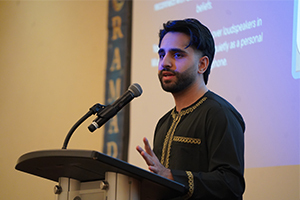
| Shayaan Aqil, M2, co-president, AMMSA, co-hosted the event. |
Iftar is the daily evening meal with which Muslims end their fast at sunset.
Community is integral to the experience, said Amina Sharif, M2, vice president, AMMSA.
“I know with my family it can be hard for everyone to sit down at the dinner table,” she said. “Ramadan is a great excuse to have dinner together…(focus) on having that with family, friends, and community members who maybe you haven’t seen in a while.”
Coupled with prayer, she said, Iftar “brings us not only closer to faith, but also to each other.”
Nabeeha Shakil-Ahmad, M2, co-president, AMMSA, said that’s why the board supported Al-Marrawi’s idea to model an OUWB Ramadan event after a similar version he participated in while an undergraduate at The Ohio State University.
“We wanted to do an Iftar at OUWB to have that sense of community, unity, breaking fast together and spending time to be grateful,” she said.
“It’s about empathy and community,” she added.
The first guest speaker at the event was Abdel-Wahab Meri, M.D., an internal medicine physician at Corewell Health Beaumont Troy Hospital.
His primary message was that physicians have an ethical responsibility to understand how Ramadan fasting affects patients’ health and to work with patients to safely optimize care.
“Every single specialty will involve you, as a physician, taking care of patients who will be Muslim — I can guarantee you that much,” he said.
Meri offered tips for how to be serve patients who fast for Ramadan. For example, he suggested a pre-Ramadan assessment to decided if it is medically reasonable or too risky. Also, he talked about adjusting medications to fit fasting hours, the importance of emphasizing hydration and nutrition, and encouraging patients to engage in self-monitoring procedures like checking blood pressure and blood glucose.
He also talked about the importance of communication.
“If you tell patients, ‘Don’t do this’ and they feel like (fasting’s) one of the things they want to do, they will do it,” said Meri. “It’s better to understand your patients and know how to talk to your patients. This is very effective communication.”
 |
|---|
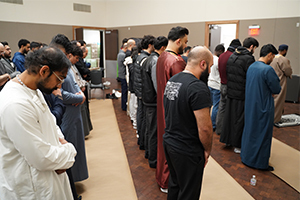
| Prayer was part of the event. |
The second guest speaker was Br. Ibrahim Abdus-Sabur, youth director at the Muslim Unity Center in Bloomfield Hills.
He emphasized that Ramadan is about change, not just fasting and rituals. He also said it can serve as a catalyst for those who feel lost or in darkness. Abdus-Sabur also relied on stories of the prophets and how they modeled humility.
Afterwards, he said he had one overarching message he hoped came across.
“I want everyone tonight — myself, first and foremost — to look internally and ask ourselves about the deep problems that are plaguing our hearts and how can we get closer to God by getting rid of those obstructions?” he said.
Wesam Almasri, M4, was president of AMMSA in 2024 and hosted a similar event. He attended Monday’s version and said it was “very rewarding” to see it continually grow at OUWB.
“I’m incredibly proud of what they’re doing,” he said. “They’re telling people about OUWB and the culture that it has, but also what we bring to the table for its culture. It’s a beautiful reciprocal moment.”
Masood Siddiqui, M.D., a pathologist and associate professor, Department of Pathology, said he wanted to attend in support of students. He said it is important for students to participate in such events as part of their holistic medical education.
“It’s important to not just focus on your medical training but other activities as well,” he said. “Be engaged socially, be engaged civically, and be engaged in all different spheres of life. When you develop this engagement of not just medicine, you become a better physician.”
Shayaan Aqil, M2, co-president, AMMSA, thanked everyone at the end of the night while keeping an eye on the future.
“We hope this evening fostered connection, understanding, and reflection,” he said. “God willing, we look forward to welcoming you all again next year.”
Students, faculty, staff and student interest groups are invited to apply for a grant of $300 to showcase their unique culture for the entire school. This showcase may be a performance, an exhibit, a workshop, a courageous conversation, a walk-through, or program of your choosing. Applications will be accepted until April 1, 2026.
For more information, contact Andrew Dietderich, senior marketing specialist, OUWB, at [email protected].
To request an interview, visit the OUWB Communications & Marketing webpage.
This work is licensed under a Creative Commons Attribution-NonCommercial 4.0 International License.