Center for Excellence in Teaching and Learning
100 Library Drive
Rochester, Michigan 48309-4479
(location map)
(248) 370-2751
[email protected]


Center for Excellence in Teaching and Learning
100 Library Drive
Rochester, Michigan 48309-4479
(location map)
(248) 370-2751
[email protected]

Behind the Scenes of Academic Misconduct: Patterns in Student Experience
There are aspects of university life that we know in praxis through our roles as faculty and staff such as roles of academic affairs, student affairs, our respective roles, and how authority and scope shape decisions. We, the Dean of Students office (DOS) team, find that the latter aspects of Oakland University and “college-life” in general are not apparent and at times foreign to our students. Ironically, it was not that long ago that I had no idea what a Dean of Students was or they could have helped me in my collegiate path.
The focus of this tip is to provide insight into the Academic Misconduct Process with a wider lens. While the Dean of Students office oversees the process and does not sanction or issue grades, our role is akin to a control tower in an airport, i.e., we do not have the authority to issue consequences but we ensure the process is followed so we do not have a punitive and inconsistent process. This role provides the “behind the scenes” perspective of what’s really going on with students and what you can do to most effectively support students while maintaining academic integrity.
What Has Changed, and What Has Stayed the Same?
An unforeseen benefit the pandemic was a spotlight on challenges Dean of Students offices across higher education already knew such as:
- dismantled the misconception that students engage in academic misconduct because they are lazy,
- challenged the notion that high-achieving students do not engage in academic dishonesty,
- provided the opportunity for students to see professors as people experiencing similar challenges as them, and
- provided an opportunity to validate how we as an institution can come together to solve a common challenge.
A current dilemma for some of our colleagues is determining to what extent the challenges brought on by the pandemic in 2020-2021 still plague our students and colleagues versus thinking that it’s time to go back to how we executed our roles pre-pandemic.
What’s Really Going on With Students: Dean of Students’ Perspective
The Academic Conduct Committee Annual reports (see all Academic Conduct Committee Annual reports) provides detailed information regarding the type of academic misconduct that takes place at Oakland University. While these data points are valuable, they do not provide the qualitative data that we gather when we meet with each student to discuss the situation reported.
The intake meetings we hold provide the DOS the opportunity to understand what took place and find that most of the time is spent informing students about support services they did not partake in and explaining the nuances of what constitutes cheating. We find that some students in this situation could have benefited from the Emergency Fund, Student Bereavement policy, support in their Requests for Exception, support services to aid in the student’s overall wellbeing such as the Oakland University Counseling Center, the Graham Health Center, the Golden Grizzly Pantry, University Recreation and Well-being programs, and of course the Dean of Students office.
As we discussed academic misconduct situations the patterns below continue to emerge:
- The pressure to retain consecutive enrollment to secure scholarships/grants led students to believe they could not take a gap or drop courses.
- Anxiety, depression was aggravated by the social, financial, medical, and academic challenges posed by the pandemic and continues to be a constant factor in students who visit or are referred to the Dean of Students office.
- Tangential challenges lingering from the pandemic such as; decrease/lack of earnings, immediate family illness/death, student physical and mental health decline continue to impact motivation and focus.
- Support services such as emergency fund, tutoring, change in U/S (unsatisfactory/satisfactory) impact to graduation, lack of understanding what constitutes academic misconduct.
- There was a spectrum of understanding online resources such as essay generators, Chegg, Course Hero, Photmath, YouTube, and Google and how they are considered cheating in various forms.
What You Can Do: Review the Process, Share Available Support Services with Students
Ken Bain asserts, “Good explanations come from people who realize that learners must construct knowledge rather than simply absorb it” (Bain, 2014, p. 126). Understanding that students, staff, and faculty, learn differently and are in different stages of their lives, the DOS team developed the following tools and is taking the following actions to create a multi-facet approach to engage and educate about the Academic Misconduct process and our overall role.
Academic Misconduct
- Updated the website with Student Code of Conduct and Academic Misconduct Process to provide the latest process and resources such as the Student Emergency Fund, Student Health & Safety Resources, where to report incidents, and definitions.
- Slide decks summarizing the academic misconduct process with tips and tools for students, advisers, and faculty.
Support Services Dissemination
- Developed OU Resources for Student Immediate Needs summarizing the support services such as the food pantry, mental health support, tips for success, and COVID-19 updates. Additional slide deck versions are below:
Our request is that you reach out to us when you have questions and refer students to our office. We can continue to learn from each other and identify opportunities to help students succeed. We are an email away at [email protected] or call 248-370-3352.
Save and adapt a Google Doc version of this teaching tip.
Resources
Academic Misconduct Procedures and Considerations for Faculty provides OU faculty an overview of possible strategies and actions when there is reason to believe cheating or other forms of academic misconduct have taken place. For this and more resources related to academic integrity, see CETL’s Academic Integrity Resources.
About the Author
Written by Aura Cazares, Ed.D, Assistant Dean of Students at Oakland University. Dr. Cazares’ interest and passion have been to address systemic gaps that preclude student success through innovation and cultural humility. Her 22-year tenure in higher education includes employing Spanish fluency and analytical skills to lead strategic enrollment for a Catholic Jesuit University and a Hispanic Serving Institution. She led risk management, Title IX, student conduct, restorative justice conferencing, and federal and state compliance at an urban community college. While the pandemic provided the opportunity to binge-watch the Great British Bake Off and The Mandalorian, her current hobbies includes spending time with family and friends.
Image by Oakland University. Others may share and adapt under Creative Commons License CC BY-NC.
Originally published in February 2021

Faculty Burnout & Sustainability
The issue of faculty burnout has become a common talking point in higher education. After working through almost three years of a global pandemic, social unrest, and economic uncertainty, many faculty report being exhausted, depleted, and lacking a sense of meaning in their work. There are concerns over an exodus of faculty leaving academia, and that those who stay may engage in “quiet quitting” as a means of coping with an ever increasing workload.
Burnout or Stress? Is It You or Your Environment?
The World Health Organization describes burnout as not a medical condition, but an “occupational phenomenon” resulting from chronic workplace stress that has not been successfully managed, and consisting of three dimensions:
- Feelings of energy depletion or exhaustion;
- Increased mental distance from or feelings of cynicism towards one’s work;
- Reduced professional efficacy
It is common to hear people referring to being “burned out” in response to routine stress. True burnout, however, can be debilitating, leading to decreased productivity, performance, and well-being. Oftentimes, burnout is framed as an individual problem, one that results from an individual’s inability to “tough it out” or “just deal” with existing workplace stressors. This can lead to feelings of isolation, shame, and guilt among those experiencing burnout. Burnout arises, however, from a mismatch between individuals and the work environment, which means that organizational responses and remedies are necessary to fully address the issue of burnout. There are at least six areas in which these mismatches may occur, including: work overload; lack of control; insufficient rewards; breakdown of community; absence of fairness; and value conflicts. Given that burnout is not solely an individual problem, it is critical that we think of solutions not just at the individual level, but at the organizational level as well.
What You Can Do for Yourself: Individual Solutions
Although burnout is not solely an individual problem, there are steps we can take to help protect ourselves from experiencing burnout. These coping strategies can include, but are not limited to:
- Reconnecting with your values. Set aside some time to identify the values that connect you to your work - perhaps it is a passion for sharing knowledge with students, or the pursuit of new knowledge through research. Reflect on your own individual personality, needs, and motivations as well. Doing so can help you to prioritize the areas of your work that give you the most energy and meaning, while making it easier to say “no” to those commitments that don’t align with your values.
- Reconnecting with your support system. Over the course of the COVID-19 pandemic, many of us have become disconnected from our colleagues and others that previously served as a support system. Make a concerted effort to reconnect with a colleague or mentor - this could be through a scheduled coffee date or a phone call, for example. Belongingness is a fundamental human need, and can help sustain us during times of difficulty or challenge.
- Prioritizing your well-being. Mental and physical resilience is a key component of protecting oneself (and recovering) from burnout. Prioritize activities that sustain and maintain your well-being, such as getting regular physical activity, eating healthy foods, sleeping 7 - 9 hours each night. While it can be especially difficult to engage in these activities when experiencing high levels of stress, maintaining your well-being will help you to weather future challenges and stressors.
What You (and Others) Can Do for the Larger Group: Organizational Solutions
Many of us have formal and informal power in our departments, units, and within the university to help implement change that can begin to address faculty burnout and lead to more sustainable, enriching careers.
- Normalizing boundaries and saying “no.” It is common for articles on burnout to include advice on saying no and doing less. However, we know there are factors that limit certain individuals' ability to say no - for example, the precarity of one’s position, or the pressure to live up to ideal worker norms. If you are in a position of power that allows you to say “no” on behalf of or alongside those with less power (within reason), consider exercising that power. If you are on the receiving end of a “no,” respect the sender’s wishes and look for another individual to help with your request. Work towards normalizing the setting of boundaries and reasonable workloads among your colleagues.
- Reviewing workload distributions. If possible, consider a review of how your area, department, or unit distributes workload across faculty. This is especially important in the area of service, where female and underrepresented faculty members are more likely to take on a larger share of the service responsibilities. Often these service responsibilities are invisible and are not readily recognized and valued by others. If there are none, consider developing shared guidelines on how these responsibilities are distributed and set timelines for rotating these responsibilities between faculty members.
- Addressing concerns related to fairness. One key driver of burnout is feeling a sense of unfairness in the workplace. This is especially relevant to the rewards associated with one’s work (e.g., promotions, raises, informal and formal recognition). Advocate for transparency around how faculty performance is measured and tied to rewards and recognition. Identify other opportunities to share information on processes, such as mentoring a junior colleague on the promotion, review, and tenure process.
It is likely that many of us have experienced aspects of burnout throughout our careers - particularly over the last few years - although not all of us will have experienced full-blown burnout. It is important that we move beyond considering this an individual problem, and look at solutions from both the individual and organizational level. Consider normalizing discussion of burnout and sustainability among your colleagues, and think about how your students may be experiencing burnout as well. Where appropriate, consider taking five minutes at the beginning of class to ask students to share a few words describing how they are feeling currently or what they are doing to cope with stress. Remind students of the resources available on campus, including the OU Counseling Center and SEHS Counseling Center. Trauma-informed teaching can further inform how we have these conversations and design our courses. Lastly, if you have tried working through the suggestions here and others and are still feeling overwhelmed by burnout, seeking out the support of a trained counselor or therapist can be incredibly beneficial.
Additional Resources
- The Burnout Challenge, Christina Maslach & Michael Leiter
- The Stress Prescription, Elissa Epel
- Honoring Ourselves and Each Other Through Burnout, Inside Higher Ed
- ‘Quiet Quitting’ Isn’t the Solution for Burnout, Inside Higher Ed
- Beating Pandemic Burnout, Inside Higher Ed
- Four Ideas for Avoiding Faculty Burnout, The Chronicle of Higher Education
- Four Self-Care Strategies to Support Students, Harvard Business Publishing
Related CETL Teaching Tips
These plus other teaching tips and resources are offered in CETL’s Productivity and Teaching Hacks: Faculty Resources.
- Creating Balance to Take Back Control
- Managing Stress and Anxiety in Uncertain Times
- Being Human Online during COVID-19
- “Productivity” during Disruption
Save and adapt a Google Doc version of this teaching tip.
About the Author
Caitlin Demsky, Ph.D., is an Associate Professor of Management in the Department of Management & Marketing. She teaches courses on organizational behavior, human resource management, and work and stress. Her research focuses on employees’ stress and well-being and the work-nonwork interface. Outside of the classroom, Caitlin can be found chasing her two-year-old son, reading, or trying out a new recipe.
Photo by Nathan Dumla on Unsplash. Others may share and adapt under Creative Commons License CC BY-NC.
Reciprocity, Empowerment and Trust: The Foundation of Student-Faculty Collaboration
Many of us can identify our start as scholars by the moment our own professors recognized us as future scholars. That belief they put in us ignited more than a career but a lifelong curiosity and passion. How are we providing that same ignition for future scholars? Better yet, how are we creating classes that invite all students to explore their potential as future researchers, practitioners, leaders, and innovators?
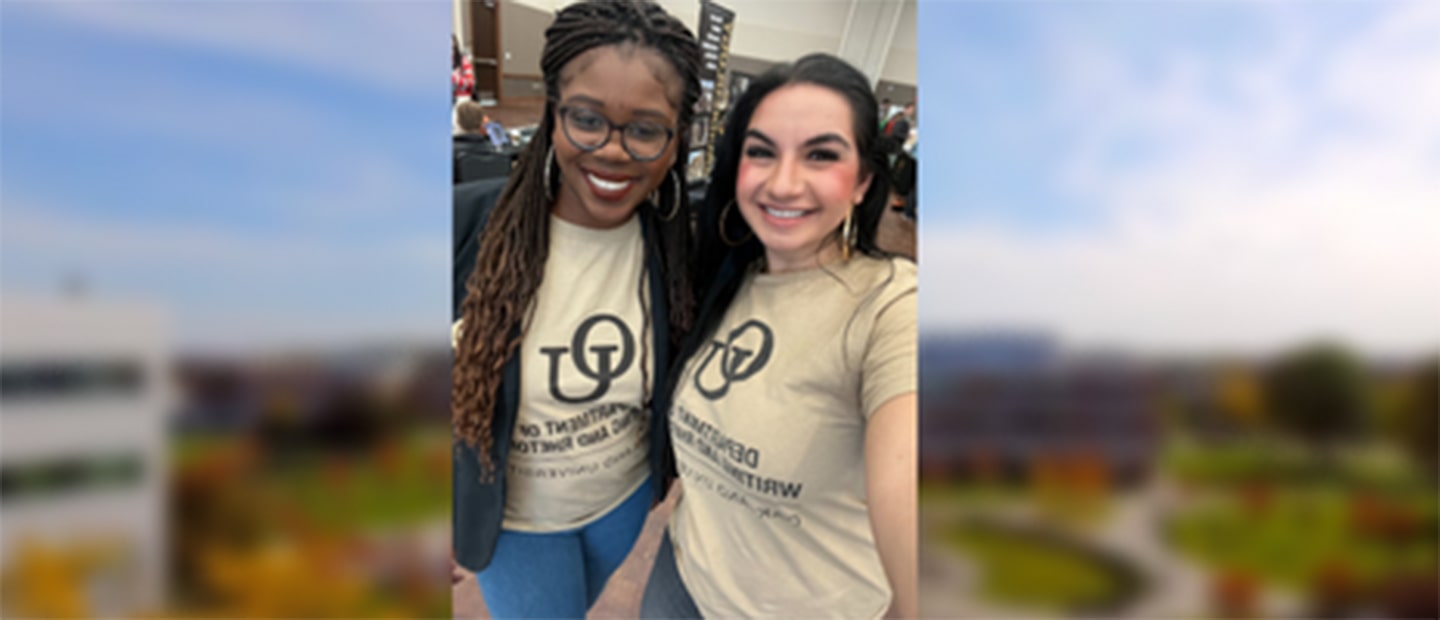
In this teaching tips interview, assistant professor of Writing and Rhetoric Dr. Felicita Arzu-Carmichael shares how she builds into every course the expectation of her students as collaborators, whether in the work of the course or beyond. We explore one such collaboration with her student and collaborator Mena Hannakachl, who was also recently awarded the Keeper of the Dream award.
Watch the 30-minute teaching tip video, or listen to the audio-only version
Transcript
Welcome to the weekly teaching tip series. My name is Christina Moore from the Center for Excellence in Teaching and Learning at Oakland University. Every Monday we published a teaching tip on our website, oakland.edu/teachingtips. And this is a very special video addition to the series.
So today I'm talking with Felicita Arzu-Carmichael, Assistant Professor in the Department of Writing and Rhetoric at Oakland University. And I'm talking with her student and collaborator, Mena Hannakachl, a professional and digital writing major, and the recipient of the prestigious Keeper of the Dream Award recently here at Oakland University. Felicita and I have known each other for a while and while I appreciate many aspects of her research and her teaching work, I think the thing that has always stood out to me the most is that whenever I asked her if she'd be willing to do something or do a presentation, she almost always asks if she can bring her students along and be active participants in that. And that is actually going to be the theme of this teaching tip. Mena and Felicita be talking about a collaboration they're doing together and what advice they give to professors and students on cultivating these collaborations as really rich teaching and learning opportunities. So to start, Dr. Arzu-Carmichael, tell us about how your teaching actively includes students, including collaborating with them on projects.
[Felicita] Yeah, First of all, thank you so much, Christina, for this platform and for the space for me tonight to have this dialogue with you. I really appreciate that. So my students are very active participants in my teaching and wherever possible in my research as well. I think that's because one of the values that I have as a teacher is based on the one-up the pedagogical theorist that I follow, Paulo Freire. And so a lot of Freire’s work, he advocates for a kind of reciprocity between teachers and students. And what this means is there's this reciprocal role where students learn from teachers and they teach teachers just as much as teachers learn and teach their students as well. So it's very reciprocal. And in a lot of the theories that I'm interested in as an instructor, I'm always trying to identify ways that I can take the values and the ideologies that I subscribe to and put them into practice, right. And so what does that reciprocity look like for me as an instructor, my classroom, and in my research as well. And so that's where this all got started for me and why I'm always interested in opportunities to collaborate with my students. So really intentional about making space for that. But one of the other things that I'm really interested in, this kind of started with Judy Ableser’s work on SoTL when she was a director. One of the things I really appreciated about Judy is that she always encouraged faculty to pursue the Scholarship of Teaching and Learning. Inquiry into student learning.
Obviously, it can happen in a variety of ways, for me, when I invite my students to present with me. What that does is it takes our conversation that started within the classroom space into a different space, right? And so I'm able to inquire a lot more into my student's interests and a lot of inquiry engineering, learning. How they're grappling with the issues and conversations that we're having in class. What that looks like for them outside of the classroom. So in a way, it's my way of also inquiring into the Scholarship of Teaching and Learning. Which also tells me a lot about my pedagogy. So I think this kind of goes back to what I mentioned earlier about this reciprocity. I teach students, but my students also teach me quite a bit.
[Christina] Mena, would you then share your experience and your hearing your professor to talk about this intentional strategy. So what did that actually look like and feel like for you in the classroom?
[Mena] Yeah, absolutely. Well, thanks for having us here at Christina. I think from my perspective, I first had Dr. Arzu-Carmichael and writing 2060 back in 2021. And I would say that this collaboration was really ignited from an opportunity of being a discussion leader in the classroom as a part of my grades. And I decided to lead a discussion on article that was written by a scholar of color. And the content of that article was actually very relevant to the issues that were affecting me and really interesting to me. And I decided to bring up the topic of microaggressions. And it was a very productive conversation with my classmates and Dr. Arzu-Carmichael. But 14 weeks they only do so much to cover such intensive topic. So I decided to investigate these issues in the work that I was doing in the classroom. And one, I would say that pivotal moment for me was deciding to write a paper FOR paper titled “writing constructors complicit in white mainstream English.” And speak of collaboration abductors, okay, if I call actually encouraged all of us, they see publication. And that was very new to me because her class was my first, I would say, writing intensive class and the major. And I was really intrigued in opportunity of seeking publication. And I wanted to explore that more with her. So we decided to extend that conversation beyond the classroom. And what happened was we actually, I asked her to help me to pursue publication in regard to that paper. And I would say the rest is history. And we had many conversations outside of the classroom for coffee and a lot of our conversation from the classroom in regards to microaggressions. And even my paper that explored the intersection between race, social justice and writing and how faculty and faculty has a responsibility of being cognizant of that connection in their assessments and teaching. And I would say that the opportunity came back a few months ago, which was presented to me. But once again, I think it's truly full circle to reflect back to that that representation that I found myself in text and do sit here and talk about our work.
[Christina] That reminds me of another professor who spoke very similarly about always having anything he assigned as an opportunity to then share it out. But that was almost an expectation, although not required. I think it came down to the point of, he got to the point of calling his students “scholars”. Very intentionally of saying like you are doing the work of scholarship in this class. If no one, even if no one sees it, although people should. And I just, I haven't thought about that in a while. But that really reminded me of that. I wanted to elaborate on that point because as a teaching tip, we want to bring it, we want to share stories but also help other faculty and students put this into practice. So Felicita, could you say a little bit more about how you encourage all of your students to publish. Whether that's in a very specific scholarly outlets or other media modes and outlets.
[Felicita] Right? Before I answer that question, I love what you just said about referring or the professor that refer to students as student-scholars. I think language is so powerful as a rhetorician study rhetoric, I study language. And so I loved that approach at that Professor takes, wanted to mention that. But yeah, I always encourage my students to publish. And one of the things that I'm always very cognizant of also is being able to practice what I preach. As a writing instructor. We think of writing as a process. There's a lot of processes that are involved in writing. So that idea of inviting students to identify topics that they're interested in pursuing in the class, but then encouraging them to continue to explore those interests beyond the scope of my class, whether that's in one of the classes in their majors or a career that they're interested in, whatever the case may be. That invites me to demonstrate to students that writing really is a process. So the paper that you're writing for this 16-week course, it doesn't just end right there because the class is over. So that's perhaps one of the main reasons why I encourage my students to seek publication, to continue to investigate, to continue to participate in these conversations that they select that are interesting, that are interests of theirs. I think another part of that is I'm one of the associate editors of College English and I worked with some amazing, I get to work with brilliant scholars in my department under the leadership of Lori Ostergaard. And so that idea of just paying attention to the different spaces that exist in our field that are welcoming of emerging scholars or students, scholars, as you mentioned, to support them, to mentor them. That's one of the things that I'm always also having conversations with about my students identifying avenues that might be beautiful homes for their work. Or if they're not interested in publication, maybe it's a local presentation on campus. I know steadily so how these wonderful instructional affairs, it doesn't have to be a huge peer-reviewed journal or a national conference. It can be something vocal that just provides opportunity for them to continue that conversation.
[Christina] I think a lot of professors are enacting something similar, but I think I'll listen to this and it will be an aha sorts. And they'll probably remember that That was when I started to feel like scholars themselves. Was when their professors invited them and said, I think you should continue with this work. What do you think of this avenue? Where do you want to see it go? I think I think that's really the spark for a lot of the work that we do in academia. So let's talk specifics about your current collaboration. What form is taking place if it has a home where you're at in the process or anything else about the specific project.
[Felicita] So the project started back in April 2022. I got an invitation and email invitation from a colleague in the field. I'm someone who I work with on a separate book project. But the scholar was working on an edited collection with some other folks in the field. And this edited collection focuses on questions and lessons about leadership, leadership and support that were revealed or that manifested during the pandemic. This edited collection. They are specifically interested in the perspective of early career faculty. I was very excited about the project and accepted. One of the things that really captured my attention though, was that emphasis on the word support. That's because you can already imagine during the pandemic, there's, there's so much, so many challenges that a lot of early career faculty and students we all face really in a variety of ways. But that's a concept that I had already been thinking of and kind of grappling with. But what was also happening at the time. Amine, I mentioned that she was taking this class with me in fall 2021 and conversations that emerge in that class that we continued through the winter of 2022 semesters. So when I got that invitation, I was I immediately made connections to some of the very, very important conversations mean and I were having about support again, but specifically about microaggressions and the support that might, may or may not connect to those, right? And so I immediately thought, what a wonderful opportunity for Mena and I to continue to have this dialogue in this space through this edited collection. So I reached out to Mena and I asked her if she be interested in collaborating with me on this book chapter, which she agreed to and she had the rest is history. So since May 2022, we've been drafting this book chapter. Lots of drafting, lots of meetings and conversations on making connections between our experiences. And big thanks to Professor Megan Schoen in the Department of Writing and Rhetoric, who has been so gracious with her time giving us feedback on this draft as we're working on. It's still very early into the process. As most publications are. It takes quite a bit of time, but it's been a wonderful process collaborating with me on this.
[Christina] Mena, did you want to add anything to, to anything that your professor said about this process and how it's spelled for you?
[Mena] Yeah, absolutely. I think it's been a very real for me to draw on my experiences having been an ESL students in high school, and having been to one of the few students of color and the major, at least in my meetings and classrooms. And I also was really grateful to be able to take my experiences in my student role at Oakland, being an embedded writing specialist who offers support in first-year writing classes and transform those experiences both positive and negative, and transform them into critical lessons for effecting positive social change. And I think it was, it has been very empowering to not only be able to put language to it, but also make sure that I can actually implement that same framework and implement the same act and empower my own students, you know, having that opportunity of offering my students support. But I think to me and I also really want to acknowledge that although some of it was both positive and negative, I was able to actually by my Keeper of the Dream scholarship award win has definitely contributed in multiple ways and I think this collaboration has tremendously impacted and contributed because I was able to draw scholarship on it. And I was also able to empower my own students. But I think what was interesting to me is I took those same frameworks and same concepts that I learned from class, from having 2060 and 2084, and make sure to apply it in our chapter.
[Felicita] I want to add real quick to that. I love that Mena brought up the concept of empowerment because that's really central to this book chapter. The edited collection is about leadership and support. And through our conversations. We determine that that concept of empowerment both how myself, as a Black faculty, a junior faculty, have empowered myself or have been empowered by others. And Mena, as an undergraduate student, a student of color. And likewise, how she has able to be empowered by others and empower herself through our shared experiences, our conversations and connecting dose through the many exciting scholarship that we've been reading in class and out of class we've been able to, or we are still in progress of working through. Okay, so what does this mean for a sense of empowerment for ourselves? Because we are writing from our perspectives. But then also recognizing that we are trying to prepare or to share lessons for other faculty, for other junior faculty, for students, for program directors, that they might be able to identify ways of empowering and collaborating with students and working toward effecting change.
[Christina] As Mena said, one thing that stuck out to me in your description of this collaboration is that It almost came out of a relationship that you two have been cultivating over time. It's not as if in the class itself. This call came out and you went to your students and said, There's this call, who would anyone like to contribute? Which of course would have been a fine and wonderful opportunity need to. But you have been talking over time about your interests, where you want to go. It hasn't just been about publication, but about growth and empowerment. And then this call came up and you're in a practice of thinking of who, which student can I involve in this? And you thought of Mena, if I understood all of that correctly, I think it speaks to not only this transactional idea of, “Oh, I can tap into students and they can provide this assistance in developing my scholarship.” But you have this rich network of students that you're always connected to. So when the opportunity arises, you're sensing, “Who can I talk to? Who can I bring in? This person would be perfect for this.” So I think that's a really important piece.
With just the last couple of minutes to try and bring this into some first steps for faculty who want to have similar experiences, want to revisit how they bring in students as collaborators. What advice would you give, whether it's to professors or two students or to both, about how to engage in this similar practice and bring students in as collaborators.? [Felicita] So one thing comes to mind in regards to advice that I would give and it relates to.
So I have a strong commitment to OU’s strategic goals, particularly one student's success and will to diversity, equity and inclusion. Much of my teaching, research and service actually center the DEI related issues. So my advice to faculty centers, these two goals, 1 and 4.
I think collaboration happens first by a deep listening. We have to listen intentionally, listen rhetorically, listen deeply to our students. I think the first week of classes, and most faculty probably ask our students to tell us a little bit about yourself: What's your major? What are you interested in? What do you do for hobbies? Whatever the case may be? Over the years, I've been very intentional about even though asking, asking my students those questions early into the semester to come back to those, right? And so there's a lot that our students are comfortable revealing about themselves first early into the semester. And being very mindful of who our students are throughout the course, even though when the semester starts, you know, we're equipped with our course syllabus and course objectives and our major minor projects. But not everything in the course there. Everything in the semester can be planned. For me. I'm listening to who my students are, what they're comfortable revealing about themselves early into this semester and what they reveal about themselves as the semester progresses. And then being very intentional and mindful about. Okay. Are there opportunities that I can identify to support you in what your interests are? Or perhaps a lot of students might also be a little unsure about what their interests might be, what their career goals might be, and that's okay as well. And it's already there taking all these excitement glasses to figure that out. But there's a lot of, there's a lot of mentoring also. I think that needs to happen.
I really appreciate what you mentioned earlier Christina about. So my approach to collaboration that's not seeking ways or opportunities that can benefit from students work. But really, it's a kind of validation of validating my students in the classroom, recognizing who they are. And making sure that even though they're in my class to study and practice writing rhetorically, who they are is also central to the work that they do, right? And I think if we're very mindful about that, it kinda makes collaboration a natural kind of easy thing that can emerge with students.
[Christina] Mena, What advice would you give to professors, students or both?
[Mena] Yeah, absolutely. So one advice I would give to instructors, if the first trust your students and be open to learning from their students and knowing that your students bring a different yet unique perspective to their pedagogy, to their assessments, to their course design. And I have always found that Dr. Arzu-Carmichael has always been actually interested in learning from her students. And I think a lot of instructors, unfortunately, maybe due to the background, kind of infuse that power dynamic of authority, of knowledge and having that authority of knowing, having that knowledge, which is amazing. But I think I would definitely tell them to be interested in learning about what your students are into, their research interests. And if you can't always collaborate with them, how can you connect them to resources on campus or in the field that can help them reach those goals. But I also wanted to say and acknowledge that opportunities like this for students. I guess I wanted to tell instructors that it opens doors for them beyond the classroom, you know, there's this kind of idea that you come into my classroom, I teach you, you get a grade, and you leave. But how can we extend those conversations and reach a broader community and a broader audience. And I think this project is a prime example of doing that.
But my advice to my fellow classmates, colleagues, and other students is to recognize that professors are actually there to hear your ideas and what you're interested in and they're waiting for you to come to them and to be a geek, to talk about your research interests and to share with them the conversation that's sparked interest in that you were thinking about after class.
And also, I would definitely say Do not be afraid of advocating for research that maybe we don't have enough scholarship about. And I remember the conversation about with Dr. Arzu-Carmichael about me being a fierce advocate about linguistic justice. And at the time, I didn't have the language and the scholarship to articulate myself because I was so new in the field. But what was really cool about those conversations is that she was also eager and curious with me to investigate these issues even if we both didn't have the same tool.
And I also would tell my, you know, I guess fellow colleagues is to ask for opportunities even when you feel like an imposter or even when you feel like you are so new to the major. I think at the time, I’m sure, I think I felt like I perhaps didn't have the expertise, but I love the language that you use, Christina, about calling students “scholars.” I know, I know for me when she first told me a scholar, what that did to me is it actually told me. It made me feel like I actually belong in the field and what I have to bring is valid and only valid is it actually can take place. And we can actually, we can actually have it in the field and put it into real action and practice. And I think this is, once again, this project is an example of that for taking it beyond the classroom and sharing it with the field and the world, essentially.
[Felicita] I want to come back to talking about trust and how important that is for faculty to trust their students. Because I think that speaks to that idea of listening to who our students are. One of the things that I really love about bell hooks’ work in Teaching to Transgress, she talks about sharing personal narratives that really enhances our capacity to know is really an important aspect of I'm centering students voices. I know as faculty we talk all the time about how important our students perspectives are, how important their voices are. But I think that's one way that we can really make sure that we're enacting those values, those shared interests that we have.
And I also think back to Mena’s Keeper of the Dream Award and the ceremony this year, the keynote speaker, Hill Harper gave such an amazing talk of powerful talk where he reminded audiences about one of Dr. Martin Luther King, Jr. it's called and I remember having something to do with. Mutual, mutuality, a sense of mutuality and destiny that we're all connected and this neutral network. And I think if we start from that perspective, that we're all already connected by this mutual destiny. That's one of the things I think that can foster collaboration with our students. And that makes this, these opportunities for students success. And then also invite students to investigate important socially just related questions that contribute to our field, but also contribute to those specific to goals that I mentioned earlier. So thank you for bringing that up about trust.
[Christina] Yeah, I shouldn't I shouldn't be surprised at this, but I know that we had this idea of discussing this collaboration and specifically this project and how it came about and how faculty can, can translate that same sort of collaboration. But I just love how this really got at the core of the relationships we have with students. Why we're doing this in the first place so that we're not trying to implement a strategy here, a good practice to do there, but we're really exploring what is at the core of that. So I'm really glad that that's what we're discussing, because that really is the seed of who knows how many collaborations are to come and all the other things around those collaborations to, which is probably the reason why whenever I asked you about a project you're doing, you want to involve your students because you aren't connected and you continue to cultivate those connections and create a community of learners switches. Something we need to continually pay attention to and create that safe and encouraging environment.
[Felicita] Thank you. Thank you so much for saying that. I always tell my students when they enter my classroom, if they leave knowing how to write a really strong paper, I would have failed them as an instructor because that's not that's not my sole purpose at the end of the day and want them to be critical thinkers. I love what you just said about community of learners. Want them to find themselves and community, build community, and really leave our institution better than better than how they came. Phil, thank you so much for that, Christina.
[Christina] Thank you both so much for taking this time to share your experiences, your ideas, and just the wonderful work and achievements you've both enjoyed recently. I know are on top of lots of other ones, so thank you so much for stopping by to see this and more. Please visit the CETL weekly teaching tip series at oakland.edu/teachingtips. Thanks everyone. Thanks to both of you. Thank you.
Their interview shared four main recommendations:
Recommendations
Create a culture of reciprocity.
Citing Paulo Freire and bell hooks’ teaching philosophies, Felicita sees education as an act of reciprocity between teachers and students in which teachers expect to learn from their students and to build understanding and new knowledge together.
Practice deep listening throughout the semester.
For Felicita, “collaboration happens first by a deep listening. We have to listen intentionally, listen rhetorically, listen deeply to our students.” Don’t stop at the first week of the semester: ask students to share their stories, their motivations, and their interests and struggles. With this knowledge, connect students to related opportunities.
Built trust to empower students.
When you show students week after week that you are listening to them and validating their contributions in class, you show students trust and therefore empower them. Students feel they have a real stake in what happens in class and can ask questions and explore ideas without fear of failure. Mena said this was key to her seeing herself as a scholarly with something to contribute to the academic community.
Invite all students to be your collaborators.
Expect all of your students to contribute to collaborative work within and beyond the classroom. Arrest biases that may make you assume some students are more interested in scholarly work than others. Many students are just learning to navigate the academy and find their role to play within it.
If you feel collaboration on scholarship is not always possible, Mena recommends “you connect them to resources on campus or in the field that can help them reach [their] goals.”
Explicitly remind students that your office hours are a time to talk with them, that you love it when students drop by to ask a question or share an idea.
References and Resources
- WRT Student celebrated at Keeper of the Dream awards (OU News)
- Keeper of the Dream: Mena Hannakachl (Oakland Post Feature)
- Keeper of the Dream: Sterling Heights immigrant finds her voice as advocate for linguistic justice (Macomb Daily News feature)
- Teaching to Transgress: Education as the Practice of Freedom, bell hooks (available at OU)
- Freire, P. (1970/2000). Pedagogy of the oppressed. 30th anniversary edition. Translated by Myra Bergman Ramos. Continuum, available online and in print at OU
Save and adapt a Google Doc version of this teaching tip.
About the Contributors
Felicita Arzu-Carmichael [she, her, hers] is an Assistant Professor in the department of Writing and Rhetoric and director of the Embedded Writing Specialist Program. She currently serves as an Associate Editor of College English and president of Oakland’s International Employee Resource Group. Felicita’s teaching and scholarly interests focus on online literacy, race, social justice and inclusion, and first-year writing. When Felicita isn’t teaching or researching, she enjoys cooking Caribbean food and playing tennis.
Mena Hannakachl [she, her, hers] is an undergraduate student majoring in professional and digital writing in the department of writing and rhetoric at OU. She is committed to research in linguistic justice and passionate about decreasing inequality in classrooms while learning about anti-racist pedagogy. Mena plans to pursue law school after obtaining her bachelor’s degree. Outside of her scholarly work, Mena enjoys tennis, makeup artistry, and keeping up with friends.
View all CETL Weekly Teaching Tips.

Use of Open Educational Resources (OERs) in an Introductory Psychology Class
Switching to free/low-cost classroom resources is one way to reduce barriers to access. Open Educational Resources (OER) are openly licensed materials that can be used in place of traditional publishers' course materials for teaching, learning and research, and are free to use. There are many open educational resources available, across disciplines, that are informative, interactive, inclusive, and accurate.
As part of the Affordable Course Materials Initiative (ACMI), I piloted an OER and a low-cost learning tool in my Introduction to Psychology class. I was a bit worried that adopting new course materials would be a time consuming process, but there were many really great options to choose from (as this is a popular introductory course). Also, the OER chapter titles and content material were very similar to the previously used publisher’s textbook, so the process of integrating the free and low-cost materials was relatively seamless.
At the end of the Fall 2022 semester, I evaluated student perceptions of the free/low-cost resources (via a Qualtrics survey) as well as their overall performance. The OER was evaluated positively by students and no difference in performance was found between my class using the free/low-cost materials and a class I taught using traditional, publishers’ course materials. Open-ended comments shared in the Qualtrics survey showed that students, many who pay their own college expenses, really appreciated the use of this more affordable option.
I was, overall, very pleased with the experience and will continue to use the OER and low-cost learning tool in my introductory psychology classes. I also plan to search for free/low-cost options to use in my other classes. Several faculty in my department have also shown an interest, as a result of the positive findings. If we were to adopt these free/low-cost resources across all of our Introduction to Psychology classes, we could potentially save our students over $40,000!
If you are interested in obtaining a copy of the full report, please contact the author.
How do I get started?
The following helpful resources were provided by Julia Rodriguez, Scholarly Communications Librarian and OER guru, and are a great place to start your search for affordable course materials.
- OpenStax.org
- Open Textbook Library
- Lumen Learning | Online Materials & Resources for Higher Ed
- Open Educational Resources: OU Libraries Guide
I chose the OpenStax textbook, after reviewing a number of good options, as it was comprehensive (it covered the same topics, in a similar manner, as the previously used publisher’s textbook), accurate, and easily accessible (you create a login and have access!). I also chose to use Waymaker by Lumen Learning, which is a low-cost (less than $40) supplemental learning tool that is similar to the one I used in my prior introductory psychology classes. I found that it was easy to navigate, and this sentiment was echoed by my students. The Waymaker tool includes a study plan, pre-quizzes, embedded videos, end of chapter quizzes, and much more. It even provides feedback to the students via email after each end of chapter quiz (e.g., “good job” or study tips for future success).
Students accessed the textbook via a link posted on Moodle. The learning tool by Lumen integrated well with our LMS and was easily accessible after purchasing an access code from the bookstore (there was some confusion surrounding access codes, but this was quickly resolved). In general, I found it quite easy to integrate the new material into my prior course structure. I highly recommend searching for open educational resources to use in your own classes.
As an added bonus: If your textbook costs are $40 or less, you can include a free or low-cost course designation on banner (Cost Designation in Banner), which will alert students to this affordable option when they register for classes.
References and Resources
- Open Educational Resources for Faculty
- Julia E. Rodriguez, Associate Professor, [email protected]
- Rebecca Malatesta, Special Instructor, [email protected]
Save and adapt a Google Doc version of this teaching tip.
About the Author
Rebecca Malatesta is a Special Instructor in the Department of Psychology. She is the Student Success Coordinator for the department and very interested in investigating inclusive practices.
Others may share and adapt under Creative Commons License CC BY-NC.