Reflective Activism in Teaching Practice
Our students are not learning in a vacuum. They scroll past headlines about harmful policies on their way to class, support friends navigating fear about immigration uncertainty, and sit with the weight of constant stigma, violence, and murder, all while trying to focus on coursework. Pretending the classroom exists outside these realities does not protect students; instead, it isolates them (Ferlazzo, 2020). When we ignore the sociopolitical dimensions of our disciplines, we signal that what matters most to students does not belong in academic space (Walker, 2018).
Reflective Activism is a flexible, three-stage assignment framework that gives students a structured pathway from personal reflection to informed micro-action. Students first engage in creative self-exploration around an issue that matters to them. Then, students investigate how systems and institutions shape that issue and design a small-scale response, and finally, present their work to peers through interactive, low-stakes formats built for conversation and engagement. This framework draws on trauma-informed teaching principles and is designed to work across disciplines (Bitanihirwe & Imad, 2023; Guthery & Ausloos, in press). When students have structured space to connect who they are with what they are studying, they move from feeling overwhelmed by the world to feeling capable of participating in it.
How to Use This Framework
Stage 1: Personal Exploration
In this opening stage, students choose a sociopolitical topic that resonates with their own experiences and produce a creative artifact that captures their relationship to it. Students should choose a medium that works for them: a photo essay, a music playlist with written annotations, a short audio monologue, a hand-drawn map of their community, a letter they will never send, or any other format that allows honest expression without requiring traditional academic writing. The point is authentic engagement. Students should consider prompts like:
- What is one issue in the world right now that you cannot stop thinking about, and why?
- If you could show someone what it feels like to live alongside this issue, what would you want them to see or hear?
- What parts of your own background, identity, or experience shape how you understand this issue?
Stage 2: Analysis and Micro-Action
Building directly on the issue students explored in Stage 1, this stage shifts the lens from personal experience to institutional impact and action. Students select one institution or system connected to their topic (e.g., a school district, a healthcare network, a media outlet, a local government body), and ask:
- What does this institution say it values, and how do its practices match or contradict those stated values?
- Who benefits from the way things currently operate, and who is harmed?
- What would it look like if this institution took the issue seriously?
After reflection and analysis, students move towards micro-action. This might look like drafting and distributing an informational one-pager for a campus office, building a curated social media thread that traces an issue’s impact, organizing a listening session with classmates, or writing an op-ed or letter to an institutional decision-maker. Alongside the action, students keep a brief process log in a way that works for them. This could be a voice memo journal, a photo diary, or a few paragraphs. This process log should include what they learned about how the institution operates, what informed the action they chose, what they encountered along the way, and what shifted in their understanding.
Stage 3: Interactive Exchange
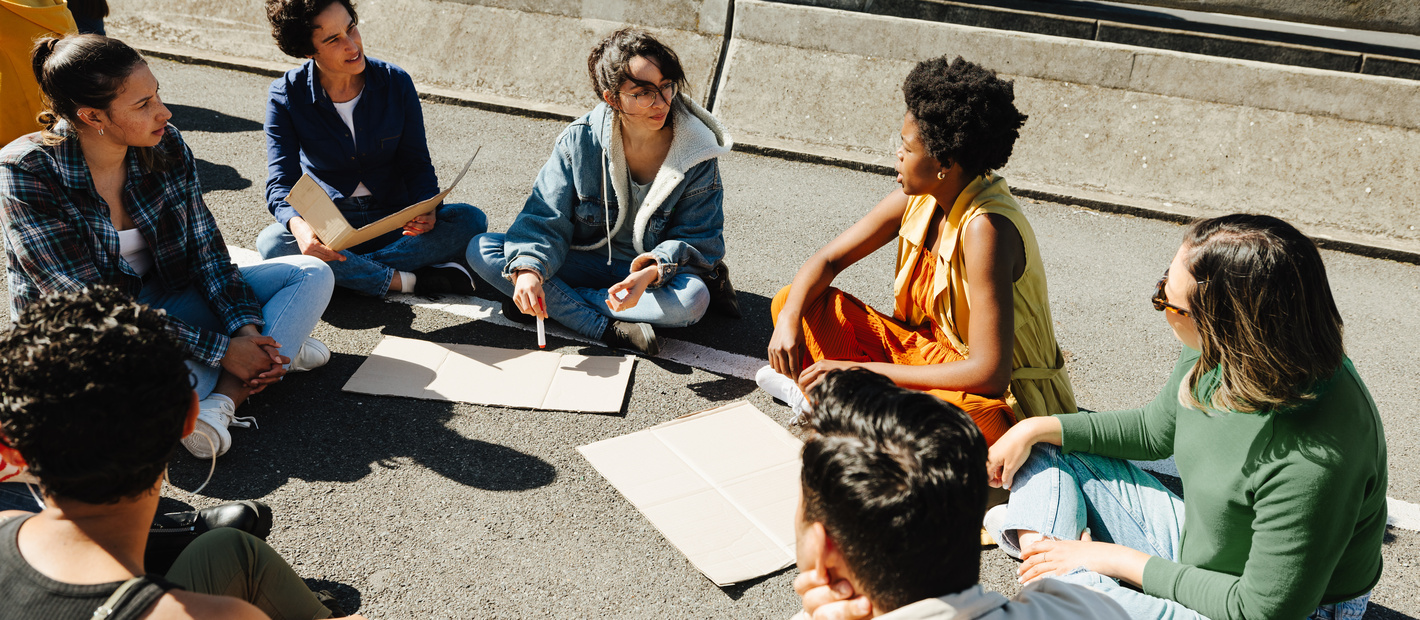
In this final stage, the goal is for students to engage with one another’s work in ways that feel conversational and relational rather than performative, emphasizing connection, curiosity, and shared meaning-making. Possible formats include a gallery walk, where students display their work and classmates circulate, leaving written reflections or questions; a paired interview model in which students interview one another for ten minutes about their projects and then introduce their partner’s work to the larger group; or a roundtable discussion, where small groups bring forward one question their project raised but did not resolve and work through these questions collectively. Faculty should explicitly frame this stage as a space for curiosity and connection rather than evaluation or critique, and should offer flexible participation options for students who may be uncomfortable with public-facing formats.
Conclusion
Higher education asks students to think critically, but rarely gives them a structured yet personal way to think critically about the world that is pressing in on them right now. Reflective Activism offers that structure, meeting students where they already are and rather than treating that overwhelm as a barrier to learning, channels it into creative exploration, analysis, and peer dialogue and engagement (Brunzell et al., 2019).
References and Resources
Bitanihirwe, B. K. Y., & Imad, M. (2023). Gauging trauma-informed pedagogy in higher education: A UK case study. Pastoral Care in Education, 41(5), 579–602.
Brunzell, T., Stokes, H., & Waters, L. (2019). Shifting teacher practice in trauma-affected classrooms: Practice pedagogy strategies within a trauma-informed positive education model. School Mental Health, 11(3), 600–614.
Ferlazzo, L. (2020, October 13). Keeping politics out of the classroom is like keeping the water out of rain. Education Week.
Guthery, A. & Ausloos, C. (in press). Using Activism to Transform Sociopolitical Crises in Counselor Education. Association for Counselor Education & Supervision Teaching Practice Briefs.
Walker, T. (2018, December 11). “Education is political”: Neutrality in the classroom shortchanges students. NEA Today.
About the Author
Dr. Clark D. Ausloos is an assistant professor in the counseling department, in the School of Education and Human Services. His teaching philosophy centers on a constructivist, student-centered approach that values developing meaningful connections with students. Beyond teaching, Dr. Ausloos holds licenses as a Clinical Counselor and School Counselor and has received high recognition from students for his engaging and sensitive handling of diverse topics.
Others may share and adapt under Creative Commons License CC BY-NC.
Receive Weekly Tips view all teaching tips Submit a Teaching Tip
Tags: