GrizzHacks Reflections
Student-alum podcast interview about GrizzHacks
School of Engineering and Computer Science
 March 26, 2026
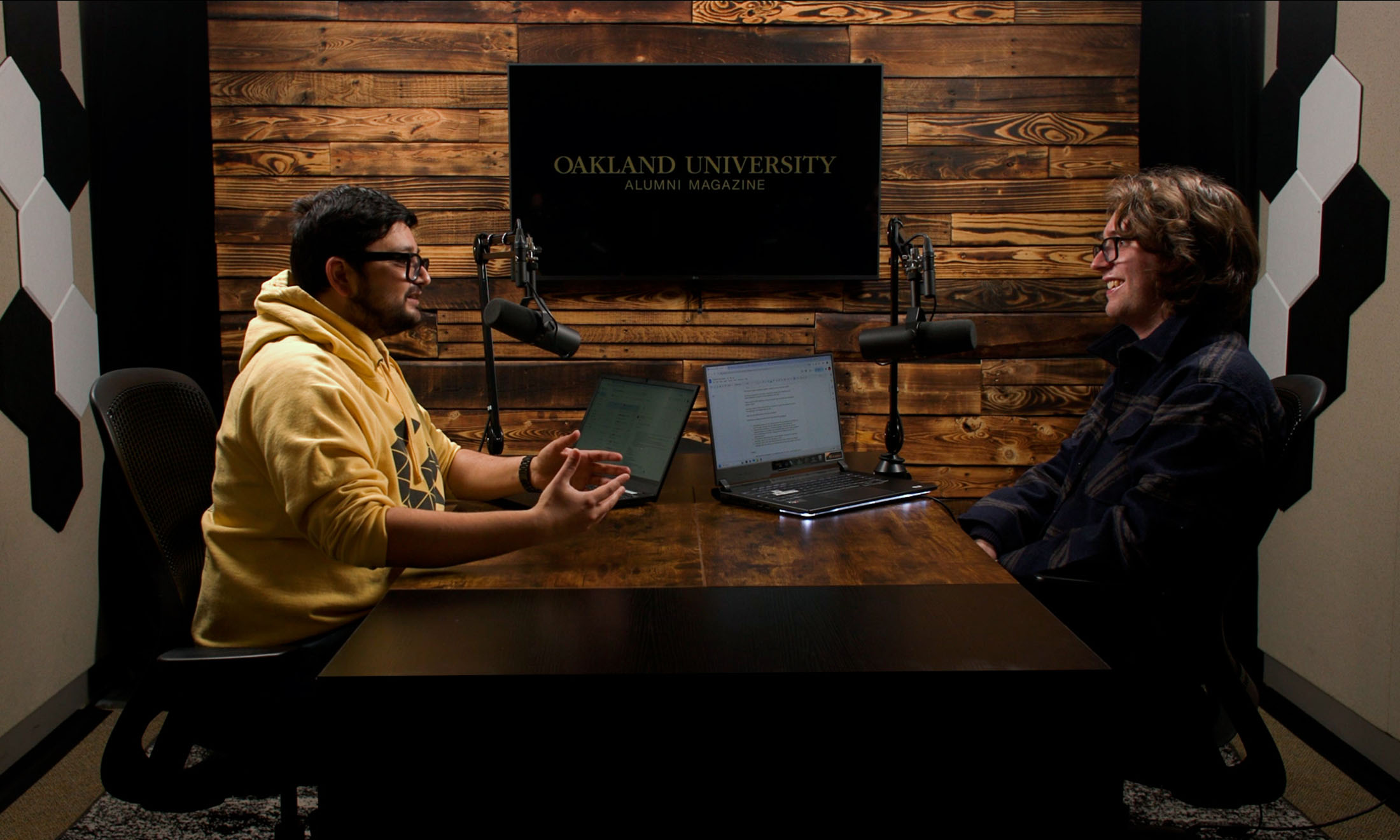
Current GrizzHacks president, Sean Collins, computer science major, chats with founding GrizzHacks president, Arpan Rughani, SECS ’18, worldwide marketing manager and application engineer for Stellantis, about the founding of GrizzHacks, where it is today and the memories made along the way.
Transcript
Hey, thanks for listening. I'm Sean Collins.
I'm Arpan Rughani.
This is a conversation about our experiences and reflections on GrizzHacks. If you're not familiar, GrizzHacks is a student-run event here at Oakland University where students have 24 hours to create the best programming or computing projects they can. It's a great place to learn and compete.
I'm Arpan. I've been with Intrepid Control System for the last 10 years, and I started GrizzHacks about 10 years ago, exactly.
That's actually something I wanted to ask you about for a while. Which what were some of the biggest challenges getting an event of this scale started? Because whenever I ask the school to do something, or I reach out to sponsors, they're often like oh yeah GrizzHacks. We know what that is, we've taken part in that, we've helped organize that.
It was definitely a challenge. I always like to tell everybody in my team. The first time doing something is always the hardest. If you do it right, you set a good foundation for others to follow. Hosting the first one, the biggest challenge was convincing our school that we're going to bring kids, and they're going to stay here 24 hours, and we're going to hold this event. Now, you remember this was 10 years ago, when the Hackathons weren't that popular. When you tell a university that they're going to be minors here in school overnight, and the building was brand new, built. They really did not want us to do this, and convincing the school was the hardest part. We had to delay our Hackathon event by twice. A little bit of background on how we got started, what inspired us. Yes, I was lucky enough that I was founding president of GrizzHacks, but actually, it was hard work from all the other organizers. Luckily, I got the role of president because I was not a senior at that time, and they all were graduating, and the way that things were moving with university, we thought it's going to take another additional year. It's like, if we do the training, get organizing, registering the org, and everything, by the time GrizzHacks happened, they all will be graduating, and we have to do all the paperworks again. I just got lucky that I have the founding president title, but everybody who organized GrizzHacks 1, they did an amazing job. I mentioned to Dominic, Andrew, Ivan, Adam, Jerk, Arno. There was a big effort to convince our school, but after doing the event, I think they were more comfortable. I'm still hosting more and more events, but I think the inspiration came from SpartaHack, actually. We all went to the first-ever SpartaHack, and we competed just like a Hackathon, you compete for a prize. We went there, and fortunately, me and my friend Dom we won the first place. Once we won the first place, we were all over the news channels at Oakland University getting praises, and that inspired one of the Professors Ansey, she now works at MSU, and she called us to our office. We like, hey, you guys should host something here at Oakland University, and then we were like, we wanted to do that. We were actually talking about it right after winning the Hackathon. Then she introduced us to the other students who also had the similar interests. And we built this circle of a group that has shared the same passion. You won't even believe it's been 10 years, and we are all still in touch with one another. That's a story of how GrizzHacks was started. Convincing everybody and making the event happen was another big challenge because of sponsorship. You go to sponsors, and they're like, what is a Hackathon? What are you talking about? We want more money than a recruiting fair. Why is that? Selling yourself to sponsors was another difficult task we had. So what we did, we went to all the organizers, and they all working somewhere as an internship. The best part about OU is it's a commuter school, and we all were working at some company as a part-time or internship, etc. We basically reach out to all our friends. Here's a sponsorship packet. Please hand deliver to your boss. I was the first one to convince my CEO to sponsor. We decided to do sponsorship, and three days later, I had a check from our CEO, and he was so passionate. At that time, our company was small, and one of my friends is, how did you convince your company? Because I cannot get my company to give me money? I was like, I just knocked on his door, and I'm like, hey, Dave Robbins, and since he was an OU alumni as well, he knew the professors, he knew the OU, and it's been great for recruiting. I just knocked on his door, and he's like, how much money do you want? I just named the price and here it is. Well, he was our first sponsor, and then every time we had to delay a Hackathon, we had to go back to them and say, hey, is it okay if we do it next semester? After doing it three times, we finally able to do it, and that was the first event was one of the hardest one, and then it got easier and easier to host.
Well, because the first time, you don't have a model showing that it works.
Exactly.
So, when you're asking for a whole building, you're asking for thousands of dollars, it's definitely a bigger ask because right now, we have decades of pictures of data of people getting internships, impressions off of this. It's a very different ballgame, I imagine, than the first one ever.
My funny conversation was going to the OUPD and telling them not to ticket people at night. This is going to be a parking. It's like, well, I need to talk to someone. After my third trip, I actually made a stop at Dunkin' Donuts and grab a box of donut. Then I asked, here, can you please do not ticket anyone at the event, because everybody had to park at the parking structure, and you cannot park outside the EC after midnight. I don't know if the rule still applies, but that time they were very strict because there was construction going on and everything. Sometimes the donut method does work, and we've done it before. There's a plex, I don't know if the company still exists, but they weren't responding to our emails for sponsorship. Our area was, we're going to go around Oakland University, see which companies are there, and then we're going to go to those sponsors and deliver donuts with a sponsorship packet.
At a career fair, seeing what companies were there?
No, companies around us in this university, and hey, do you want to sponsor GrizzHacks? The front desk lady is like, what is that? I was like, Just give the sponsorship pack, and here's a donut for you. It only worked with one sponsor, but it was worth $500, I guess.
That's a good return on investment for a box of donuts.
It was, so we done some crazy stuff. The first event, it was a lot of fun, too. Great great shout out to all my friends who helped make it happen. I don't want to take the whole credit, but I did.
Of course.
Question for you. Like you said, GrizzHacks has grown so much over the last decade. When do you remember the first time you heard the name GrizzHacks, and what were your initial impression of the community?
Well, I think the first time I heard the name GrizzHacks would be my sophomore year. I didn't attend, but I just heard it around campus from a couple of friends. Travis, who's now coordinating, he was an attendee, but the first time I really thought about GrizzHacks was the start of my third year, because I was in a computer architecture class with Haley, and he was the president of GrizzHacks before me. She was recruiting coordinators for that year. It just seems like a really good way to get involved with the computer science field on campus, all the people in the field, because I think at a school like OU, which, of course, has advantages, like you talked about, to it being a commuter school. I think you do really need to put in a little extra effort outside of just attending classes and things to get involved with the community and other people in your major make those connections. Because it can be, I think, pretty easy to just show up, go to class, and then drive home.
That is true, and I think it's a great way for you to make friends, as well, in a community like this, because I think those friends you are making right now as GrizzHacks, you will remember them for next decade. I'm a living example of that because all of them, they graduate. I went to their weddings, and you just see them grow, and they all help you, too. If I need something from Google, let's say, I just call my friend Dominic, hey, Dominic, I need an internship. Actually, never asked, but that's if he's listening.
But it's just such a great way to make those connections because you really get to create something tangible and really cool and spend all this time working with people towards a common goal. I thought a really good way to get out there.
Once you host it, I think a lot of people recognize you in the hallway when you're walking by. Ever happen to you, guy from GrizzHacks? I was definitely a crazy experience starting GrizzHacks, and I can imagine what you're going through because you're only a couple of weeks from hosting a GrizzHacks 8 now, that's happening.
Well, it's March 28th, a little more than a couple of weeks, but we are getting close there. With you, specifically, I feel you probably have one of the more diverse resumes in terms of involvement with Hackathons. You've attended them, you've organized them. You've come as a sponsor and judge to them. I'm just curious how your perspective on the value of Hackathons has shifted from all of those different positions you've held in them.
I just want to give you a little bit of background how I got into Hackathons. My cousin's sister, she was an organizer of MHacks 2, Ann Arbor, and she called me once. I was in medicine, a medical college. I really wasn't into engineering, but I like to build websites and stuff like that. She calls me up, and I'm organizing this event, MHacks 2. There's seven seats left, and we have 1,000 students coming, and it's at the big house, so come check it out. I'm like, sure, it's like, if you don't like it, I'm going to be at the Hackathon all weekend. You just feel free to crash at my place. I went there, and I didn't know anything about programming except making a website in HTML and CSS. Basically, when I went there, I saw companies like Apple, Google, everybody's recruiting, they're letting you borrow their equipment. There was one person, I don't even know that person's name, and I was like, what is this in your screen? He's like, this is Linux, and he started teaching me Linux. Then I went to a workshop on how to make an iPhone app and an Android app and everything. After 36 hours, Sunday, I went home, and Monday, I went back to my counselor and be like, I want to drop all my medical classes while I'm getting in computer science. That gave me the inspiration, and that's how I see it as a Hackathon. When I go to a Hackathon, I want to learn something, I want to build something. As a sponsor, I always thought when a sponsor come to judge you, they're looking at the code, they want to really want to see the finished product. But no, as a sponsor, what I learned is we want to see what your thought process is, how you're taking on challenges. Then we want to give you an internship offer. We are there to recruit you and see how you attack a challenge, and just at SpartaHack, we saw a bunch of winners, and we already called them for an interview after they won the first place. That's how we hired talented engineers at our company with our new tool-free Willie, that's another tool that we built for engineers and hackers, just like Hackathon, to give them access to hardware hacking, because software is getting done by AI now. AI is doing all the software, now, the hardware is the big challenge. The biggest hurdle for students is, I don't know anything about hardware. My goal is to make students who is in computer science learn embedded system, make it so easy for them to get started, and then use your hardware project as in your resume to get a job. I even thanks Intrepid that they're letting me do this as for fun and over the weekends.
But we hire tons of engineers from Hackathons, and for us, the biggest value is you build something, you show us something, how you present it, how you communicate your project. Then we will give you a job offer. I think it's the best recruiting. It's better than any recruiting fair right now. All the sponsors, if you're listening, you're thinking, "Oh, we don't have money to sponsor this year." This is the great time to sponsor events like this because you are actually letting your tools used by all the students that you will be hoping your tools grow, your software grow, and you'll get to hire the best engineers now.
I really love both of the things you said there, both from the sponsor perspective, trying to see the creative process of an engineer and that being a big benefit of seeing them not just work through a technical interview or something, but create a full project and really see what ideas they have. Also, what you said about, your first Hackathon it being just such a great learning experience though it is like a competition, there are prizes. There's so much to learn. You can have some of your best experiences at a Hackathon trying something that you've really never worked with before.
Exactly, and I think that's the thing. First Hackathon, I didn't know Linux, and I learned it. My question from me to you is stepping into presidency is a massive undertaking. What has been the most unexpected lesson you learned about leadership while running Grizzhacks?
I think it might be about the importance of delegation of tasks. Because when you're present or something a leadership position, sometimes a task comes up and you just, I can take that on myself. But then if you keep doing that, you end up putting off certain things because you've got classes, you've got other tasks, you got other things you need to do. Even though you feel productive for taking on this task, you're really, doing a disservice to the people that both want things to be done and also want to contribute themselves. Just learning how to give people the opportunity to contribute and structuring the organization more around that, I think that was a big lesson for me with Grizzhacks and becoming president this year.
I think that's true. I think that takes you a lot of places when you become a manager. My biggest problem was delegation. My experience at Intrepid. I was an intern for first two years, and I used to not delegate. I'm, I can do it better. I can do this. Then my boss [OVERLAPPING]
Especially, all the tasks, they seem exciting. There are things that, you want to do, but.
Then you're at 2:00 AM, but still working on it. But my boss gave me this advice. You got to let it go. That's why after GrizzHacks 3, I let everybody do their task. Even though I actually demoted myself at GrizzHacks 3 to just adviser because I wanted other people to step up. Delegation is such a key. I think you can only control so much, and then I learned about management, and now I'm a manager at Intrepid, and it just feels different.
Well, especially when you're working with any scale of organization, if you want it to be productive, you really need to focus on building the infrastructure [OVERLAPPING] for it to be successful. In your wide experience with Hackathons, is there any specific area you think that they can grow or improve?
Hackathons, I think mostly since AI is coming in, hackathons will adapt, in my opinion. One advice would be to focus on hardware as well, because just like I mentioned earlier, softwares are getting basically written by AI now. Computer science is a field where we are going to struggle a lot. I feel back in 90s, there used to be people used to get a major on making Word document look pretty using typewriters and HTML and CSS. Then Google Docs and Microsoft Word came along, and now all those degrees are just trashed. I don't know if the shift going to happen with computer science the way AI is going, but you still need a hardware, robotics. All that stuff, I think computer science students will adapt too. That major shift in AI, Hey, we want to run compute all the AI processing in the edge of the device. We can actually run robots. We can run models fast in the device itself. I think hardware will play an important role, and I already seen a few hackathons. They already sponsored. Hey, best hardware hack focus on that. Since we are in Detroit in Michigan, and we known automotive brands around us, I think the best ways to get into automotive field is to learn hardware. Get inside your car, start collecting data, start adding features that your car companies don't allow you, start doing cybersecurity. That's another field that while, if you think AI is going to take over your job, it's about time we also introduce cybersecurity to real Hackathon. People, when they hear Hackathon, they think it's a hacking competition. we're hacking real things. But maybe it's about time that we bring that to Hackathon itself, create a track for cybersecurity.
Interesting.
That's what I see it as. In order to reverse engineer all this stuff, hardware, you need to learn software as well. That's something AI won't be able to help you. Imagine you open up your iPhone and start learning about each of the chips it has, and then figure out how they wrote that and then reverse engineer that and see if you can find a bug, and now it's a real hack. But again, just have fun. A lot of times, when I go to Hackathons, I see students so passionate. They want to win. It's all about first place. It's not. [LAUGHTER] The time I expected, I will not win. That's when I won. I always went there, I'm going to win this Hackathon and I didn't win anything, and I felt sad and I see that same thing happening. But it's not that anymore. It's about learning. I think you guys are doing great. I don't have much feedback other than that.
With that last point, we always try to emphasize that it's not all just about winning, there's many ways that you can take a hackathon. If you really want to try, you can. If you want to treat it as a big learning experience, learn new language, and new technology, anything like that, or if you just want to hang out for a while, get some free Chipotle or something. That's always an option, too.
That was the fun part. Actually, my friend Andrew Lisa will agree with me on this. We used to host events on campus just for free food. [LAUGHTER] That's another motivation we had. But we used to, of course, bring a speaker and everything. But biggest motivation is we didn't have to pay for lunch today. Every president leaves a mark. What was the one initiative you were most passionate about as being a president of Grizzhacks?
Well, this is actually, in line with what you were saying. A Hackathon, it's like a one day event, and we put in all this work behind the scenes, but really it's only super visible to the people who owe you for that one day. We've been trying to get a little more involved throughout the year. Previously last semester, we had a speaker come in, Vinny Hoxha, who was the former Chief Information Security Officer of GM currently at McKesson. He came in. He gave a talk about getting started a career in cybersecurity, and it was very successful. We had a ton of people show up for it and just things that to get the Grizzhacks name out more throughout the year versus just the one day, as well as we were very fortunate to get a few coordinators this year fill in the shoes of people that have left. Well, after last year, the only remaining coordinators were me and Kaden. We had to get a whole new team. But fortunately, within all the coordinators we recruited, some of them had extensive experience with marketing clubs, either at high school or earlier in college. We've been trying for a bit harder a marketing, social media push to like I said, just get the Grizzhacks name more around campus.
I love seeing all the design and marketing on social media. This year is theme is Duck, isn't it?
Ducks was last year. This is, a tropical vacation.
Tropical vacation. Ducks was last year. I always enjoy seeing every time I look at my Instagram or Facebook and I'm, Hey, this is cool. I have a theme this year. That's pretty cool. I love whoever's doing all the design for Grizzhacks. That's unbelievable.
No. Shout out Maria and Riley doing the social media for the most part.
It's crazy. It's pretty cool.
It was super nice. How does it make you feel to see something you started so long ago, a decade ago, you said, continue to draw new coordinators, new attendees. Just how's that feel?
I think it feels inspiring, honestly. I really set the foundation. I wrote bylaws for this organization so people can continue, and I thought it will die someday and that was the thing. But then I was still thinking about where it's going to go in five, 10 years with my friends, we're like they're going to have fun. They can do whatever they want. But when we leave, we're going to leave the organization at a better spot. First Grizzhacks you won't believe that 24 hour event we hosted with $8,000, including prizing. The first place the prizes were $1,000. GrizzHacks 2 we left behind $20,000 extra money in the bank account for people GrizzHacks 3, 4, and 5 to continue. The COVID Grizzhacks was very funny because they had extra money, so they shipped our prices and t shirts to everyone that joined. After that, I wasn't part of it after GrizzHacks 3, but I saw, where this money during COVID when nobody wants to sponsor anything, Grizzhacks was still going on. The reason was because of the money we left in the bank account for you guys to use. That's where I see, if you are current president, if you leave enough cash flow for the next Hackathon to take place, even when it's a couple thousand dollars, it will continue to go. But if you decided to go all out, zero dollars in the bank account. The next people that are going to come in, you don't know what environment we're going to be in. Are we going to recession? Are we going to place time COVID? If they have funds, they would love to spend that, and it's always good to keep some savings and your organization will grow faster. Probably people on the audience probably wondering how we pulled off $8,000 Hackathon 10 years ago? We basically went to this Rangolian Indian cuisine was owned by my aunt. She founded the Rangolian. She sold it before COVID. But when I went there, I'm like can I get a discount? And she's like how much discount do you want? I'm like how much discount can you give me? Well, 50%. Then we paid for the catered dinner for $900. Our budget was $2,000. Even though I had money, I tried to go. I went to DeBellacen which I'm, Hey, you guys need to give me discount. I cannot afford this. People will give you discount. They get a tax benefit. Just because you have money as a student you have to have expensive prizes, have to have all this.
I think that's how I set up in the bank account, and that's why it continued so long. I think you guys are doing the same thing. You take advantage of all the discounts you can get, all the spas. Now there's alumni support. You guys have the former GrizzHacks organizer that you don't have to worry about all this. But it's really inspiring to see where GrizzHacks is going. I think in the next decade, it will be very interesting to see where it goes. Speaking of that is incredible that we are 10-year milestone. Looking at the current tech landscape where AI is coming, I want to ask you, where do you think GrizzHacks 2036 will be.
Asking, like, where a hackathon is going to be in 10-years is like asking where software engineering is a career going to be in 10 years, which is very, I would say, hard to predict. But I think you were talking about, a lot of the discussion right now is centered around AI. I think the ideal outcome of this would be a possibility where hackathons are more like inter teams are more interdisciplinary because right now, the majority of teams at a Hackathon, everyone's pretty CS programming focused. That's partially because those are just the people that hear about it the most, but it's partially because if you're starting a project from zero. There's a lot of boilerplate generic easy code that needs to be written, but no one really wants to spend any time on it. If that code can be generated in the future, then maybe one of those team spots could be used for people that are more into hardware that don't really work with software as much. But you don't need that pair of hands to write as much code, so you can bring in someone with a different expertise, or even someone that's not necessarily related to building the project. But if you're, for example, creating software for education or marketing, you could have someone that just has expertise in those fields. Involved and either and that the iteration process would be quick enough that they don't feel like useless or bored the whole time. They're more actively giving feedback that the programmers then implement to create a new version relatively quickly. That might even be more like we talk about the process of GrizzHacks or hackathons, in general, being like a great place to show off. Your creative skills that are more relevant to real engineering in the field. That might, if this more interdisciplinary team style comes to pass, that might even be more representative because it'd be like a client and, like, team like programming team relationship versus just a team, which as far as I'm aware, is like, more analogous to work in the real world.
I agree. I think you're right. Who knows what happens in 10 years? Ten years later, I thought the same thing, and I'm sitting here it is happening. I really wanted to throw in that question. I know it's very difficult. But maybe you'll look back and in the same room doing a podcast again. Then somebody will be like, what do you think is going to happen in 10 years? Oh, man.
No, I think the possibility of more diverse in terms of interest groups for hackathons is a very exciting one.
What's your biggest challenge right now as running a Hackathon? How do you think alumnis like us and the ones who are listening can help you? In GrizzHacks aid or the future Hackathons at Oakland University?
Well, our main the main goal of any Hackathon, throughout the year is outreach to the student base and to companies and sponsors. As far as sponsors go, most alumni like yourself, help where they can. You're a sponsor. Of course. Then also, I guess, just sharing, experiences with newer students or people that are going to Oakland about, what made GrizzHacks a valuable experience to you. I guess that's really the only thing we need.
That's true. I think that basically sums it up for me. But you guys are doing a great job. I think whoever took over two, three years ago. I've been to Hackathons, and I always say, GrizzHacks is the most organized Hackathon.
I've actually heard that a couple of the Hackathons I've been to.
Exactly. You guys are focusing on experience of all the hackers. If you ask me like GrizzHacks one and two, we weren't that organized compared to how organized you guys are, and it just makes me feel like that's awesome. If you make me a president next year, I would say don't. But we won't be able to pull it off like you guys.
It's different challenges.
Exactly.
You had all your challenges, laying the foundations and then keeping it up. Nowadays, it's just a different thing. Then also reviving it a few years ago.
That was what I was I mentioning.
Haley, and them; reviving it. I thought after COVID, it was dead, and because they used all that money, and you had to start over again. That probably wasn't easy, either. That's why there is it's GrizzHacks 8. Not GrizzHacks 10 because two years, nobody hosted a Hackathon. The reason it was because it takes one organization, one group, Hey, today, we're going to spend all our money. Not thinking about next year, and let's ship prizes. Let's go. Let's send T shirts to India. Why not? It's going to be the biggest online Hackathon we ever seen, and then no sponsors wants to do that. That's where things can go wrong. I think if you are organizing future Hackathon, I think that's a lesson you can give. We like got to think of future. But I'm excited. I'm always there to help, and I think all the alumnis are there to help you guys.
Of course. We greatly appreciate that, and we'll be very excited to see you at this one. I got big plans this year, too.
Oh, yeah?
Yeah.
Anything you can share here?
Well, I cannot share it in podcast, I'll because it does include some of our future product ideas, so we will have challenges for GrizzHacks where students will be able to use some of the sensors like NFC sensors and IMU sensors, six axis IMU sensor, magnometer. We're going to bring the whole hardware lab that we have. In addition to MMOH Hardware lab.
Yeah.
To really inspire students to build the hardware projects using AI. It's so funny they just type chat GPT wants to do, and it just works. Now your ideas is really helpful, and it's great. I think GrizzHacks will love it this year. Next year, it's going to be even bigger. I can promise you that.
Glad to hear it?
Yeah.
I just want to ask, what was your favorite memory of organizing GrizzHacks?
Oh, man. Favorite memory. A favorite memory was seeing first Hackathon coming to an end. We all took a selfie, and we almost had tears in our eyes because a lot of them were graduated. They still came back to help us out. We really thought we weren't able to pull it off because of the limitation we had. It comes to finances, support. But once that was over, we took us, and we're like, we're done with this GrizzHacks and then everybody's like, Now it's Arpan's fault. Like, if the future doesn't happen, it's Arpan's fault. Then GrizzHacks two. I did the same thing. But at the end of the day, at the end of the Hackathon, I'm like, Now, it's your guys' fault if it doesn't go.
I think that was the favorite memory. Pulling the first one off was we fought. We all friends were fighting two nights before over stupid stuff. Now, I look back about why are we spending the $600 in fitting some I forgot the name of the restaurant. At the end of Sunday when you can just feed pizza, and it will be done in $200. We're fighting for, like, $400. Now I look back, and I was like, It wasn't really worth it.
We just had fun at the end. We had connection and memories, and every time we meet all the friends, we don't feel like we're meeting after two, three years. We still discuss like we were in school, and we all have that GrizzHacks memory. Remember that time when we did this stupid thing. Great shout-out to our adviser, Professor Subra.
Of course.
Who was the chilliest supervisor ever had.
Oh, he's super chill. I never had a problem with him.
The funniest part, we had an adviser walk away from a Hackathon two weeks before the GrizzHacks because he didn't want to take responsibility of having minors in school overnight.
He's like, There's OUPD involved. I'm out. I'm not signing any document. Thankfully, I knew Dr. Subra because I was intern at Intrepid, and I went to him and I was like, Look, we're in this situation. He's like, Sure, just let me know what to click. I'll click it. I was like, Sweet. Every time if I need approval, I'm like, Hey, can you approve this? He's like, Approve, and he was nice. His son invited me to his surprise birthday party. I couldn't make it that time. But he's the best adviser we had, and I'm so glad you guys still kept him because he let us be. He didn't ask us. He just trust us. That's the best thing he does. But, Imagine your adviser walking out on you two weeks before Hackathon. It's a scary stuff we had to deal with during that.
Especially with all the commitments you have with companies.
We already delayed it three times. We almost order shirts and everything was, like, I would be in debt, so it's a good memory. Now we look back, it was fun. I think you guys you guys have different challenges, for sure.
I think it'll be fun for you guys, too.
I will say, I do very much agree that there is the picture afterwards and cleaning up the event. No matter how tired you are, there's something, like, really cathartic about it.
It's sad. Next week, we won't be meeting again with our friends. I think that's the best part. The reason we were all inspired because we were chatting every day on Slack. Then we were also meeting every week at night. The meeting used to start at six o'clock on Wednesday, but we will be in the campus till midnight. Just hanging out, talking, talking about not just GrizzHacks, but life.
Oh, yeah, of course.
Those friends became your best friends. At least for me, they sticked around 10 years, and I think the people you meet are the real reason you should think about going to school, and I think this is the best.
I hope you have the same thing going on right now with you.
Like I said, it was such a great way to get connected with people, get involved with the technology community here at OU, make those friends.
Yeah.
It's a really great experience.
Yeah.
My wife always says, the amount of Hackathons I go to. She's like, You should go back to school. You really love school. I'm like, I love GrizzHacks.
Thank you for keep continuing this effort.
Yeah Of course. Thank you for founding it, and thank you for coming to do the podcast with me.
Thanks, Sean.
Great talking to you.
More Like This: |