‘Recognizing outstanding performance’
Two OUWB medical students receive Clinical Skills Training and Simulation Center Awards for 2025-26
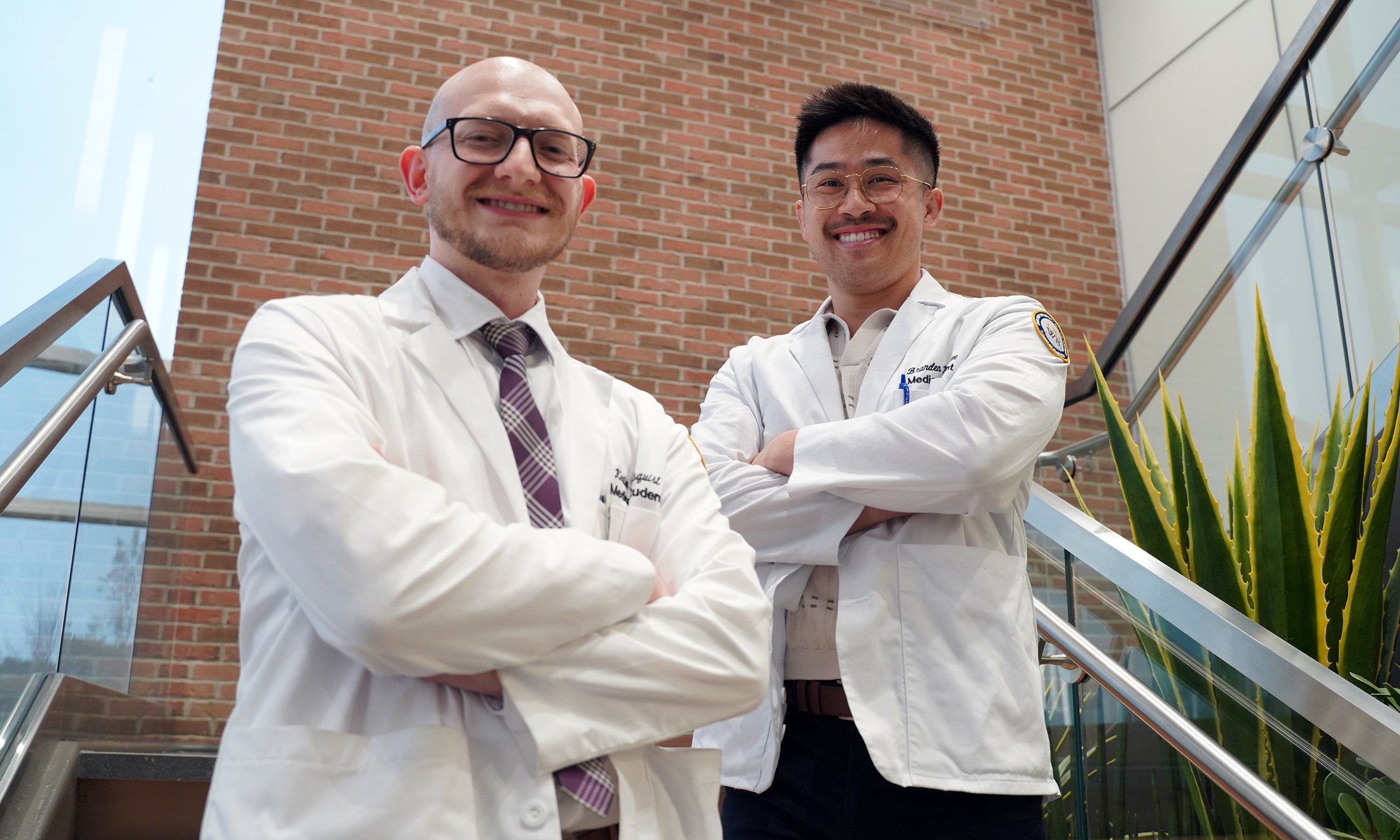
Keaton Rosquist (left) and Branden Lee
Student Success
 November 09, 2026
 By Andrew Dietderich
Two medical students from Oakland University William Beaumont School of Medicine were recently awarded Clinical Skills Training & Simulation Center (CSTSC) Awards for the 2025-26 academic year.
Keaton Rosquist was recognized for his clinical skills training as an M1 during OUWB’s Art and Practice of Medicine (APM) 1 and 2. He is now an M2.
Branden Lee, now an M3, received an award for skills demonstrated as an M2 during APM 3 and 4.
Each student received $1,000 as part of the recognition.
Jickssa Gemechu, Ph.D., associate professor, Department of Foundational Medical Studies, serves as chair of the Student Awards Committee.
“Recognizing outstanding performance in the clinical skills laboratories honors students who consistently demonstrate excellence in clinical best practices, exemplary professionalism, and exceptional achievement throughout the APM 1–4 courses,” he said.
“These awards also promote the continued development of essential clinical skills and reinforce the professional standards and competencies expected of future physicians,” he added.
The OUWB Clinical Skills Training & Simulation Center (CSTSC) is the primary site for learners to practice and perfect their patient skills in a realistic, state-of-the-art facility.
Located on the campus of Corewell Health Beaumont Troy Hospital, the CSTSC is home to 16 simulated patient rooms, separate student and patient assembly areas, classrooms, and video control and observation suites. The goal is to provide as realistic a clinical experience as possible in a welcoming environment.
For the CSTSC Awards, the awards committee relies on recommendations from course directors. The awards have been presented three times since they were first given out for the 2023-24 academic year.
‘Helping each other’
Rosquist grew up in Bluffdale, Utah, and attended Riverton High School. After serving a two-year church mission he attended community college and the University of Utah, where he graduated from in 2023 with a bachelor’s degree in biology.
His interest in medicine developed through his father’s chiropractic practice, exposure to occupational and physical therapy, and positive relationships with physicians.
Rosquist said he was drawn to OUWB by its curriculum, the tight-knit community, and the number of other students with ties to Utah. “Accessible and supportive” faculty and peers who collaborate rather than compete destructively have enabled him to thrive and find success at OUWB.
“We’re helping each other be better physicians and surpass our limitations,” he said. “The biggest impact has been having people around me who want me to be better and vice versa.”
That includes the success that led to the CSTSC Award.
“Being able to have that space where you can apply what you’ve learned is super helpful,” he said. “It allows me to review and receive feedback on things I do right and things I need to improve on.”
Rosquist said he is especially appreciative of the opportunities to interact with standardized patients, or trained professionals who act like real patients in a clinical setting.
“It gives you an opportunity to experience medicine and feel like you’re practicing,” he said. “It’s a nice reminder of why we are going into medicine.”
Lee grew up in Arcadia, California, and attended Arcadia High School.
He earned a bachelor’s degree in Biochemistry from University of California – San Diego.
As an undergraduate, Lee worked full-time an EMT where his job was primarily limited to transporting patients between hospitals.
With a desire to work closer with patients, Lee said he decided to pursue becoming a physician.
He chose OUWB for medical school due to its service-oriented culture and emphasis on medicine as a human-centered profession. His experiences at OUWB “have been great” and he said the school has given him many ways to grow as a physician.
Two big ways, he said, are through the clerkships he is currently experiencing as an M3 and before that, at OUWB’s CSTSC.
“It’s almost like a gym for your doctor skills,” Lee said of the CSTSC. “The first time you work those skills out there are going to be aches and pains and awkwardness that you would rather have at the (CSTSC) with a standardized patient rather than at the hospital with a real patient.”
Lee called it “a good training ground” and said it was humbling.
“There were a lot of moments where I would leave and feel like I could have done better and that helped a lot,” he said. “It was a safe environment to foster that feeling of constantly wanting to improve and have a space to improve.”
As an M3, Lee said he “definitely” can see a connection between those skills he practiced at the CSTSC and those he is now employing with real patients.
“I’m no expert by any means, but knowing what to look for has been very beneficial,” he said. “If there weren’t the opportunity to practice before treating patients, it would be a disservice to the community and for us.”
More from inMedicine