Learning never stops
Writing and Rhetoric professor connects with seniors through lectures and writing
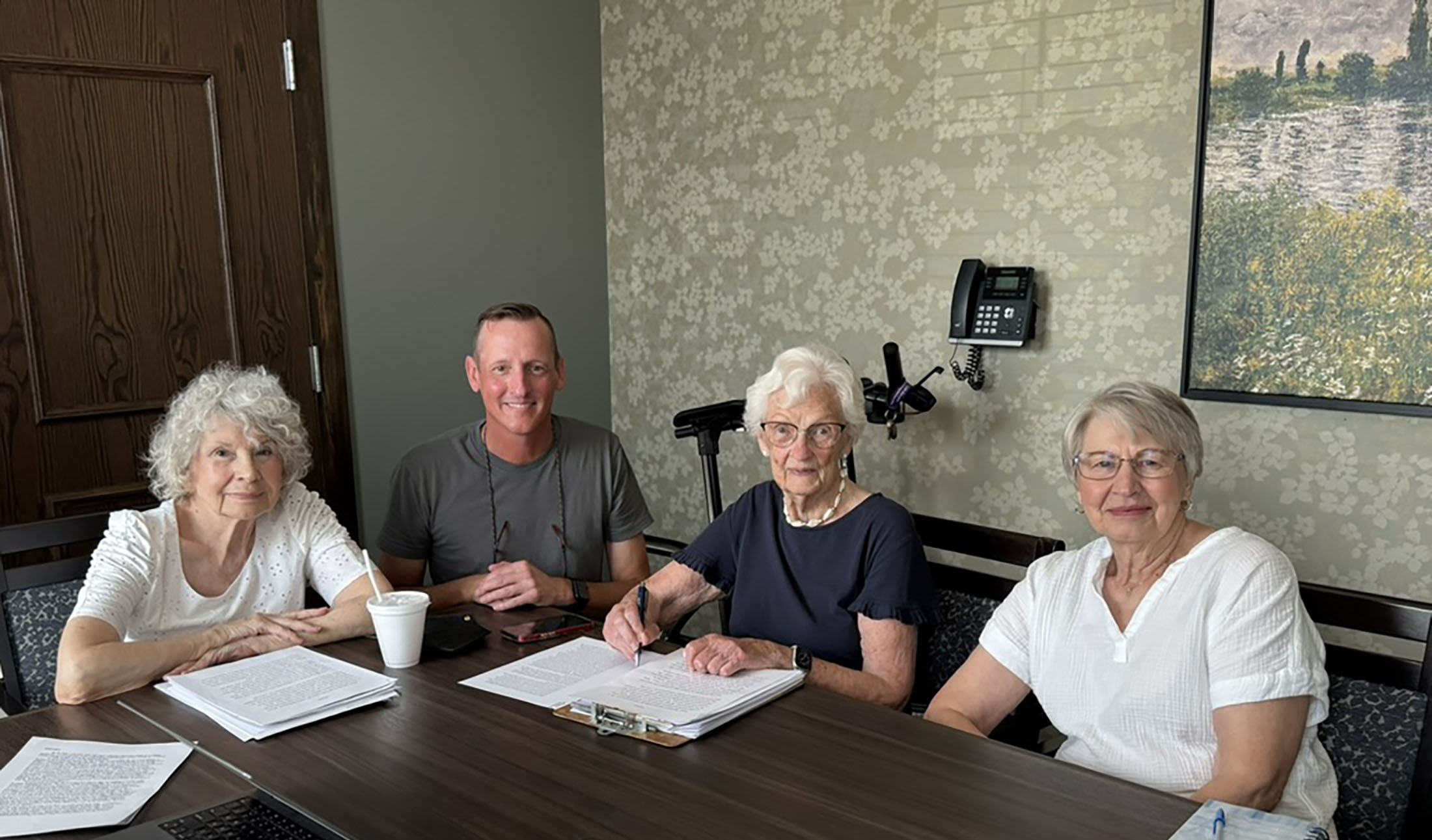
Professor of Writing and Rhetoric Greg Giberson poses for a photo with the three women who participated in his writing workshop at Pomeroy Senior Living Orion community.
 May 29, 2026
 By Dave Pemberton
Professor of Writing and Rhetoric Greg Giberson was looking for a project with a community engagement element, so when he began touring independent living facilities with his mother, he came up with the idea of hosting a creative nonfiction writing workshop at one of the facilities.
After a failed attempt at another facility, he, along with his mother and brother, toured The Pomeroy Senior Living Orion community. During their tour, he mentioned the workshop concept to the woman giving them the tour and was able to quickly gain some traction.
“I mentioned to the sales rep that I had this idea and by the time I left that day, I had talked to the director of the facility, and we had agreed that we were going to do something,” Giberson said. “The director at that time was also a writer, so she was interested and excited about the possibilities. I worked with her and the activities coordinator to organize, schedule and promote the workshop.”
Giberson’s first group consisted of three women living in the independent living community.
“We met weekly for about an hour and a half,” Giberson said. “I would assign short readings that we would discuss. I gave them writing prompts, and they would respond. I figured out quickly that I needed to take things slowly, as it took them a little bit longer to write. So, we started out with very short writing assignments like ‘Write two paragraphs about an important moment from your past.’ The stories that ended up coming from this workshop were just extraordinary.”
Giberson said the three women were between the ages of 78 and 98 years old.
“The memories and the experience that they brought to the table were just incredible,” Giberson said. “And as we were getting toward the end of those nine weeks, they basically told me that we couldn't stop, and that we had to do something more.”
Giberson had become aware that more people wanted to participate, but facilitating a voluntary writing workshop, and his own job at the same time, would be too difficult with a larger group.
“It takes a lot of time to read people's writing and respond to it effectively,” Giberson said. “I figured I probably couldn't do a writing workshop, but we could do a reading and discussion group that could bring more people in. The three ladies who were in the writing workshop wanted to expand it and get more people involved, because everybody was talking about it. They wouldn't let me go.”
Along with the workshop participants and staff at Pomeroy, Giberson worked to organize and promote the reading and discussion group. Starting in September 2025, the group met every other week to talk about two or three short pieces of creative nonfiction, typically drawing 8 to 12 participants.
“We discuss the readings, which are often thematic and connected in some way, and those discussions often lead to broader questions about things that are going on in the world or to the sharing of personal stories,” Giberson said. “Many of them are so willing and excited to share their own small moments and wisdoms. It’s been very inspiring. The fact that we’re reading ‘real’ stories helps them find connections to their lived experiences. So, we laugh, cry and learn together.”
The discussion group led to Giberson creating a lecture series where different experts from Oakland University’s faculty come in to lecture and lead discussions on a variety of topics.
“While I'm an expert in my field, they had so many questions that, while I have my own answers, I didn’t feel fully qualified to answer them. So, I wanted to bring in experts who could help them work through some of the things that they find confusing and challenging about the world we share,” Giberson said.
Pomeroy hosted the first lecture with OU Professor of Communication and Director of Women and Gender Studies Program Erin Meyers. Giberson said 18 people attended and that it was considered a huge hit with the residents.
“My understanding is that there was an ongoing discussion over meals and in the halls for a week or two after Erin’s lecture,” Giberson said. “There is a great deal of potential for improving the lives of the residents with this program, so I'm hoping that it continues to grow and perhaps expands to other facilities around the area. I have met with a representative of the COO of Pomeroy corporate office, and there certainly is interest there. Pomeroy also operates an independent living facility in Rochester, so making connections with that facility and its residents is one of our next steps.”
Giberson started talking to some of his colleagues at OU about the project. These discussions led him to Oakland University’s Center for Public Humanities (CPH), which was very interested in the program and invited him to join the CPH board.
“The Center for Public Humanities and Pomeroy Corporate are now sponsoring this work, helping to recruit potential lecturers, providing guidance and assistance on how to expand and improve on what we’ve been doing at Pomeroy Orion, and promoting the guest lecture series,” Giberson said. “This is becoming more of a program now, instead of me just winging it, which was my hope all along.
“I'm really appreciative of CPH and their support because I started this without a real plan,” Giberson added. “Then, as it's grown and evolved, I've had to kind of figure things out on my own. But CPH is really excited about what I'm doing. They're helping me come up with a lot of ideas about what might be possible. They are a great group of people.”
Giberson said he’s also considering turning this into a research project based on conversations he’s had with other board members.
“At first, I didn't really think of it as a research project, but now that I see the potential and how it's growing, I'm likely going to be submitting a proposal for a paper for a national conference next year to talk about this work. Just bringing more minds together has been very helpful,” Giberson said.
Giberson said he really enjoys the fact that the residents challenge him and that he learns so much from the discussions.
“They tell me how stifled they feel where they are, like no one listens to them, and no one talks to them about the world, and they're curious,” Giberson said. “They want to learn more about the world. They know it's very different now than it was when they were growing up, and they find a lot of it confusing. What I really enjoy is how open they are to having difficult discussions about issues that can be uncomfortable. I learned so much about their personal histories and how they’ve experienced our changing world. It's really rewarding because I can see how much they enjoy what we are doing together, and how much we all get from it.
“They tell me almost every session that this experience has been one of the best things that's happened since they've been living there, because it's real. We talk about real things.” Giberson added. “We engage with intellectually and emotionally challenging topics. Having the opportunity to work through those things with them is very inspiring and keeps me motivated to continue this important community-based work.”
The mission of the Center for Public Humanities is to cultivate social connections and civic engagement within Southeast Michigan.