
Community Engagement|
 October 20, 2025
 By Amy Ritt
A Lesson in Service Learning
Opportunities for experience-based learning at OU benefit students and communities alike


Robert Hall
"The community service emphasis in the Bachelor of Interdisciplinary Studies program allows us to see first-hand the effect of interdisciplinary thinking in the real world, tying what we have learned into a constructive experience,” says Mary Cleveland-Hutchison, Bachelor of Interdisciplinary Studies major and business minor.
Service-learning courses, such as the Bachelor of Interdisciplinary Studies (BIS) 3000 class, play an important role among OU’s offerings for experience-based learning. The flexible nature of the BIS degree program, which empowers students to customize their plan of study by integrating coursework from multiple disciplines, lends itself to creative community collaborations. Although required for BIS majors, the BIS 3000 class is open to all students.
“It’s a true privilege to be part of a program that extends learning beyond the classroom — using our knowledge and talents to make a meaningful impact on the communities around us,” says Lindsay M. Zeig, Ed.D., BIS special lecturer.
 |
|---|
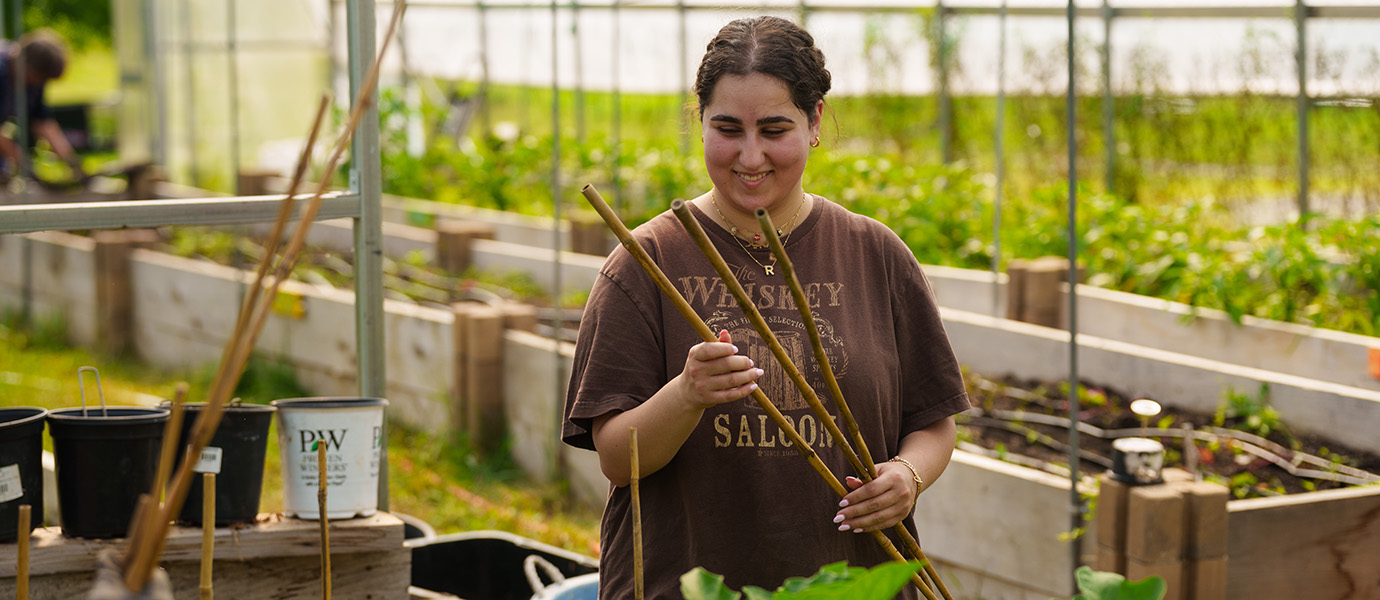
| “The BIS program allows you to see things from different perspectives. In my presentation [for this project], I outlined that the farm has an emphasis on sustainability — making sure access to organic food is available for the community — as well as nutrition and community engagement,” says student Angela Jaro, major in interdisciplinary studies with dual minors in criminal justice and cybersecurity analytics and management. |
The Role of Service Learning
“The BIS 3000 course helps to introduce interdisciplinary theories that students may not have encountered before, and it helps them synthesize their various interests,” says Jennifer Cordon Thor, J.D., BIS director and professor at OU. “We also wanted to incorporate a civic engagement aspect into the class because it’s so important to give back.”
 |
|---|
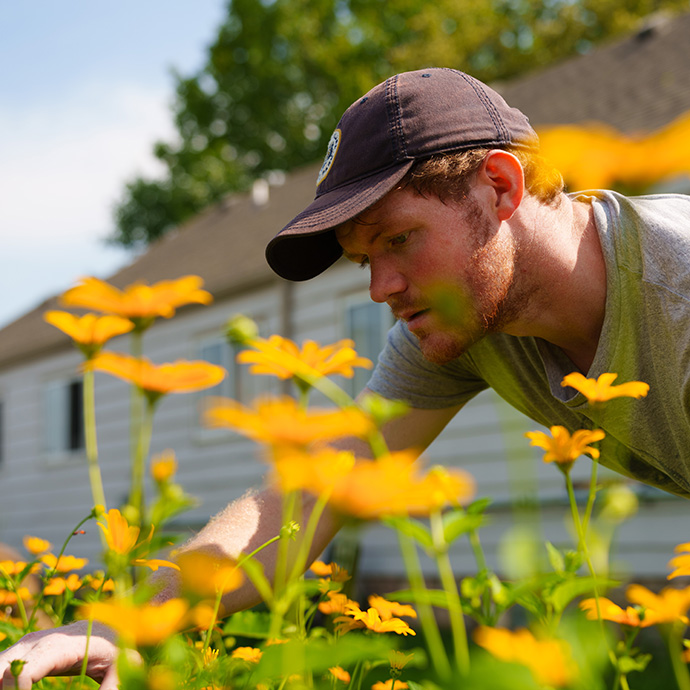
| BIS student Griffin Seifert volunteers with fellow BIS 3000 classmates at the OU Student Organic Farm. |
Thor says that the community component can be traced back to OU’s founding, when Matilda Dodge Wilson and Alfred Wilson donated their 1,400-acre estate, its buildings and $2 million in 1957 to establish Michigan State University-Oakland (now Oakland University). “Matilda Dodge Wilson was a person who was civically engaged and also gave back,” Thor continues. “Although not necessarily trained in higher education leadership, Matilda came from a varied background and used an interdisciplinary approach to help solve a problem in Michigan higher education by donating land that would become Oakland University.”
BIS 3000 students go beyond “just” volunteering with community nonprofits. Students collaborate with the organizations to identify a complex problem; connect with community members to address the problem; analyze methods to identify how an interdisciplinary approach can be used; and reflect on the improvements. “Using an interdisciplinary approach to solve community problems is a way to reinforce with students that they can help their communities with their BIS degree,” Thor says.
Combining Community and Career
OU students enrolled in BIS 3000 report that their experience positively affects their career aspirations as well as the organizations that they serve. As part of his service-learning project for BIS 3000, senior BIS major Michael Dotson-Branch volunteered at Make Food Not Waste, a nonprofit that addresses issues of food insecurity and food waste.
 |
|---|
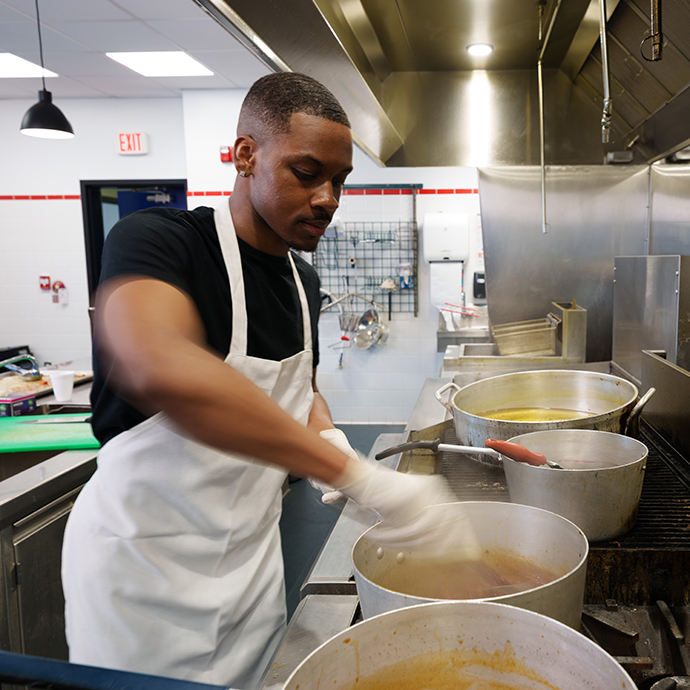
| Michael Dotson-Branch, BIS major, volunteering at Make Food Not Waste in Detroit. |
“This experience showed me how multiple disciplines can become integrated in civic work,” Dotson-Branch says. “I related two disciplines to my experience at Make Food Not Waste and described how they related to the issue that the organization works to solve. The experience left me feeling a deep sense of community as I assisted the members of the organization by distributing groceries, cooked meals and hygiene products to the people who had gathered to receive them.”
“I witnessed how impactful my efforts were to the people this organization serves in the community,” Dotson-Branch continues. “This volunteer experience inspired me to someday find a way to use my disciplines of science and nursing to provide service to the community.”
BIS student Aya Almaoued’s service-learning experience echoes that of Dotson-Branch in that it strengthened her resolve to make a difference. Almaoued completed her service-learning project at the Gary Burnstein Community Health Clinic in Pontiac, where her primary duties involved scribing for physicians during patient visits and assisting in the clinic’s pharmacy.
“Through this experience, I had the opportunity to support both the medical and pharmaceutical teams by providing free, high-quality health care to uninsured and underserved individuals,” Almaoued says. “Volunteering at the clinic was deeply meaningful to me. It opened my eyes to the challenges that many people face and strengthened my passion for medicine. This experience affirmed my commitment to becoming a physician who advocates for accessible and equitable health care for all,” she says.
Making a Mutually Beneficial Impact
 |
|---|
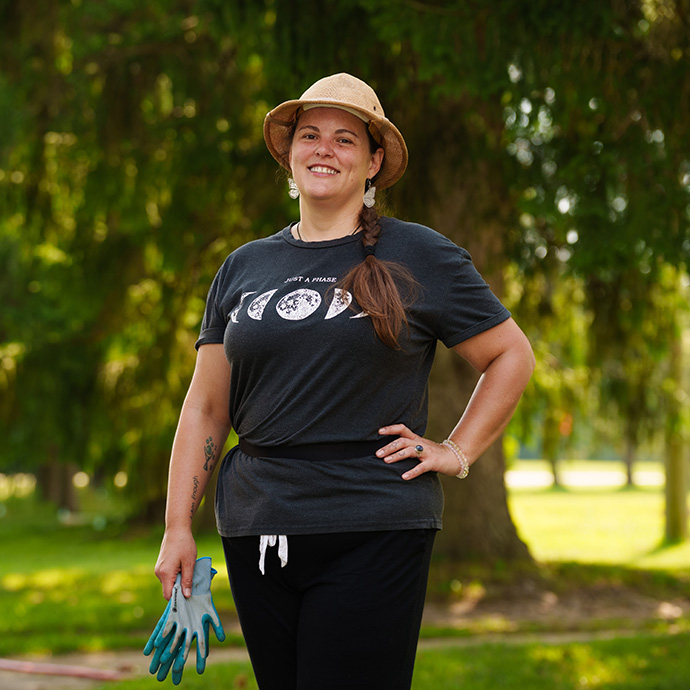
| "The community service emphasis in the Bachelor of Integrative Studies program allows us to see first-hand the effect of interdisciplinary thinking in the real world, tying what we have learned into a constructive experience,” says Mary Cleveland-Hutchison, Bachelor of Interdisciplinary Studies major and business minor. |
While BIS 3000 students gain valuable insight from their interdisciplinary coursework and hands-on experiences, the organizations benefit as well. “The feedback that we get from the organizations is that they are very happy when they see that an OU student wants to come and be a part of their program through our service-learning courses,” Thor says. “Our faculty will also sometimes get inquiries when organizations have a project coming up and seek out the participation of OU students.”
BIS 3000 students performing their service-learning projects often encounter OU alumni who volunteer with or run the organization, which facilitates networking opportunities. No matter the project, BIS 3000 students have the flexibility to tailor their experiences to their specific majors.
“Service-learning courses are a great way to give back to the community — and it also helps our students to see the impact that OU has on our community,” Thor says. With such positive results, OU students will undoubtedly continue to make their mark in the classroom, in the community and beyond.
“It’s a true privilege to be part of a program that extends learning beyond the classroom — using our knowledge and talents to make a meaningful impact on the communities around us.”
Lindsay M. Zeig, Ed.D., BIS special lecturer
Robert Hall
MORE LIKE THIS |


©2025 Oakland University William Beaumont School of Medicine✎