'A very big deal'
OUWB professor secures competitive $3M NIH renewal for multi-university stroke research project
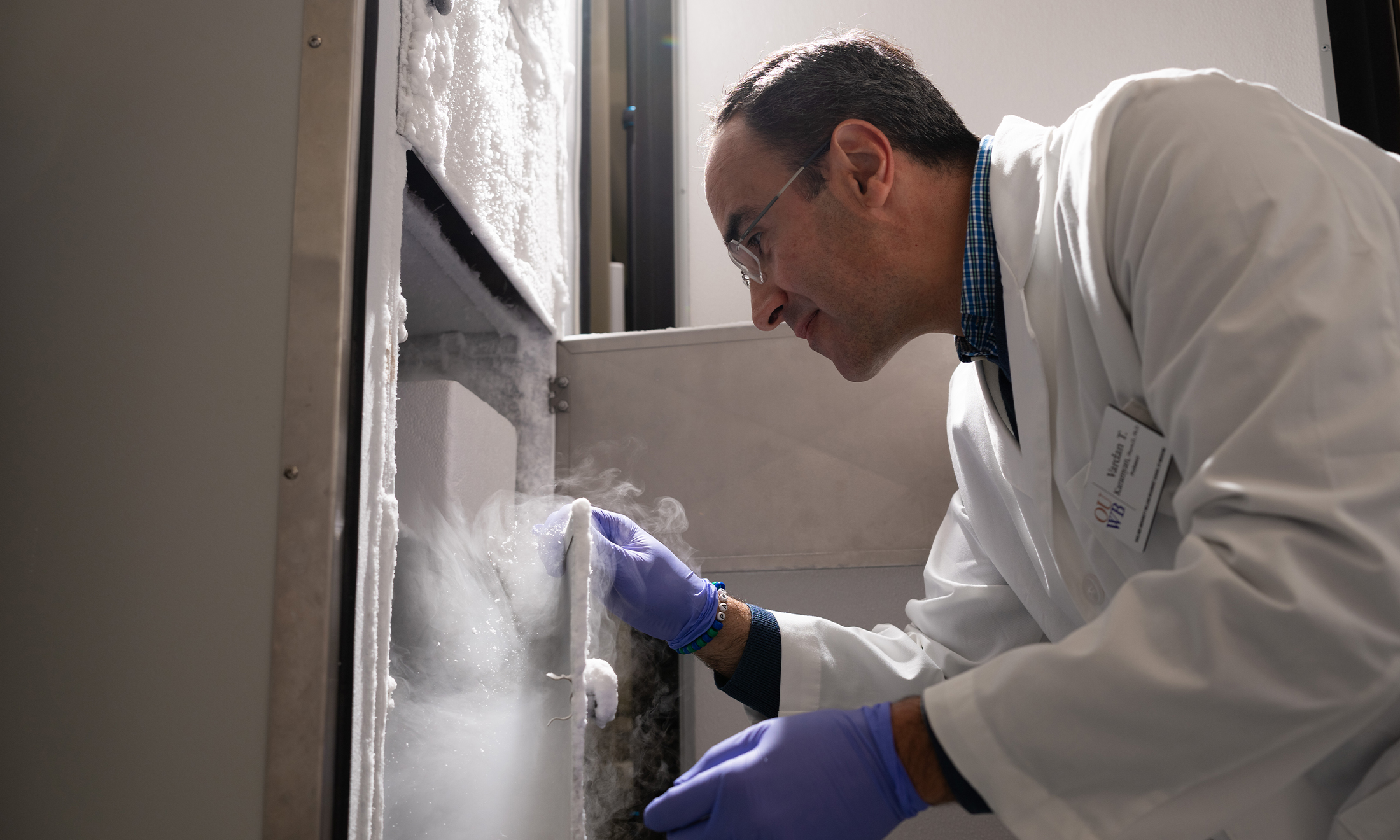
Vardan Karamyan, Pharm.D., professor, Department of Foundational Medical Studies and the OUWB Laboratory for Neurodegenerative Disease and Drug Discovery, is principal investigator on the project that also includes researchers from Texas Tech University, University of Nebraska, and Michigan State University.
Research
 March 20, 2026
 By Andrew Dietderich
An OUWB professor has been awarded a $3 million, five-year competitive grant to continue research on what could be a groundbreaking therapeutic approach to treating stroke.
Vardan Karamyan, Pharm.D., professor, Department of Foundational Medical Studies and the OUWB Laboratory for Neurodegenerative Disease and Drug Discovery, is principal investigator on the project that also includes researchers from Texas Tech University, University of Nebraska, and Michigan State University.
The $3 million National Institutes of Health (NIH) grant was awarded Sept. 1. It was a competitive renewal of a previous grant.
Currently in the preclinical research stage, the hope is to develop a new drug that could be administered to patients following ischemic stroke — the top cause of adult disability, according to the American Brain Foundation.
“If proven in future clinical trials, it would essentially be the second drug available to treat stroke in the United States,” says Karamyan. “This would be very impactful.”
“But the research is also high risk with a lot of unknowns,” he adds.
‘OUWB was a good opportunity’
Karamyan earned a Pharm.D. in 2000 from Yerevan State Medical University. Four years later, he earned a Ph.D. in biology from the Institute of Biochemistry, National Academy of Sciences of Armenia.
After completing postdoctoral training in pharmacology at the University of Mississippi, Karamyan joined the Department of Pharmaceutical Sciences, School of Pharmacy at Texas Tech University Health Sciences Center (TTUHSC), as a tenure-track assistant professor in 2008.
He advanced through the ranks to become a full professor and vice chair of the Pharmaceutical Sciences Department before joining OUWB in 2022.
“OUWB was a good opportunity to contribute to the future of a relatively new school,” says Karamyan.
Since joining OUWB, Karamyan has built a state-of-the-art lab in Oakland University’s Dodge Hall. He also recruited graduate students and postdoctoral researchers to help continue the work started by the team of researchers Karamyan was part
of at TTUHSC.
That work officially began in 2018, when the National Institute of Neurological Disorders and Stroke (NINDS) at the NIH awarded the project a five-year, $2.9 million R01 grant.
The project: “Development and Characterization of Peptidomimetic Small Molecule Activators of Peptidase Neurolysin for Stroke Therapy.”
The goal: reduce mortality and disability associated with stroke.
“Stroke is a devastating disease … at least half of the patients who survive a stroke are left with lifelong disabilities,” says Karamyan.
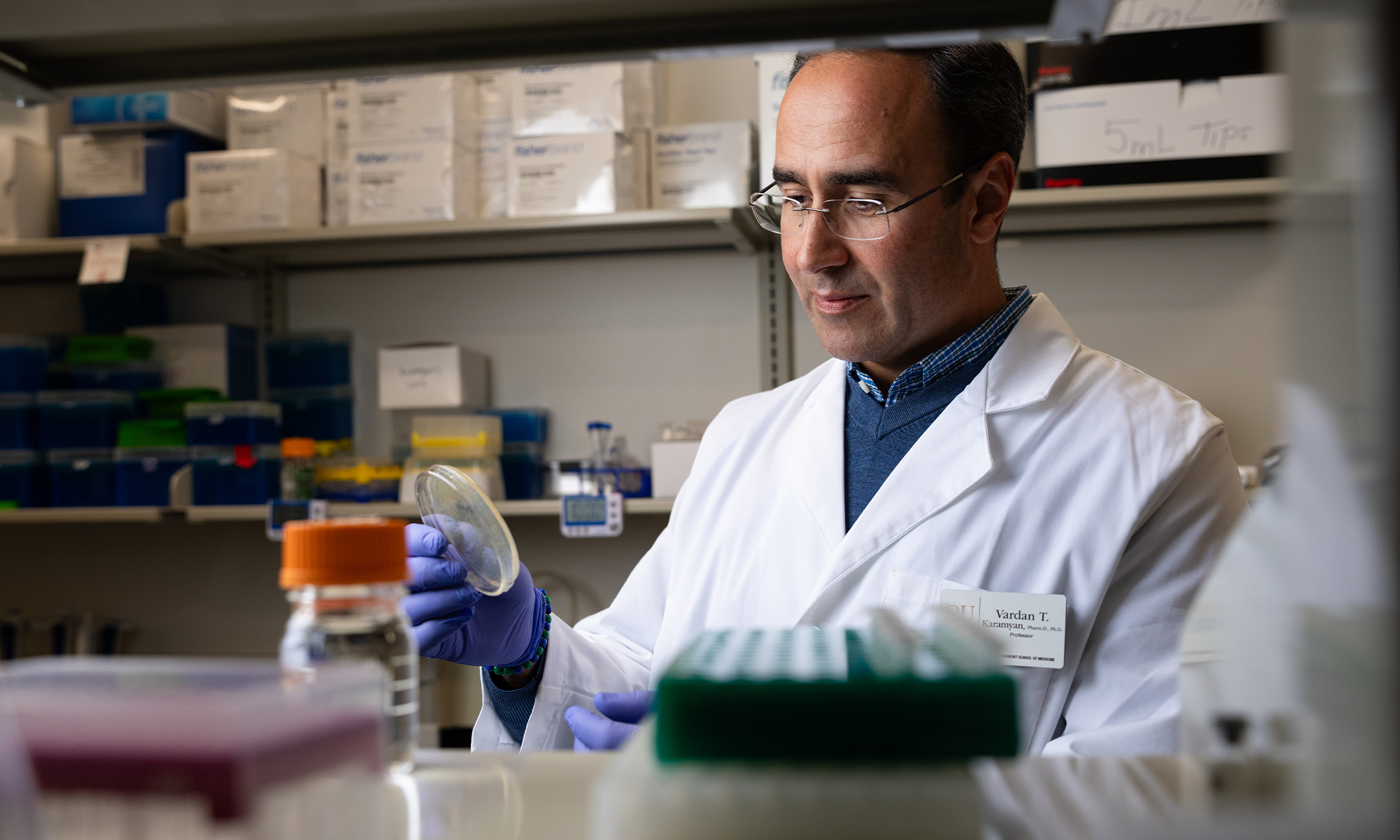 Because of COVID-19 and other factors, Karamyan’s team was able to extend the 2018 grant from five to seven years. Because of COVID-19 and other factors, Karamyan’s team was able to extend the 2018 grant from five to seven years. |
|---|
Because of COVID-19 and other factors, Karamyan’s team was able to extend the 2018 grant from five to seven years. Already, the project has produced 29 experimental, conceptual, and review publications, and two patents.
“When I came to OUWB, it was near the end of the first five-year period for this grant and it was my No. 1 priority to prepare for the competitive renewal,” he says.
“My team was able to convince the reviewers and the NIH that the research is valuable and strong enough to continue another five
years of funding.”
The renewal grant is called “Development and Characterization of Small Molecule Activators of Peptidase Neurolysin for Stroke Therapy.”
Promising research
Years of research led by Karamyan has provided greater understanding of the role of peptidase neurolysin in the event of a stroke. Neurolysin is an enzyme that functions as a “multi-mechanism” shield, simultaneously inactivating neurotoxic peptides while generating cerebroprotective ones.
In short, enhancing neurolysin activity protects the brain, and Karamyan’s team is working to develop a drug-like compound that aims to activate the enzyme.
“We’re trying to develop a molecule that an individual would take like they do any other drug, (such as) aspirin,” says Karamyan. “It would get to the brain and enhance the activity of this enzyme.”
The first grant allowed for Karamyan’s team to identify “first-in-class” drug-like substances that have been demonstrated to pass into the brain and reduce brain tissue damage in animal models of stroke.
The next phase is focused on optimizing the compounds into potent drug-like molecules and using cutting-edge technologies to elucidate the mechanisms of neurolysin activation.
To get to that point, Karamyan says the research team has several goals. They want to find the right compound that binds to the target enzyme in the brain and activates it. They also want to determine what candidate molecules are stable in the body, determine if they are reaching the brain, ensure they are not toxic, and determine if they have good pharmaceutical properties. They also are studying when the drug can be administered and the proper dosage.
So far, most of the research has been in vitro but in vivo testing is now helping the team better understand the efficacy of various compounds — specifically, if they are helping animals survive stroke and suffer less impairment. They’re also developing an artificial intelligence-based tool to quantify recovery more efficiently.
Researchers from across the country are involved too.
Chemists from Nebraska work with molecules and refining compounds. Those that seem most promising are evaluated by TTUHSC researchers who study pharmaceutical properties. Concurrently, researchers at Michigan State further evaluate the interaction between the compounds and enzymes at a molecular level. Karamyan’s lab guides and interconnects all these research groups from in vitro and in vivo testing of the new molecules to detailed molecular studies to meet the aims of the grant.
If successful, the right compound could advance the research toward later-stage preclinical work and, eventually, clinical trials in humans.
Realistic and cautious
For all the promises of the work, Karamyan generally remains realistic and cautious when it comes to predicting success.
One challenge, says Karamyan, is that in the field of biomedical research, projects considered “high risk” aren’t always welcomed.
Second, the field of enzyme activation is in its infancy. According to Karamyan, “very little” is known about enhancing enzyme activity, while much is known about inhibiting it. (Ibuprofen is an example of an enzyme inhibitor.)
Also, Karamyan says the research faces the challenge of recruiting motivated students, postdoctoral researchers, and staff to do the demanding experiments.
Still, Karamyan smiles when he considers the potential of the research.
That’s because it could not only lead to a new drug that saves lives and reduces disability but also yield other positive outcomes. Those include training new scientists, building OUWB’s research profile, and changing the fundamental understanding of how to essentially turn
on enzymes.
Richard Kennedy, Ph.D., associate dean, Research, OUWB, says it’s extremely promising for many reasons.
“Based on previous data, I am confident that clinical studies will subsequently be instituted to determine if the agents can ultimately limit the death and disability resulting from stroke in patients,” says Kennedy.
Kennedy adds that OUWB is “very fortunate” to have Karamyan be part of a strategic plan that includes neuroscience as a focus of future research growth and development of a sustainable, externally funded, and nationally recognized program.
“The impact of his research on stroke survival and recovery will increase OUWB’s recognition as a school committed to creating new knowledge to improve the health of patients in Michigan, U.S., and beyond,” says Kennedy.
More from inMedicine