Faircloth Evening of Medical Humanism
Empathy and compassion featured at OUWB, SEHS event that included induction of 19 into Gold Humanism Honor Society
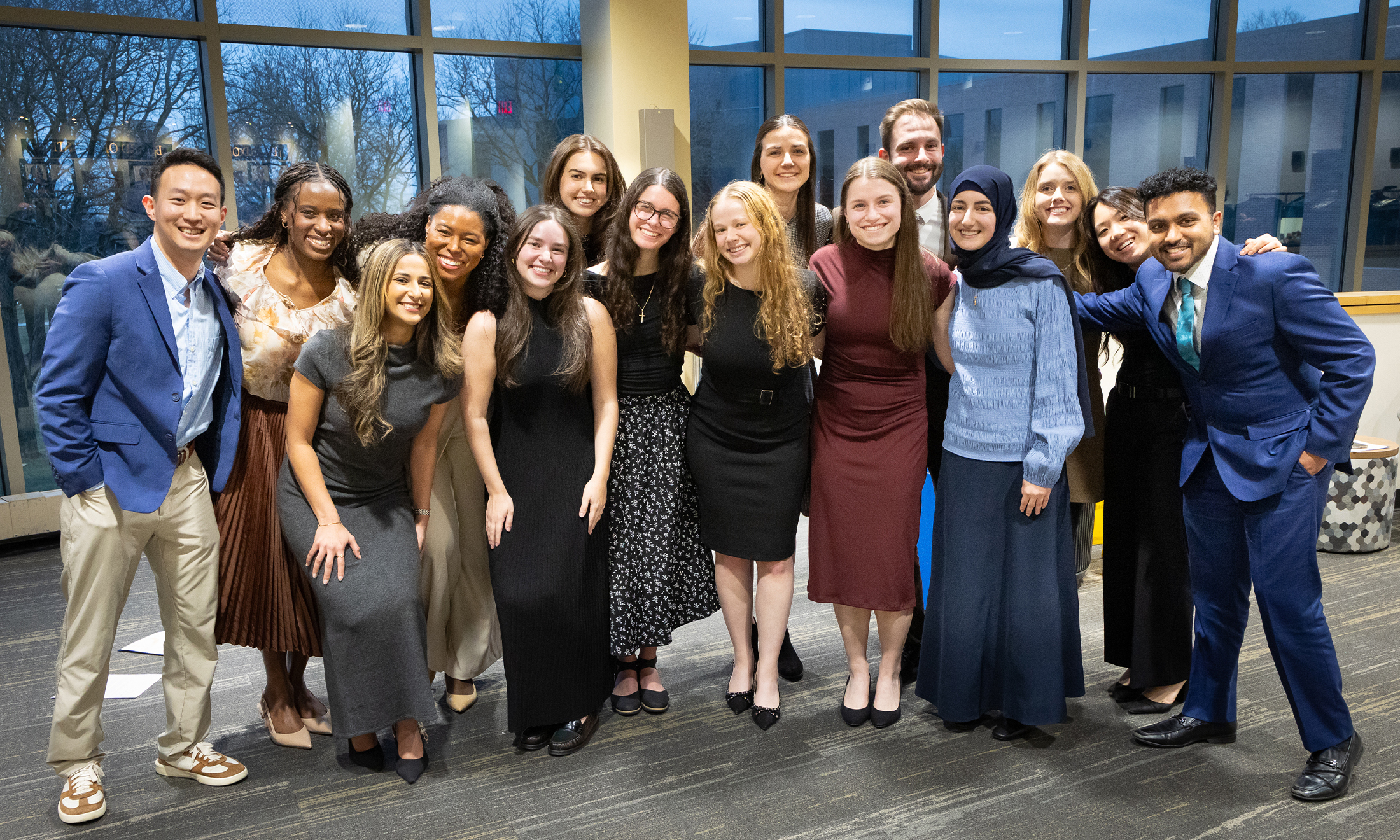
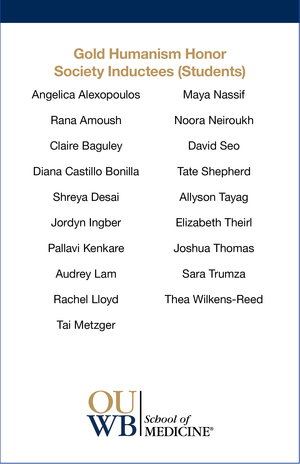
OUWB third-year medical student inducted into the Gold Humanism Honor Society in 2026. (See box below for full list of names.)
Events
 March 20, 2026
 By Andrew Dietderich
Humanism in medicine took center stage at a recent event co-hosted by Oakland University William Beaumont School of Medicine (OUWB) and Oakland University School of Education and Human Services (SEHS) Department of Counseling.
The Faircloth Evening of Medical Humanism took place March 18 in Oakland University’s Oakland Center.
It featured the induction of 19 third-year medical students into The Arnold P. Gold Foundation Gold Humanism Honor Society (GHHS), as well as several awards given to both medical and counseling students.
The keynote speaker was Rachel Wood, Ph.D., founder, AI Mental Health Collective, who presented “Irreplaceable: The Power of Human Presence.”
Christopher Carpenter, M.D., Stephan Sharf Dean, OUWB, welcomed everyone by highlighting the longstanding collaboration on the event by the schools, and emphasizing the importance its theme.
“In a world where AI continues to evolve, I believe it’s even more important for us to be here tonight to recognize humanism,” he said. “It’s my privilege to be here to celebrate OUWB’s partnership with the School of Education and Human Services Department of Counseling, and or joint commitment to humanism in medicine.”
Event coordinator was Steven Joseph, M.D., an emergency medicine physician, and assistant professor, Department of Emergency Medicine.
“This lecture and event were forged out of a union between (OUWB) and (SEHS) in an effort to honor counseling and medical students who have exemplified empathic care for their patients,” he said. “Empathic care to me means, among other things, focusing on the human being in front of you and seeing them as a person and not a disease.”
“As we enter and quickly careen into an era of AI, it can be harder and harder to delineate between what’s human and what’s artificial, but recognizing the difference is paramount to providing compassionate care for our patients going forward.”
History, induction, and awards
 |
|---|
The event’s namesake is Patrick Faircloth, Ph.D., an Oakland University alumnus, who created an endowment for OUWB and SEHS.
Carpenter explained to attendees that Faircloth “established this endowment after his experiences with medicine toward the end of his father’s life.”
“Those experiences led him to believe that medical experts would benefit greatly from learning to strengthen their communication and interpersonal skills,” he added.
He said the evening is dedicated to that realization.
“Therefore, it’s fitting that we recognize the ongoing success of our collaboration with this award ceremony that included induction of OUWB third-year medical students … into the Gold Humanism Honor Society,” he said.
GHHS is a community of medical students, resident physicians, and faculty who practice compassionate patient care and who have been recognized as role models, mentors, and leaders in medicine. Inductees from OUWB often go on to land residencies at programs affiliated with the likes of Johns Hopkins University, Brown University, University of Texas MD Anderson Cancer Center, and more.
Inductees are nominated by their peers. For this year, members of OUWB’s Class of 2027 were asked to nominate those they felt demonstrated values of humanism in health care with a strong focus on compassion, empathy, teamwork, accountability, inclusivity, and commitment towards service.
Of those nominated, 30% were asked to submit a personal statement on what humanism means to them along with a letter of recommendation from a clinical faculty member who could speak to each nominee’s clinical skills and commitment to community.
Finally, of those who submitted the requisite materials, half — or 19 — were chosen for induction by the OUWB GHHS executive board.
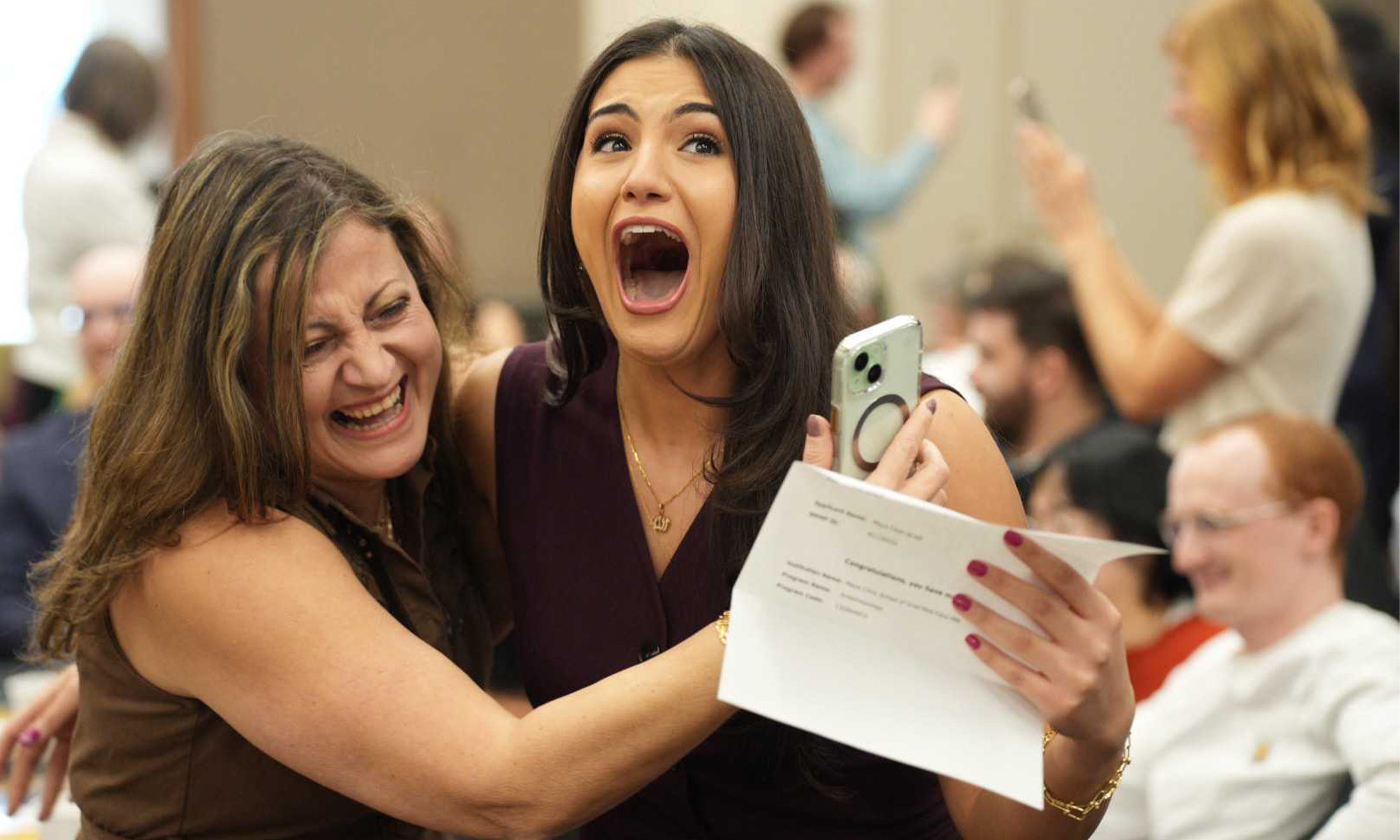
M3 Joshua Thomas was among the inductees.
“I’m super grateful for those who nominated me,” he said. “It speaks to years of commitment to service and the community and just finding ways to be a better person and help those around me be better. I’m looking forward to what’s ahead.”
Thea Wilkens-Reed, M3, called her induction “such an honor and truly a blessing.”
“It was nice having a night that honors and recognizes such a vital and crucial aspect of medicine that people don’t always think about but that patients crave,” she said. “When we’re able to deliver it and really emphasize that part of care … it’s really special.”
In addition to recognizing the GHHS inductees, Chi Sigma Iota, Theta Chapter Awards were given to several SEHS Department of Counseling Students along with the Leonard Tow Humanism in Medicine Awards. The two Tow recipients were OUWB M4 Ryan Victor-Joseph and Bassel Salman, M.D., assistant professor, Department of Pediatrics, and PRISM mentor.
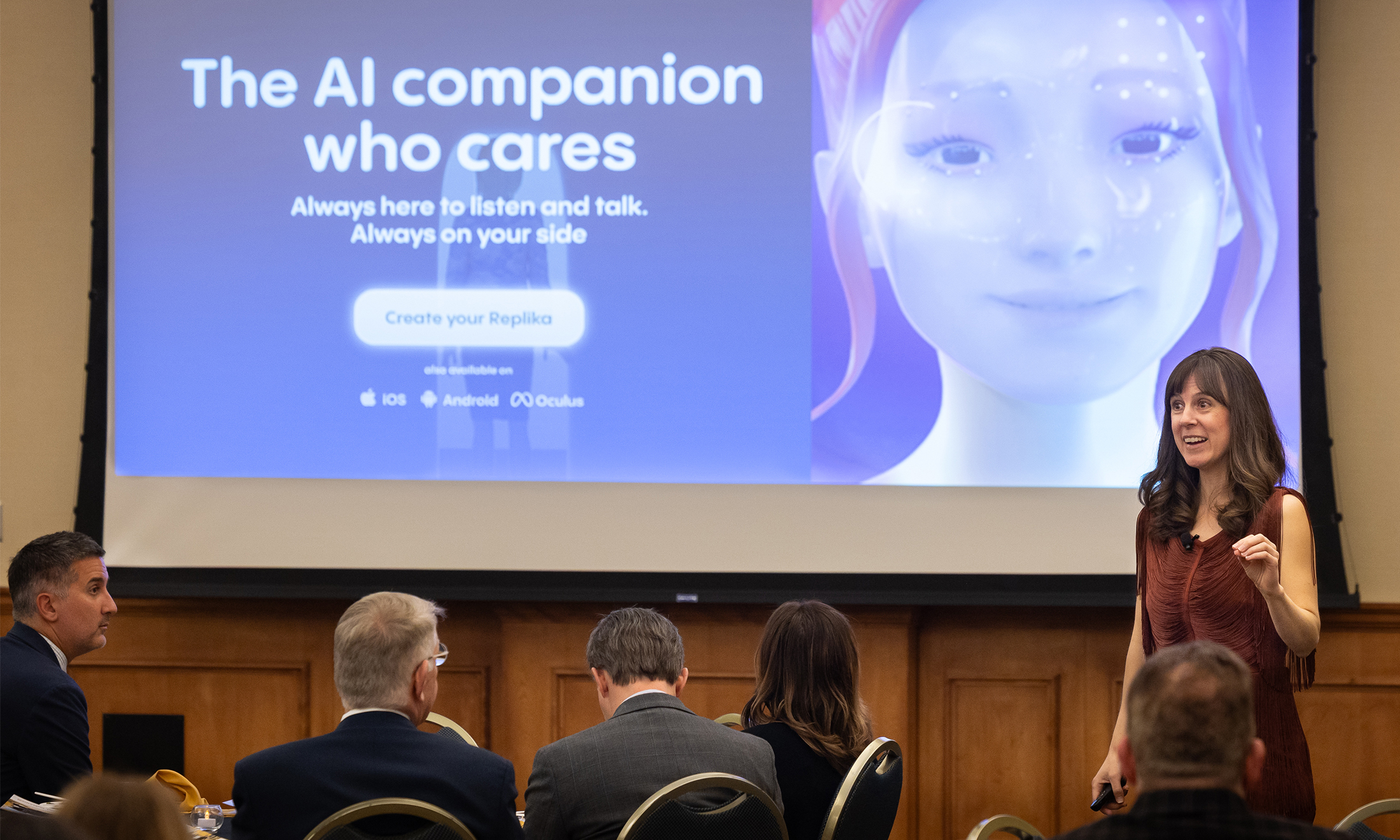 “(Mortality” is what drives you to do what you do, because life is but a breath,” said Rachel Woods. “(Mortality” is what drives you to do what you do, because life is but a breath,” said Rachel Woods. |
|---|
Why AI won’t replace humans
Wood holds a Ph.D. in cyberpsychology with expertise at the intersection of AI and mental health. She is founder of the AI Mental Health Collective.
The core theme of her presentation explored why human clinicians and caregivers are irreplaceable in the age of AI. She focused on three areas to make the point.
First, she said, humans are masters of content. Humans can “read the room” and feel its emotional tone. Humans also can integrate biopsychosocial history, family systems, and life circumstances to see a whole person and not just isolated data points.
Second, humans offer “knowledge plus experience.” In short, she said, AI can have vast knowledge, but no lived experience, no suffering, no embodied life, and therefore no true empathy.
The last major differentiator between humans and AI, she said, is that humans are mortal. Because AI will never face death, it will never have true purpose, meaning, or existential stakes.
“(Mortality” is what drives you to do what you do, because life is but a breath,” she said.
Separate from her presentation, Wood said that it made sense for her to talk to the Faircloth audience specifically about why humans in medicine are irreplaceable.
“What’s so unique and special about this group is how they already are leaned into empathy, compassion, and humanism to a really excellent level,” she said. “Those things they’re already doing make them irreplaceable … there’s no robot or AI that can come in and do what they’re doing.”
More from inMedicine