Fighting for memories
Psychology student dedicated to Alzheimer’s advocacy and research
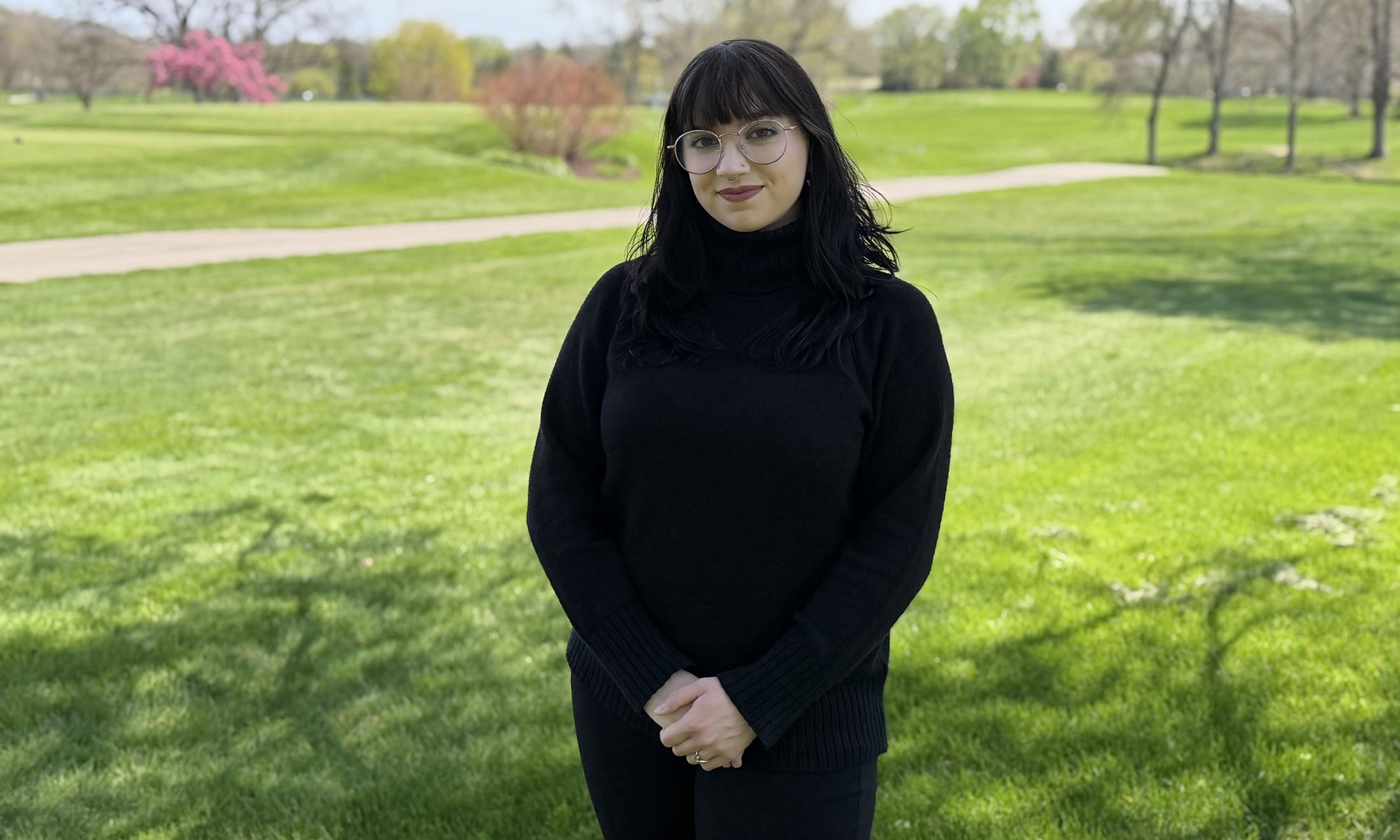
Sophia Vecchi has been advocating with the Alzheimer’s Association since she was 15. She has worked on several research projects related to Alzheimer's disease during her time at Oakland and was recently awarded the College of Arts and Sciences Meritorious Achievement Award.
 May 29, 2026
 By Dave Pemberton
Sophia Vecchi enrolled at Oakland University to study psychology because she is passionate about helping people with Alzheimer’s disease. Her grandfather was diagnosed shortly after she was born and passed away when she was 11, so the cause is very personal for her.
Vecchi’s passion for helping those with Alzheimer’s never wavered, but her approach evolved during her time at Oakland.
She began to get involved with research which opened up a new world of possibilities to her.
“I really grew up understanding the disease, witnessing the progression of it and how it can affect the people around that loved one,” Vecchi said. “That was really the driving force for my interest in psychology.
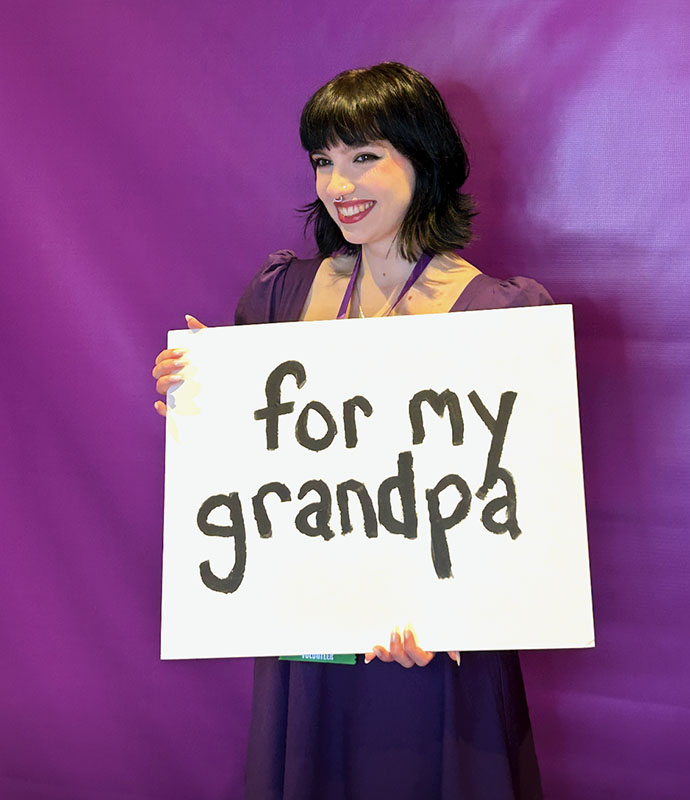
“When I got into college, I went into psychology because I wanted to be a therapist for older individuals and their families,” Vecchi added. “But then in order to get into grad school, I knew I had to do some research work. And so I started to do a little bit, and I really fell in love with it.That's when I realized that I could research Alzheimer's disease and really make a difference in that realm. From there, I started to get involved in labs on campus.”
Vecchi started working with Professor of Psychology Martha Escobar and Associate Professor of Psychology Andrea Kozak on research projects they had already started.
“I have been working on a systematic review about mobile treatments for weight loss,” Kozak said. “Sophia agreed to join the project. She did an excellent job closely examining research articles to make a determination for inclusion or exclusion from the review. I also asked her to assist me in synthesizing and writing up the results. It has been such a delight working with her. It is important to highlight that Sophia is the only undergraduate student working on a project that is primarily being conducted by professors and graduate students.”
Once Vecchi gained some research experience, she wanted to do research related to her passion: Alzheimer’s disease. Vecchi started working on a project she created in Escobar’s lab.
“I don't think OU has ever really conducted an Alzheimer's research study,” Vecchi said. “My professor has never really touched on that much in her research, but as soon as I said, ‘I want to somehow incorporate Alzheimer's disease and dementia,’ she was like, 'Perfect. Let's do it.’ There was no pushback. She was so excited that I had an idea that I was passionate about.”
Vecchi turned the research into her Honors College thesis: “Emotional Learning in Older Adults with and without Alzheimer’s Disease.”
“Sophia’s Honor thesis project explores cognition in older adults. More specifically, it explores whether older adults experiencing memory difficulties have intact emotional memory,” Escobar said.
Her efforts were recognized by the Midwestern chapter of Psi Chi (the International Honor Society in Psychology), and she received an award for her study at the Midwestern Psychological Association’s annual meeting in 2025. She also presented her study at the Alzheimer’s Association International Conference in Toronto in 2025.
“Oakland University has a great research culture that I really appreciate,” Vecchi said. “You can get very close to your mentors and learn a lot firsthand. At OU, I can literally take a study from the very first step of thinking of a research question all the way through to the very end of writing that article and getting it published. And that's not the experience that a lot of people get at other schools.
“Oakland’s research labs are always very welcoming,” Vecchi said. “You have the opportunity to really take an idea and run with it, and do what you want. Whereas at a lot of other schools, they care more about more publications and names on the study. At OU, it's more focused on learning to produce really high-quality research, and it really allows students to be creative and study what they want to.”
Once Vecchi had experience doing research at OU, she expanded her research to projects at both Wayne State University and the University of Michigan.
“Sophia’s long-term goal is to pursue a degree in neuropsychology; specifically focused on age-related neurodegeneration,” Escobar said. “Although this is not one of the areas of primary expertise in OU's Department of Psychology, Sophia understands that learning is not only about the classroom experiences and is not limited to what Oakland University can offer. She has used her Oakland experiences as a launching pad, reaching out to nearby institutions and volunteering as a student researcher for teams currently exploring neurodegenerative disease.
“Over the past year, Sophia has been working as a research assistant in Dr. John Woodard’s Alzheimer’s Neuropsychology Laboratory at Wayne State University and in Dr. Annalise Rahman-Filipak’s Cognition and Neuromodulation-Based Interventions Laboratory at the University of Michigan,” Escobar added. "Both laboratories have progressively assigned responsibilities to Sophia, who consistently shows the quality and work ethic that characterize Oakland students.”
Vecchi also works at Bellbrook Senior Living Facility. She works as a receptionist, but also runs activities and spends time with the residents.
“She sought employment at the Bellbrook Senior Living Facility, where she has transitioned from receptionist to activity coordinator,” Escobar said. “In this role, Sophia not only develops the calendar of activities for the facility, but also creates the educational materials used to provide cognitive stimulation for the facility residents.”
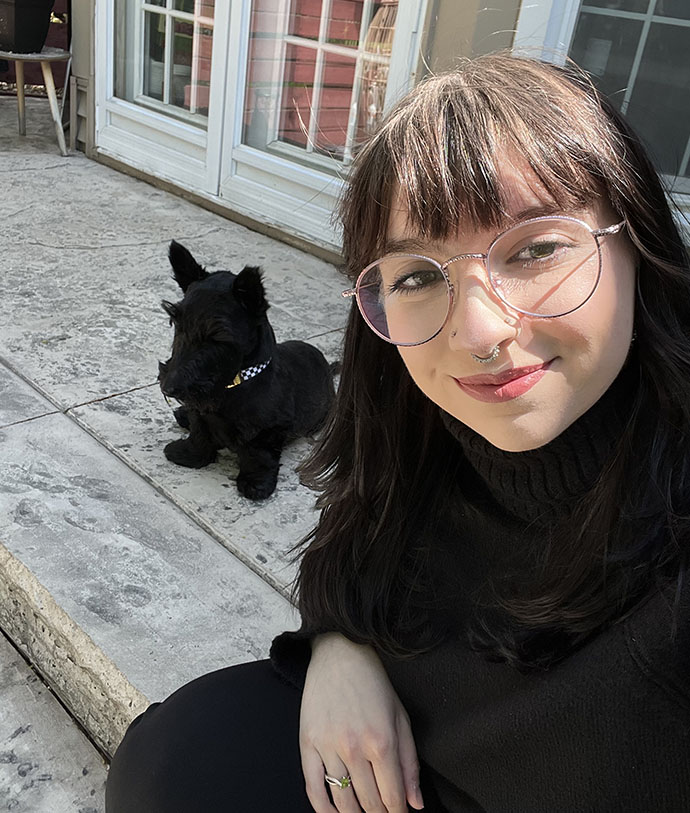
Vecchi also advocates for Alzheimer’s disease as a member of the Alzheimer’s Association. She began advocating with the Alzheimer’s Association when she was in high school and went to Washington, D.C. for the first time with her mother, who also does advocacy work, when she was 15.
“We go to a big forum every year. It's a national forum” Vecchi said. “Every state meets there and we learn about what we want to ask Senators and Representatives for. It's usually an increase in research funding, support for caregivers and families, and things of that nature. A recent push has also been on accepting new medications and on educating first responders in the event that they encounter someone with Alzheimer's or dementia, so they know how to interact with them.
“Then we go to Capitol Hill and have meetings with our assigned senators and representatives and ask them to co-sign or sign bills that give us an increase in research funding, or help us pass these bills so we can get more support,” Vecchi added. “That's really where my passion for this started.”
She continues to go to Washington, D.C. every year and feels like the work they have done has made an impact.
“I'll be going back this June. I think it'll be my sixth year,” Vecchi said. “I definitely feel like we’ve made progress, and that's something I say with a huge smile on my face. It has definitely improved a lot. We have increased research funding by hundreds of millions of dollars.
“We have new medications. When my grandfather was diagnosed, he was on antipsychotics. That used to be the standard. Medications were antipsychotics or antidepressants to help the symptoms, but now we have medications that actually slow the progression of the disease,” Vecchi added. “They're still not super easy to get, but it's getting a lot easier to get diagnosed and to get those medications, which can give people an extra five to seven years of life with their memories. That's so important to people, especially those who are diagnosed at 60 or 65 that want that extra time. Even the people who are diagnosed at 80, they deserve the extra time that these medications can give them. That's something that's really amazing.”
Vecchi was recently awarded the Meritorious Achievement Award, which is the highest honor for a student in the College of Arts and Sciences.
“It’s a huge honor,” Vecchi said. “I was telling all my friends at the nursing home where I work. All of my residents were so proud of me. I’ve worked very hard and I have such a passion for what I do so the goal was never to get recognized. It was to make a difference. I was extremely honored and it’s a great feeling to have someone tell you that you’re on the road to making an impact. I think a lot of people are very deserving of it, but I’m very proud to hold the title and represent such a great Department of Psychology.”