Global citizen
OU Spanish and History major aims to make the world a better place
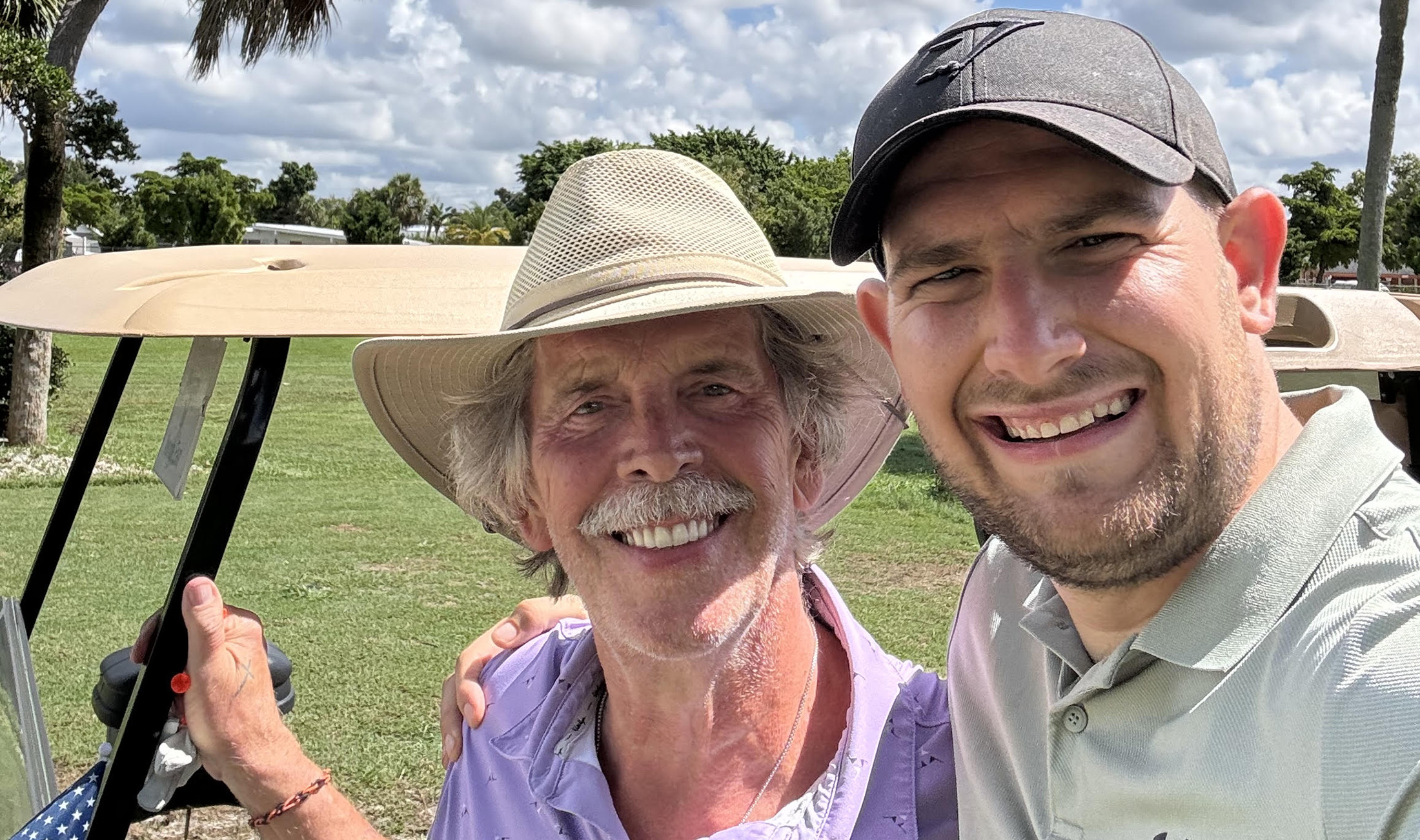
Joshua Hamann (right) poses for a photo step father Dean Schubring. Hamann recently graduated from Oakland with a dual degree in Spanish Language & Literature and History. He was awarded the College of Arts and Sciences’ Meritorious Achievement Award, the highest honor for a student in the College of Arts and Sciences.
 June 18, 2025
 By Dave Pemberton
Oakland student Joshua Hamann initially decided to study Spanish because it was something he enjoyed and he felt he was good at. But as he began to dive deeper into his studies, he realized there was so much more to being a Spanish major than just a language.
"I think as I progressed, I realized that there was a lot more to learning a language than just it being a skill that you can use,” Hamann said. “I was more and more attracted to it because I was getting all these other benefits. I felt like I was a better critical thinker. I felt like I was more able to understand the perspectives of people from around the world. I was able to have more experiences. I think it helps me express my empathy for others and my passion for helping the world.”
Hamann recently graduated from Oakland with a dual degree in Spanish Language & Literature and History. He also minored in Teaching English to Learners of Second Languages. He was awarded the College of Arts and Sciences’ Meritorious Achievement Award, the highest honor for a student in the College of Arts and Sciences, and spoke at the spring commencement ceremony.
“It means a lot,” Hamann said of winning the CAS Meritorious Achievement award. “But I think more than anything, it's a reflection of my support system and the people around me. I think I've had great professors at Oakland, especially in the Spanish department.
“The Spanish department's been absolutely wonderful to me. I've learned so much from them, and just not just about being a better Spanish speaker, but just more about myself,” Hamann added. “I think when you learn another language, you're forced to confront the unconscious nature of your own language. You're forced to understand what makes up a language and the identity mechanisms. I think when I was doing that, I learned a lot more about myself in the process, and I developed a really good relationship with myself. And I think that’s the key to me being a successful individual.”
Hamann maintained a 3.97 GPA (grade-point average), served as treasurer of Delta Sigma Pi, was a member of the Spanish Club and was the student representative on the College of Arts and Sciences Advisory Board.
“Joshua is like no other student, and I am certain that every professor who knows him would agree,” Professor of Spanish Aldona Pobutsky said. “He stands out in scholarship and in citizenship. He might be the most reliable student ever when it comes to school work, but also when it comes to the well-being of others. Joshua has varied talents and interests and he devotes most of his time to his many intellectual pursuits and caring for others.
“He is an exemplary student in every sense of the word; he is smart, knowledgeable, diligent, courteous, co-operative, profoundly open-minded and respectful of others,” Pobutsky added. “Since Joshua is also majoring in history, his knowledge of Latin America goes far beyond what most Spanish students learn. Yet Joshua is incredibly modest and humble, and he would never make anyone feel insecure.”
Hamann took a break from college after two traumatic experiences and returned to college at the age of 26 and arrived at Oakland three years ago.
“I got to Oakland when I was 28 and now I'm 31,” Hamann said. "I actually had a really traumatic incident when I was 19. I found my father dead. My brother died nine months after that. So I kind of took a break from school, was working, and then I went back right around COVID-19.”
Hamann’s life experiences helped mold his view on life and helping others. While at Oakland, he began teaching ESL (English as a Second Language) courses through La Casa Amiga and often did it free of charge.
Pobutsky said Hamann taught 45 ESL classes in a six-week span to two different groups of students.
“This involved constructing many different lesson plans and dedicating countless hours of preparation, but as he told me, it was very rewarding as he, ‘Aims to inspire and invigorate the same passion for language into others that he has within himself,’ ” Pobutsky said. “Now he mainly does private tutoring, and most of it for free. The reason he doesn’t charge for his efforts is because many of his students struggle financially.”
Hamann enjoyed the relationship he created with his students and feels like teaching ESL is his true calling.
“I think it gave me a lot of respect for what teachers do, because teaching is not easy at all,” Hamann said. “I think it gave me a lot of respect for what foreign language learners experience in the United States.
“I gained a lot of empathy for what they go through,” Hamann added. “And it spoke to a lot of my passions because I love Spanish, I love teaching and I love being involved in the Hispanic community. I love learning about new cultures, and I love helping people. It’s definitely a lot of work, but it's a very rewarding job.”
Hamann said a lot of his students live and work in areas where they can get by speaking only Spanish, but he encourages them to venture out and practice their English.
“I try to really encourage them to get out of their comfort zone, because I think when you when you learn a language, it's really easy to stay in your comfort zone and not get uncomfortable, and I think it's really important to get uncomfortable,” Hamann said.
Hamann said now that he’s graduated, he plans to travel and get his translation license.
“I plan on teaching English in a foreign country, spending a lot of time abroad, solidifying my Spanish skills, gaining fluency, just kind of living and enjoying life, and trying to do what I'm passionate about,” Hamann said.
Hamann also enjoys helping people expand their knowledge of Spanish-speaking cultures.
“Learning about Spanish language and literature isn't just learning about Mexico and Spain,” Hamann said. “There's a whole lot more to it. And that's something a lot of people don’t take the time to learn. They just think Mexico and Spain. Or like your typical stereotypes: Mexican food, mariachi bands and sombreros.
“If you learn Spanish at Oakland you get a variety of different accents in Spanish. There's a variety of different backgrounds. Oakland has a diversity of expertise and a diversity of thoughts and perspective. And it helps you get better at Spanish. You also get better at being a world citizen and you get better at being a thinker. I think that's really important to have analytical skills in the modern world.”
 |
|---|
| Joshua Hamann (right) taught 45 ESL (English as a Second Language) classes in a six-week span through La Casa Amiga. |
Hamann’s passion for Spanish culture also carried over to his history studies. Hamann did a capstone project that focused on the 1958 attack on Vice President Richard Nixon’s motorcade in Caracas, Venezuela.
Associate Professor of History Elizabeth Shesko oversaw Hamann’s work on the project and said Hamann was inspired to do this capstone after reviewing the existing literature and feeling it neglected the Venezuelan perspective on the attack.
“He used his considerable research and Spanish-language skills to find and interpret a range of primary sources,” Shesko said. “Over the course of 35 pages, his paper skillfully explained how Nixon’s visit fit into Venezuela’s turbulent politics, arguing that Colonel Jesús María Castro León masterminded the attack. This argument is by far the most ambitious I’ve ever seen made by an undergraduate student during my 10 years at OU. He’s already been in contact with some of the top historians in the U.S. who work on Venezuela to solicit feedback on his research.”
Hamann said the project has changed the way he views history because there is two sides to every story.
“I think it's been a very valuable project for me in terms of understanding that history is complicated, right?” Hamann said. “We tend to make it simple. We like to have simple narratives, but it's a lot more complicated. When you're in the U.S., you're going to be reading U.S. based perspectives, right? But the U.S. based perspective of the Cold War in Latin America is a lot different than a Venezuelan perspective of the Cold War in Latin America.”
Hamann is thankful for his time at Oakland and believes it has prepared him to be world citizen.
“I think the main thing I've learned from Oakland is just how to develop good habits, how to develop good routines, how to stick to my principles and to have an open mind,” Hamann said. “I think nuance is something in this country that we really lack. I think it's important to understand that there's two sides of the story, and often they intertwine. And there's some place in the middle where we can meet, where both sides have a point right. And I think that developing that nuance has been the biggest thing for me at Oakland. Just understanding, challenging my perspectives, challenging my belief systems, challenging how I think and just trying to be a better critical thinker and trying to be a more objective thinker.
“Not to say that my opinions are perfect,” Hamann added. “They're far from perfect, but I think I have the ability to listen to the other side, another opinion, and gain something from it, and be a more active listener and be a more active citizen in this country and in the world.”