Physics Pioneers
Six OU physics professors awarded Pioneer Award by Alumni Association
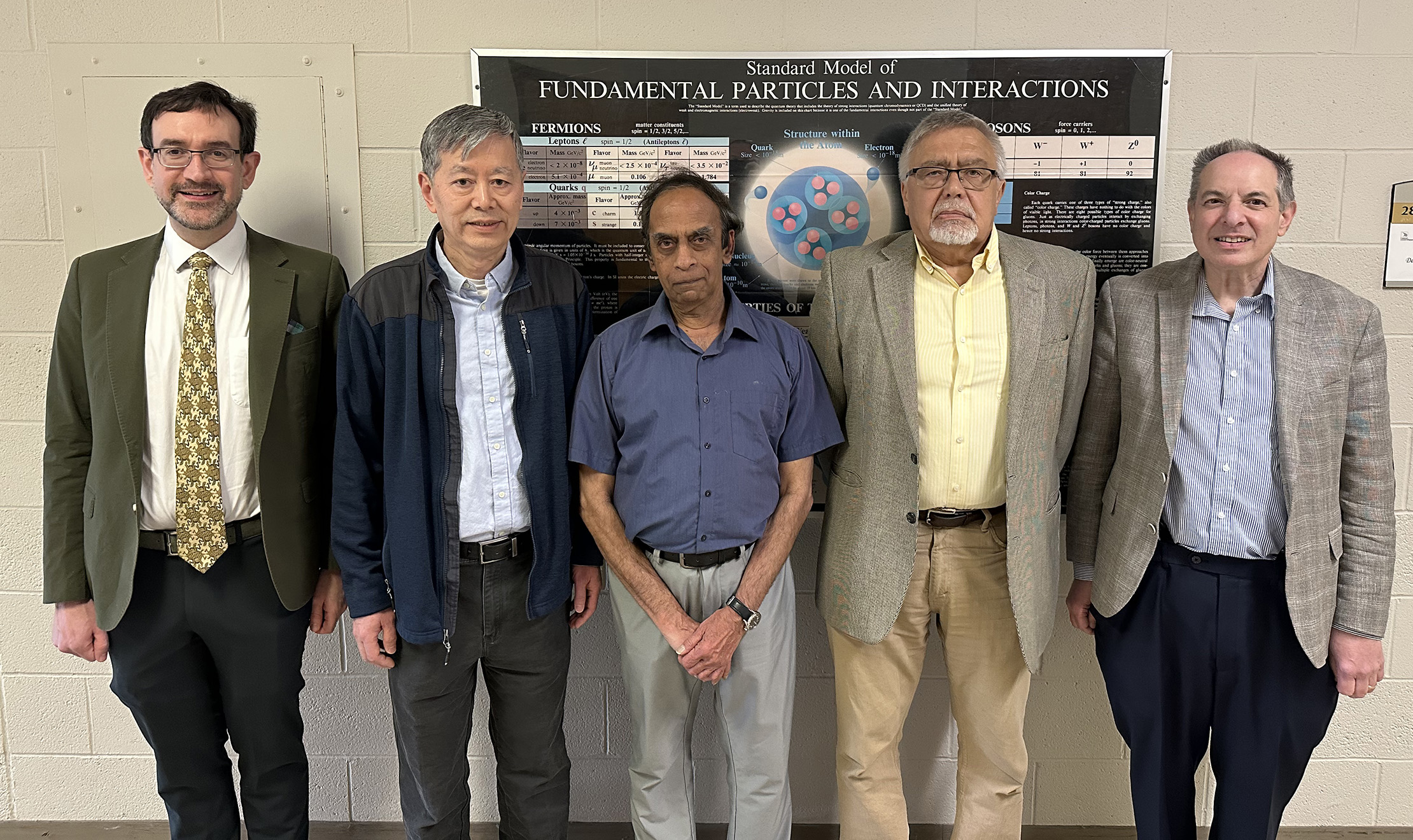
Physics professors (from left) Ilias Cholis, Yang Xia, Gopalan Srinivasan, Andrei Slavin, David Garfinkle and Michael Chopp (not pictured) have been awarded the Pioneer Award. All six made Stanford's list of the top 2% of scientists in the world.
 May 07, 2025
 By Dave Pemberton
The Oakland University Physics Department features some of the top scientists in the world, according to Stanford University’s list of the top 2% of scientists globally.
The renowned Stanford list includes six OU physics professors (listed here in alphabetical order): Associate Professor of Physics, Ilias Cholis; Distinguished Professor of Physics, Michael Chopp; Distinguished Professor of Physics, David Garfinkle; Distinguished Professor of Physics and Chair, Andrei Slavin; Distinguished Professor of Physics, Gopalan Srinivasan; and Distinguished Professor of Physics, Yang Xia.
Honoring their outstanding contributions to their fields, this group of faculty will be awarded OU’s Pioneer Award on May 17 at the Alumni Night of Excellence.
“We have very productive and talented faculty at the OU Department of Physics who are always ready to help each other and discuss new ideas,” Distinguished Professor of Physics and Chair Andrei Slavin said. “The administration of OU created a very comfortable atmosphere encouraging scientific research.”
The Pioneer Award honors a group of individuals who have made significant contributions that led to the growth and excellence of Oakland University.
Since its inception in 2013, this is only the fourth time the award has been presented. Unlike other alumni awards, which are conferred annually, the Pioneer Award is presented only under very special circumstances.
“It is both a surprise and an honor to be awarded the Pioneer Award, and I deeply appreciate it,” Distinguished Professor of Physics, Yang Xia. said.
Ilias Cholis, Ph.D., Associate Professor of Physics
Dr. Cholis’ work is a mix of theoretical astrophysics, cosmology, particle physics and astronomy/data analysis.
“I work on developing new theoretical models to describe astrophysical systems at extreme energies and conditions, impossible to replicate in a lab on Earth and think of how to best use current and future observations of the cosmos,” Cholis says.
Cholis is happy to see his work have an impact on the OU community. He uses data from observations of astrophysical phenomena in very high energies to study new or not well modeled physics, including the physics of dark matter.
“Dark matter makes up about 85% of all matter in the universe and about 25% of all the energy in the universe,” Cholis said. “Its nature is unknown; it could be made out of a new kind of particle or particles, compose a new kind of field or even be made out of black holes that were formed when the universe was seconds old, well before the more conventional black holes have been created.”
Michael Chopp, Ph.D., Distinguished Professor of Physics
Dr. Chopp has pioneered multiple areas of biomedical research, including the first studies on the use of stem cells for the treatment of neurological diseases and the field of restorative neurology.
Chopp says he’s thankful Oakland helped him establish a lab at Henry Ford Health.
“Without the encouragement and support of the staff and administration at OU, I would not be on the Stanford 2% list,” Chopp said. “I feel very privileged and honored to have made contributions to science, particularly to biomedical science, that have been recognized and have positively impacted people’s lives.”
Chopp’s recent research focus has been on developing therapeutic biological nanoparticles, Extracellular Vesicles (EVs), for the treatment of diseases, primarily neurological diseases and injury (stroke, dementia, traumatic brain injury) as well as cancers.
“EVs mediate communication between cells, and if we can control ‘communication’ intercellular communication, we can gain fundamental insight into the nature of biological systems and understand and treat disease,” Chopp said. “We were the first to demonstrate that EVs generated from stem cells mediate the therapeutic benefits of stem cells. In addition, we pioneered the ‘engineering’ of the molecular content (microRNA) of EVs to augment their therapeutic benefit. We have now greatly extended our early studies and have developed novel and potentially clinically applicable EV-based therapies.”
David Garfinkle, Ph.D., Distinguished Professor of Physics
Dr. Garfinkle is grateful for the recognition from both OU and Stanford.
“The physics department has a large number of people on the Stanford list because we are dedicated to hiring and supporting talented researchers,” Garfinkle says.
Garfinkle’s research focuses on Einstein’s theory of relativity, “articularly black holes, the Big Bang at the beginning of the universe and gravitational waves,” Garfinkle said. “This work involves solving Einstein's field equations, sometimes through mathematical techniques and sometimes using computer simulations.”
Andrei Slavin, Ph.D., Distinguished Professor of Physics and Chair
Recently named a ScholarGP Highly Ranked Scholar, ranking No. 1 in the Lifetime Spin Wave category, Dr. Slavin’s research is in the field of theory of magnetic phenomena at microwave frequencies.
“My main expertise is in the field of magnetic excitations, and, in particular, in the field of spin waves,” Slavin says. “The applications of my research work are in the field of magnetic recording, high frequency signal processing and neuromorphic computing using spin waves in ferromagnets and anti-ferromagnets.”
Gopalan Srinivasan, Ph.D., Distinguished Professor of Physics
Dr. Srinivasan’s research is on the physics of materials, particularly on smart materials that are capable of responding to a variety of forces including electric, magnetic and mechanical forces.
“We work on basic physics as well as applications,” Srinivasan said. “These smart materials are useful for sensors that could be used for magneto-cardiography (MCG-mapping magnetic fields produced in cardiac function), magneto-encephalography (MEG) (mapping magnetic field produced by neurons in the brain); high frequency devices used in consumer electronics and satellite communication, and energy harvesting.”
Srinivasan said it’s nice to be recognized by the university and the Alumni Association.
Yang Xia, Ph.D., Distinguished Professor of Physics
Dr. Xia has worked at OU for more than 30 years and says his research has been funded by more than $7 million.
“Our research concentrates on the discovery and validation of pre-clinical imaging biomarkers for osteoarthritis and other joint diseases, which are the number one cause of disabilities in the adult population in the country,” Xia says. "Being able to detect the disease early — before the bridge of no-return — can significantly improve people's health and quality of life, as well as reduce the healthcare cost.”