Digging deep
Oakland professor working to improve observational records of hurricanes
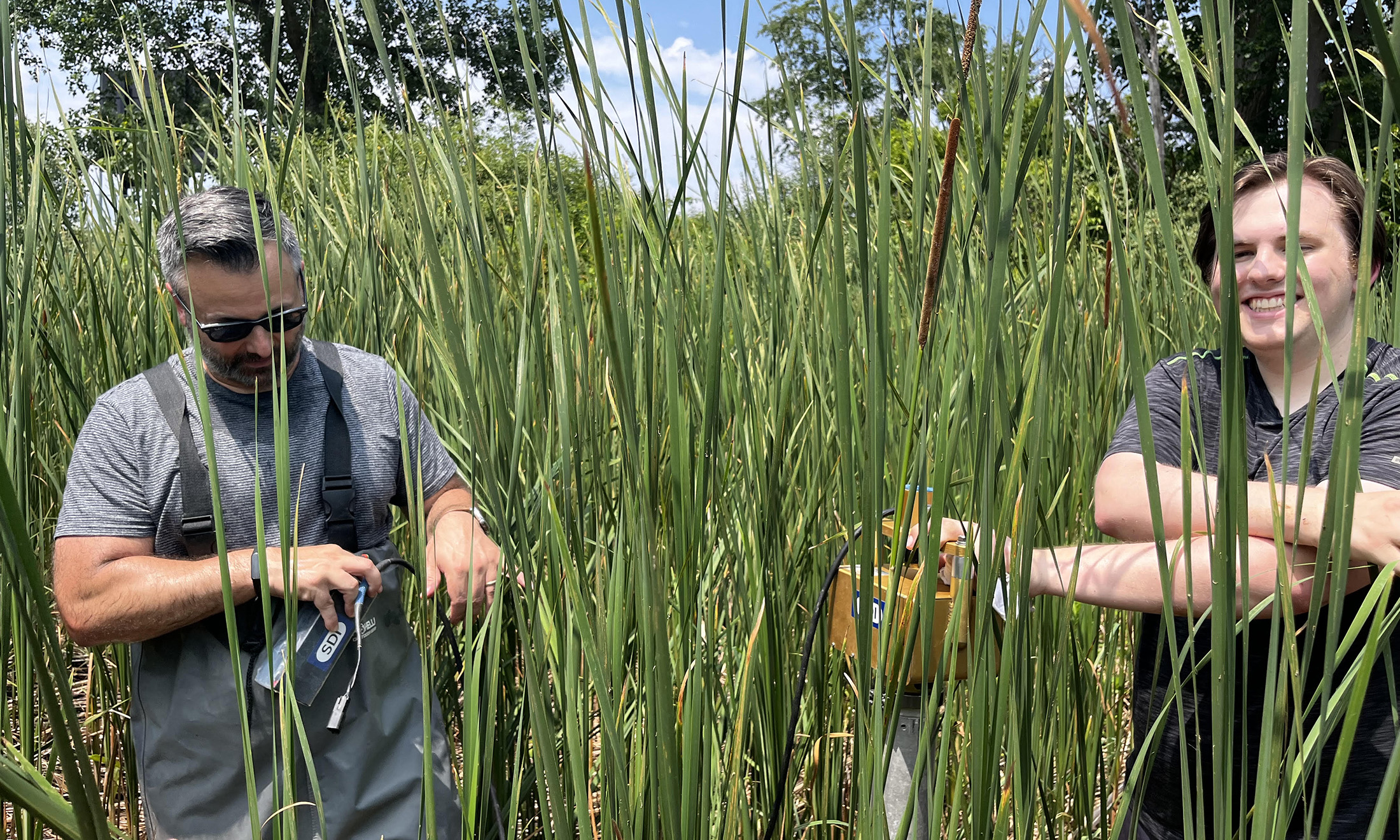
Oakland University Assistant Professor of Chemistry Thomas Bianchette (left) shows a student how to use a vibracorer.
 June 13, 2025
 By Dave Pemberton
It’s hard to say when Earth experienced the first hurricane, but there’s evidence they have been occurring for thousands of years. Unfortunately, in most areas the observational records of hurricanes typically go back less than 150 years.
Oakland University Assistant Professor of Chemistry Thomas Bianchette is working to change that. Bianchette runs the Coastal Hazard and Environmental Reconstruction Lab.
“I'm a sedimentologist, and I take sediment cores to reconstruct old environments,” Bianchette said. “The main thing that I reconstruct is old natural hazards, mainly hurricanes, but sometimes tsunamis, river floods and things like that. The main reason I do that is that our historical records are very brief.
“Hurricane-induced storm surge, for instance, is capable of overtopping a coastal beach and transporting sand into an adjacent lake, marsh, or swamp. By extracting sediment cores, scientists can locate these ancient deposits, and radiocarbon date them to determine their ages and calculate return periods.
“People are always surprised to hear this, but our observational records of hurricanes for the U.S. coast — so the Gulf and the Atlantic — they go back to around the 1850s and some experts argue that the best records start in the early to mid 1900s.”
Bianchette feels it’s important to improve the observational record of hurricanes because the records of the past can help more accurately project models for the future.
“I often give the example of Hurricane Katrina,” Bianchette said. “When I moved down to Louisiana for graduate school, Hurricane Katrina made landfall three weeks later. And everyone said that, ‘A storm like Katrina was a once in a lifetime event that has never happened in the past.’ But no one really knows what that means or if it’s happened before. Maybe it’s happened several times in the past, but so far back in the past that there’s no reliable record. We need to extend records of the past to see if what's projected to happen has actually happened in the past.”
Bianchette was recently awarded a three-year National Science Foundation grant to reconstruct hurricanes in Western Mexico, where the records don’t start until the 1940s.
“You have so much reliance on tourism there with Puerto Vallarta and Cabo,” Bianchette said. “If you don't know how frequently these things happen over longer periods of time, efforts must be made to improve coastal risk assessment. And that's mainly what I do.”
 |
|---|
|
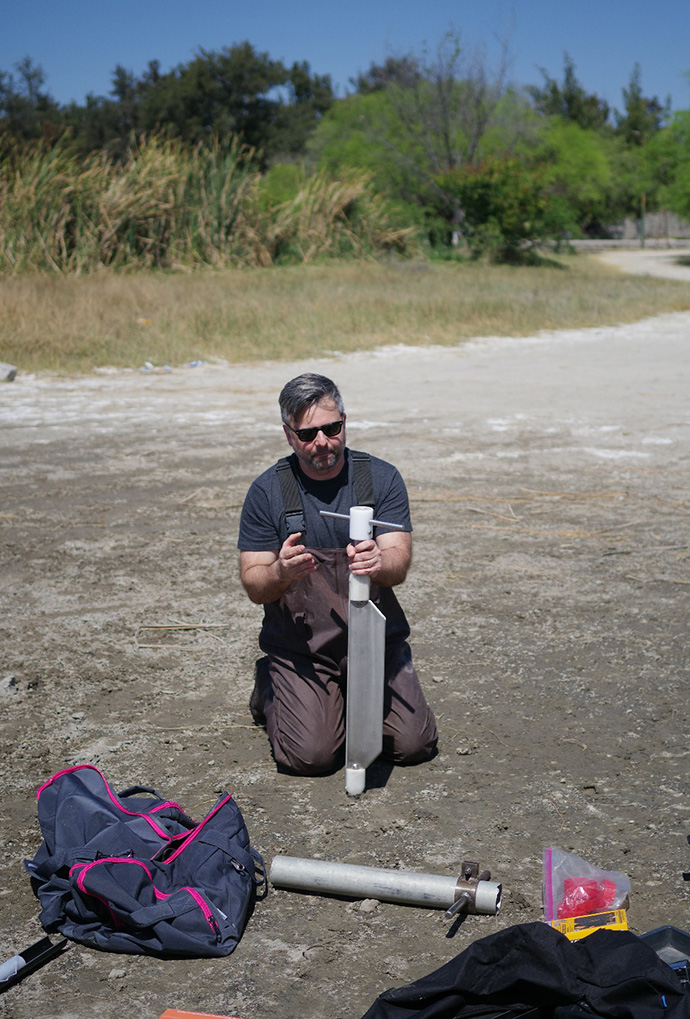
Oakland University Assistant Professor of Chemistry Thomas Bianchette shows students how to operate a peat borer at his "Field School in" Guadalajara. |
Bianchette traveled to Mexico in February, and will make two additional trips this summer. When he was there in February, he introduced this burgeoning scientific field to college students, showing them what he does in hopes that they can potentially do their own research in the future.
“I taught college age students at a university in Guadalajara about the scientific discipline, about techniques, about lab work and about field work,” Bianchette said. “I gave lectures. We went out in the field. I gave what I call a ‘Field School.’
“It went very, very well. There was excitement. There's something brand new for them. Many of them never heard of what I do and didn't know it was a possibility for their careers. And a lot of them were environmental engineering students, so it kind of made them think about complex issues in a different way.”
Several Oakland students will also work with Bianchette as part of the grant.
“I have three students working with me,” Bianchette said. “A lot of them love being in the field, so they love to get dirty and to do field work. I think a lot of times what students like is that when you do tests on a sediment core, there's all different types of tests: there's geological methods, chemical methods and biological methods.
“I think that what's nice about this discipline, no matter what you're into, you would be interested,” Bianchette added. “You could be into chemistry or you could be into geology and be interested in how different types of hazards transport different grain sizes into a sediment core. If you're into the biological aspect, you could get into this field. It's very multi-disciplinary.”
Bianchette said the projected job growth in Environmental Science is strong and he lets his students know there’s plenty of job options out there.
“I teach GIS (Geographic Information Systems) and with GIS you could do anything,” Bianchette said. “You could work in real estate, you could work for the police department and map out crime hot spots, you could enter so many fields. The students enjoy the program. They learn a lot of skills. The courses in this program are very diversified, so there’s been a lot of strong feedback from the students, and not just about the program, but about how quickly they were able to land good jobs.”
Bianchette is also working with Oakland engineering professor Vijitashwa Pandey on a grant funded by Oakland to improve the detection of natural hazard deposits in sediment cores using machine learning and AI.
“I have been working a lot on machine learning and AI applications,” Bianchette said. “We have a paper recently published, and we're going to be submitting another manuscript for publication soon. We can potentially find evidence of old events that our traditional methods cannot find in a sediment core.
“We could potentially look at an old record of 3,000 years where we found 10 events. We could do it again and say, ‘No, we didn't have 10 events, we actually had 22 events. That’s a huge improvement in accuracy, and this information would be crucial to better assess coastal risks. We’re also finding that with some automation methods that we are currently testing, we can possibly save a lot of time performing these lab analyses, which would therefore allow more time for data analysis as well as manuscript and grant proposal writing.”
To learn more about Oakland’s Environmental Science program please visit: https://www.oakland.edu/chemistry/undergraduate-programs/environmental-science/