
U.S. Senator Elissa Slotkin shares how 9/11 shaped her path to public service
Senator Slotkin spoke to students in an Honors College class on the September 11th attacks
University News
 November 02, 2026
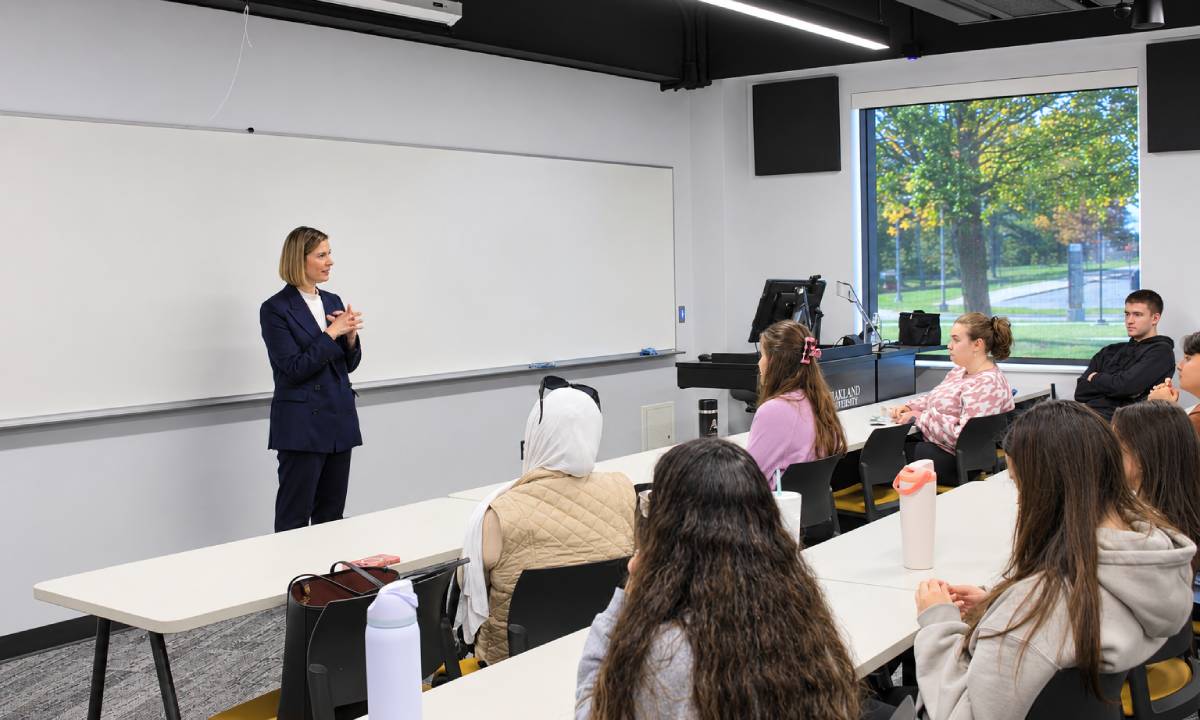
Michigan U.S. Senator Elissa Slotkin recently visited Oakland University to share how experiencing the Sept. 11, 2001, terrorist attacks as a graduate student at Columbia University in New York City shaped her path to public service.
Speaking with students in OU’s Young Honors College course HC 2040: September 11, 2001, Slotkin recalled watching the attacks unfold on TV and witnessing their impact on the city.
The experience led her to shift her academic focus to international security policy. She later became a CIA analyst and served three tours in Iraq alongside the U.S. military. Slotkin also discussed how the attacks transformed national security priorities, including counterterrorism efforts and intelligence coordination.
Her visit resonated with students, including sophomore finance major Gino Ciranni.
“The fact that we had a U.S. senator come into our class to speak to us in itself amazes me,” said Ciranni. “Senator Slotkin’s appearance helped us to connect what we’ve learned in class to someone who is involved in our government, and hearing how her experience on 9/11 directly led to her career was fascinating.”
The course is taught by Steffan Puwal, Ph.D., who designed it to help students understand the attacks and the responses of first responders, government institutions and international allies.
Students examine the U.S. response and NATO’s response to the 9/11 attacks, as well as the anthrax attacks that followed. In addition, they study firsthand accounts, original reporting and documentaries to understand the attacks’ lasting consequences.
Students are reading Garrett Graff’s “The Only Plane in the Sky: The Oral History of 9/11” and comparing television news coverage from the day. They have also participated in a remembrance activity hosted by the 9/11 Memorial and Museum.
“I've learned about the many events leading up to 9/11, what happened on that day, and some of the lasting effects that it has on society,” Ciranni said. “One thing that's especially interested me is the significance of the aftermath of the attacks and how it's changed security measures and foreign policies.”
Puwal also invites first responders, law enforcement personnel, Manhattan residents and government representatives of U.S. allies to share their perspectives with the class.
“I have been very careful not to relay to students someone else’s memories, but to instead share them with students through documentaries, our course book and invited speakers,” Puwal said. “In doing so, I hope to provide students with first-hand accounts that are not filtered through my own memories and interpretations.”
During her visit, Slotkin answered questions about her education and career, international relations, current conflicts and the responsibilities of public officials. She also discussed what younger generations should understand about 9/11 and the importance of civic engagement among today’s youth.
“I feel fortunate that we have the Young Honors College at OU, which allows faculty the opportunity to teach coursework on special topics like this,” Puwal said. “Since this year marks the 25th remembrance of September 11th, I thought it was important to offer students a course that conveys both the historical and emotional importance of that day.”