
OU researchers develop first high-quality genome for Caribbean long-spined sea urchin
New genomic resource provides scientists with a powerful tool to study the species’ genetic diversity, disease susceptibility and recovery — and help restore threatened Caribbean coral reefs
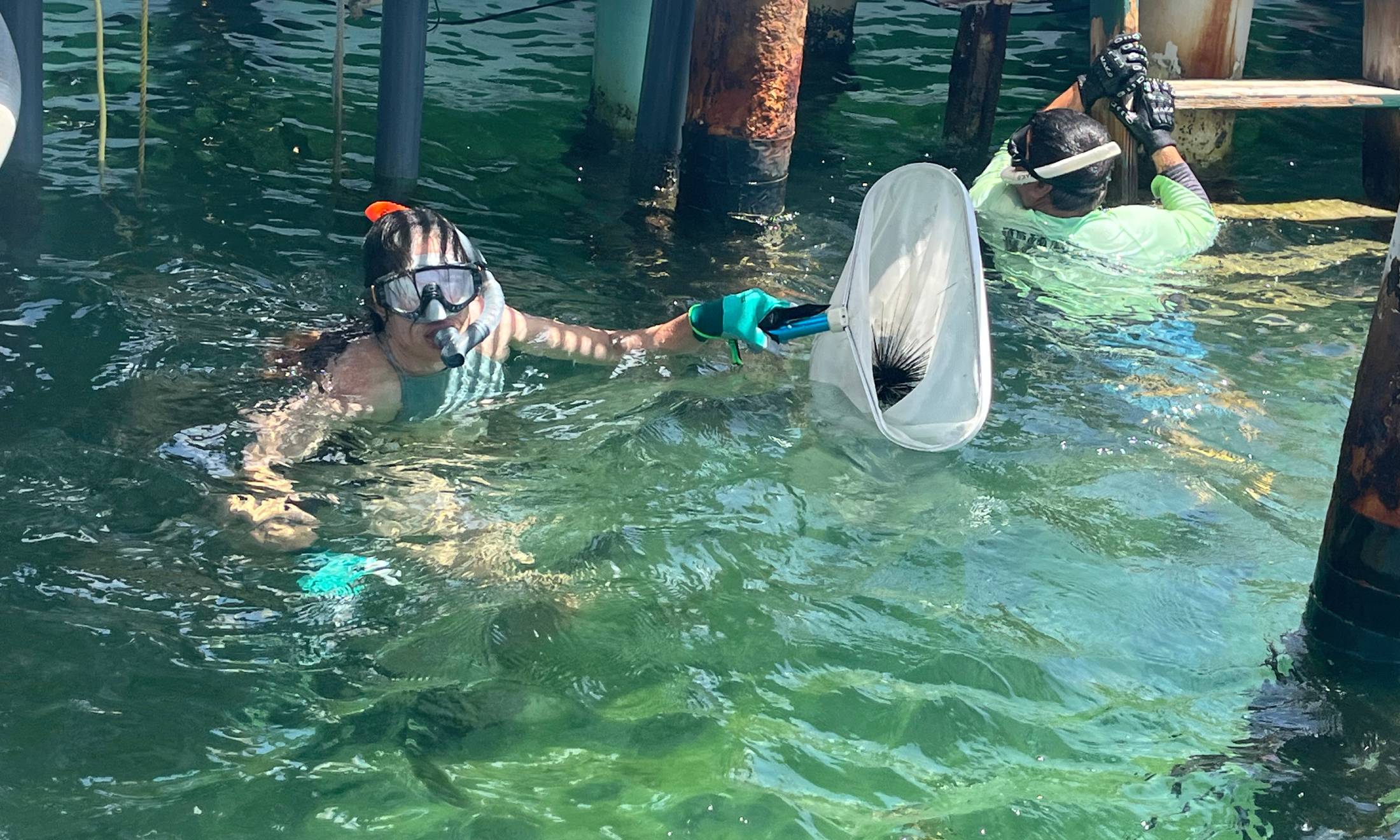
Audrey Majeske, Ph.D., special instructor of biology at OU, and Nikolaos Schizas, Ph.D., associate professor of molecular invertebrate biology at the University of Puerto Rico at Mayagüez, are shown collecting sea urchins in Puerto Rico.
Research and Discovery, University News
 September 21, 2026
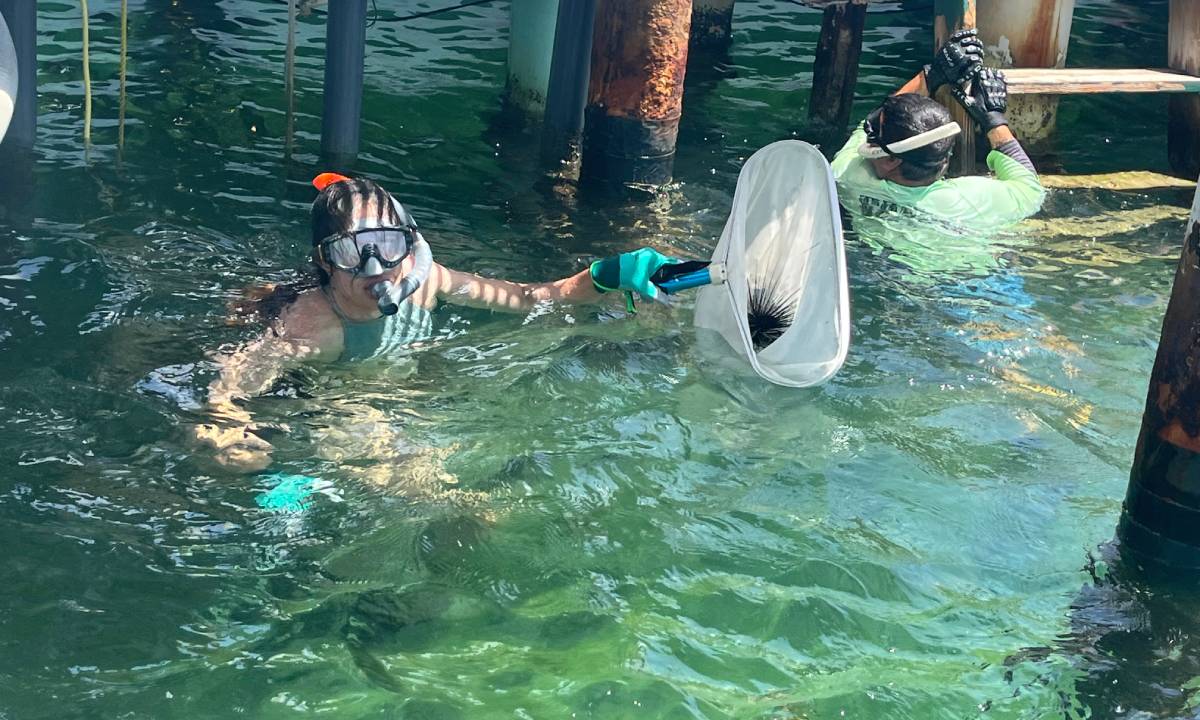
Researchers in Oakland University’s Department of Biological Sciences, in collaboration with scientists from Duke University Marine Lab, the University of Puerto Rico at Mayagüez and other institutions, have assembled the first high-quality genome of the Caribbean long-spined sea urchin, Diadema antillarum. Several OU students also co-authored the study, including Kenneth Hilkert, Stephanie Castro-Marquez and Walter Wolfsberger.
The study, published in the journal Genes, provides an important new resource for understanding the biology, genetic diversity, evolution and health of a species whose decline has had profound consequences for Caribbean coral reef ecosystems.
A critical species for Caribbean reefs
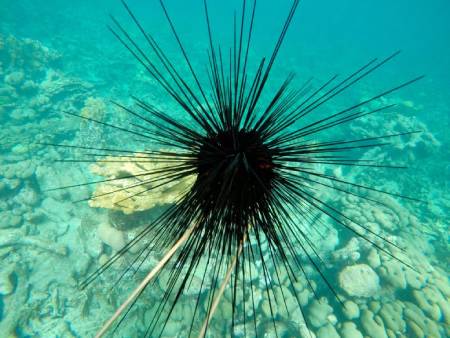
Caribbean long-spined sea urchin
Known as a keystone herbivore, D. antillarum plays a critical role in maintaining healthy coral reefs by grazing on algae that can otherwise overwhelm corals.
In 1983-84, a devastating disease outbreak reduced Caribbean populations of the sea urchin by approximately 93%, with some populations being completely wiped out. The loss of this important grazer contributed to a shift from coral-dominated reefs to reefs increasingly dominated by macroalgae.
The species has experienced some natural recovery in parts of the Caribbean, and efforts to restore populations through monitoring, harvesting and restocking have increased in recent years.
Because additional die-offs remain a concern, particularly as environmental conditions change, researchers need better tools to understand the genetic characteristics that may influence the species’ survival and resilience.
A new genomic tool for understanding recovery
A high-quality reference genome gives researchers a way to examine genetic differences among individual urchins and populations and investigate whether those differences may influence survival and recovery.
"This genome gives us a framework of reference," said Audrey Majeske, Ph.D., co-first author of the study and Special Lecturer of Biology at Oakland University. "You can't manage a species' recovery if you can't distinguish its populations. It lets us ask which urchins survived the die-offs, whether the survivors carry something the others didn't, and it gives restocking efforts a baseline for monitoring the species' genetic diversity."
The research team developed the reference genome using DNA from a single male D. antillarum collected off Puerto Rico. Using a technique known as haplotype-resolved assembly, the researchers were able to distinguish the two sets of chromosomes inherited from the urchin’s parents.
The resulting genome is approximately 1 billion base pairs in length and accounts for about 99% of the genes expected in the species. Its sequence accuracy is approximately one error per 28,000 DNA bases, providing researchers with a detailed foundation for future genomic studies of the species.
An unexpected level of genetic diversity
The project also revealed an unexpected challenge: D. antillarum possesses an exceptionally high level of genetic diversity in comparison to other vertebrate species, but is on the lower end of variation compared to other sea urchins.
While the two inherited chromosome sets in a human typically differ at about one position in every 1,000 DNA bases (a 0.1% difference), the two chromosome sets within the particular sea urchin studied differed at approximately one position in every 40 bases, a 2.5% difference.
That unusually high level of variation initially created a computational challenge. Standard genome-assembly software interpreted many of the differences between the two chromosome sets as evidence of additional genetic material, which produced an assembly nearly twice the size of the actual genome. Thus, the researchers used specialized computational approaches that were designed to keep the two haplotypes separate.
Understanding that higher variation between each D. antillarum could prove particularly important for conservation. Genetic differences among individuals and populations may help researchers identify animals with characteristics associated with disease resistance, environmental resilience or successful recovery.
A resource for restoration and resilience
The new genome will allow researchers to investigate questions that previously were difficult or impossible to answer. Future studies can examine immune-system genes and other genomic features, investigate relationships among D. antillarum populations and compare the species with other sea urchins.
“Every restoration project in the Caribbean has been flying partly blind,” said Taras K. Oleksyk, Ph.D., associate professor of biological sciences at Oakland University and corresponding author of the study. “With a reference genome, a tissue sample becomes a source of real information about health, ancestry and resilience.”
By providing a high-quality genomic reference for a species central to Caribbean reef health, the research team has created a valuable resource for studying disease, genetic diversity and population recovery. This will help scientists to better understand how to protect and restore degraded Caribbean coral reefs.