
Crossing the line: OU’s Electric Racing powers to the Purdue podium
 June 08, 2026
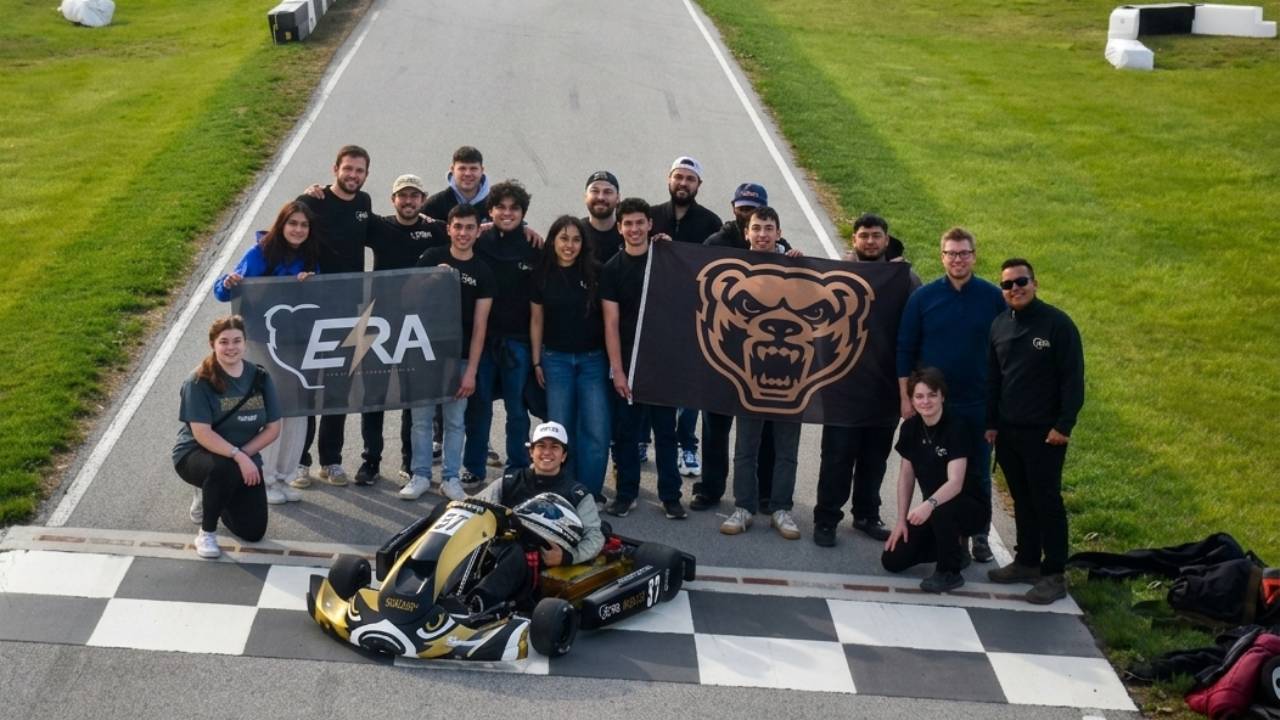
Oakland University’s Electric Racing Association (ERA) has crossed the finish line of a two-year design, testing and problem-solving run, debuting its first electric kart at Purdue University’s evGrandPrix and bringing home a trio of trophies.
The collegiate electric go-kart endurance race, often called “The Greatest Spectacle in College Racing,” draws teams from across North America to the Purdue Grand Prix Track in West Lafayette, Indiana. This spring, OU’s rookie kart outperformed its more seasoned counterparts, finishing second overall in a 50-lap showdown.
Behind that finish is a long build-up. The countdown to 2026 evGrandPrix started with a question: could Oakland University students design and race a fully electric kart that could hold its own on one of the biggest collegiate stages in North America? The answer emerged as a bold idea in spring 2023, when a group of students turned their Senior Design project into a fully-fledged electric racing program.
ERA, a student-driven experiment in electric mobility, was created to give engineering students a true hands-on proving ground.
“We wanted ERA to be a place where students don’t just learn about electric vehicles in class, but actually design, build and race one, so they graduate with real skills and real confidence,” said Logan Hein (SECS ’23), who along with Fares AlShubeilat (SECS ’23), Gabe Petersen (SECS ’23), and Jason Wegryn (SECS ’23) founded the organization.
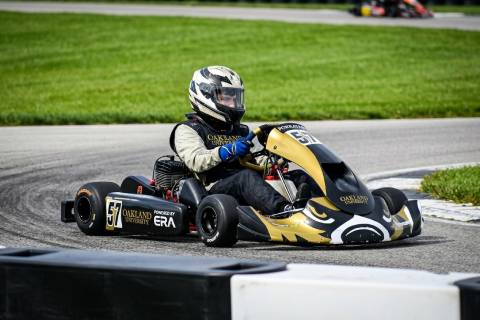
Driver Jose Barrios on April 18, 2026, at Purdue Grand Prix Track in West Lafayette, Ind.
In its concept, ERA was more than a club — it was a hands-on pathway into the future of transportation, where students could design, build, and race the very technologies reshaping the automotive industry. Over two years, it grew into a multi-cohort community of engineers, with its current leaders inheriting the founders’ vision and pushing it toward Purdue’s evGrandPrix.
In April 2026, that long runway came to an end when OU’s inaugural electric kart lined up at the checkered start line alongside 16 entries from nine universities.
“Getting a spot to compete at evGrandPrix is a milestone of its own,” shared Guillermo Valenzuela Gomez, ERA president and crew chief, who traveled to Purdue with Erick Cervantes Corral, ERA technical director, earlier in April for a preliminary technical inspection.
“We learned that we needed to incorporate a few fixes, which we did when we returned to OU. We traveled back to Purdue and officially passed our technical inspection on April 16, two days before the race,” he adds.
A successful technical inspection cleared the kart for competition, putting ERA on track for practice sessions and sprint race qualifiers that set the final grid. ERA rookie driver Jose Barrios secured ninth spot on the starting grid, followed by a 50-lap endurance race that demanded both pace and careful energy management.
“We gained one position on track to finish eighth, but the event’s scoring takes into consideration design and innovation, race results, and efficiency (using the least amount of energy in Watt-hours per lap, for a minimum of 25 laps), which put our kart in second place overall. We also earned third place in the design category and the Livery Award for best aesthetics among all participating karts,” shared Gomez.
This moment also carried special meaning for Hein, AlShubeilat, and Petersen who watched from the sidelines as their vision took shape on track. They saw exactly what they had hoped for: a culture where competition fuels learning.
“My heart is full. We wanted a place where students could fail, fix, and try again on a real racecar. Seeing our new team finish second overall shows how powerful that culture can be,” said AlShubeilat.
“This placement is a testament that our students are thinking like complete engineers,” stated Osamah Rawashdeh, Ph.D., chair of the Department of Electrical and Computer Engineering and one of ERA’s faculty advisers. “Designing a kart that can compete on track, impress judges on technical merit, and manage energy intelligently — this is exactly the mix of skills industry expects in the future of electric mobility.”
The broader significance of ERA’s debut reaches beyond a single race weekend. For Oakland University, ERA represents a living laboratory where students train for the rapidly expanding electric vehicle sector, gaining the kind of experience — systems integration, powertrain design, data analysis, teamwork — that employers increasingly demand.
This applied, project-based work directly aligns with Oakland University’s strategic focus on experiential learning and workforce preparation, which equips OU students to lead in Michigan’s evolving mobility and EV economy and strengthens the university’s partnerships with industry.