
Students tell America's story through 250-year timeline
 September 04, 2026
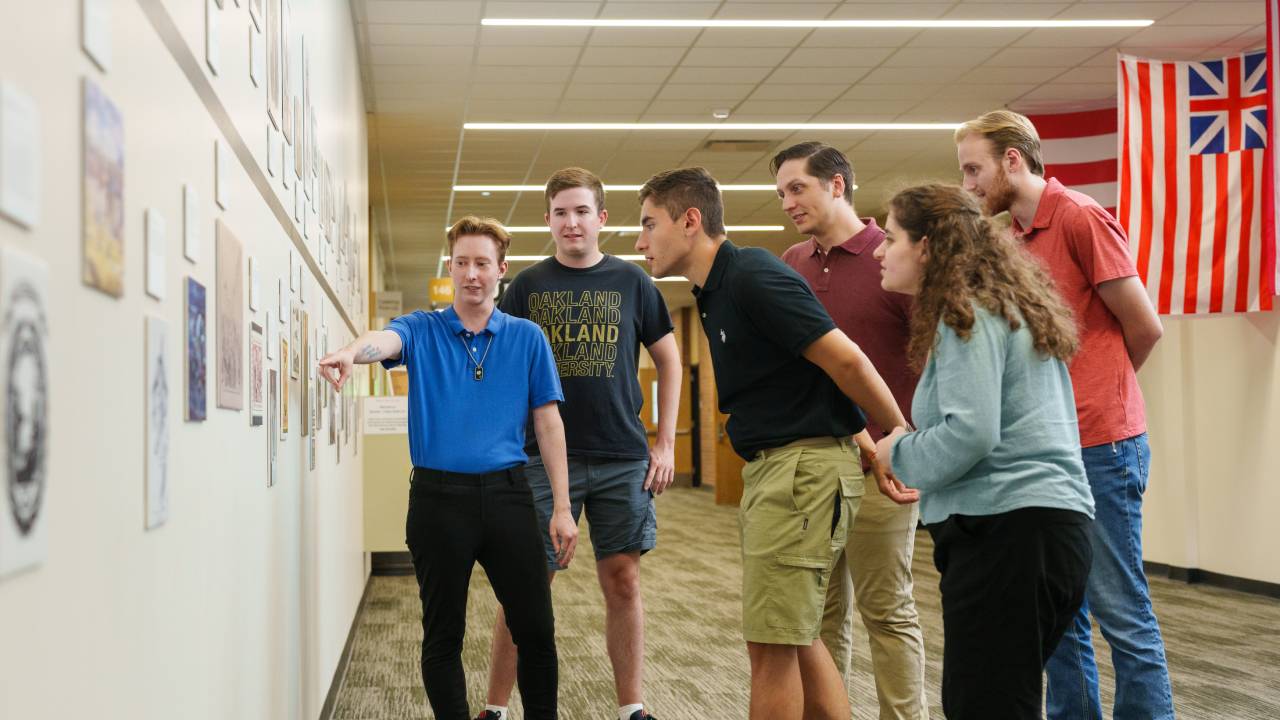
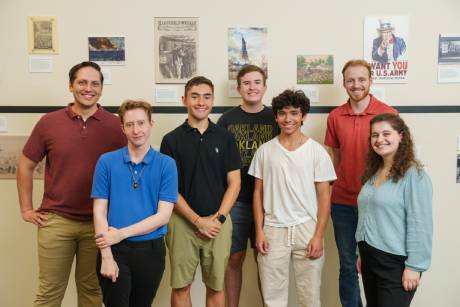
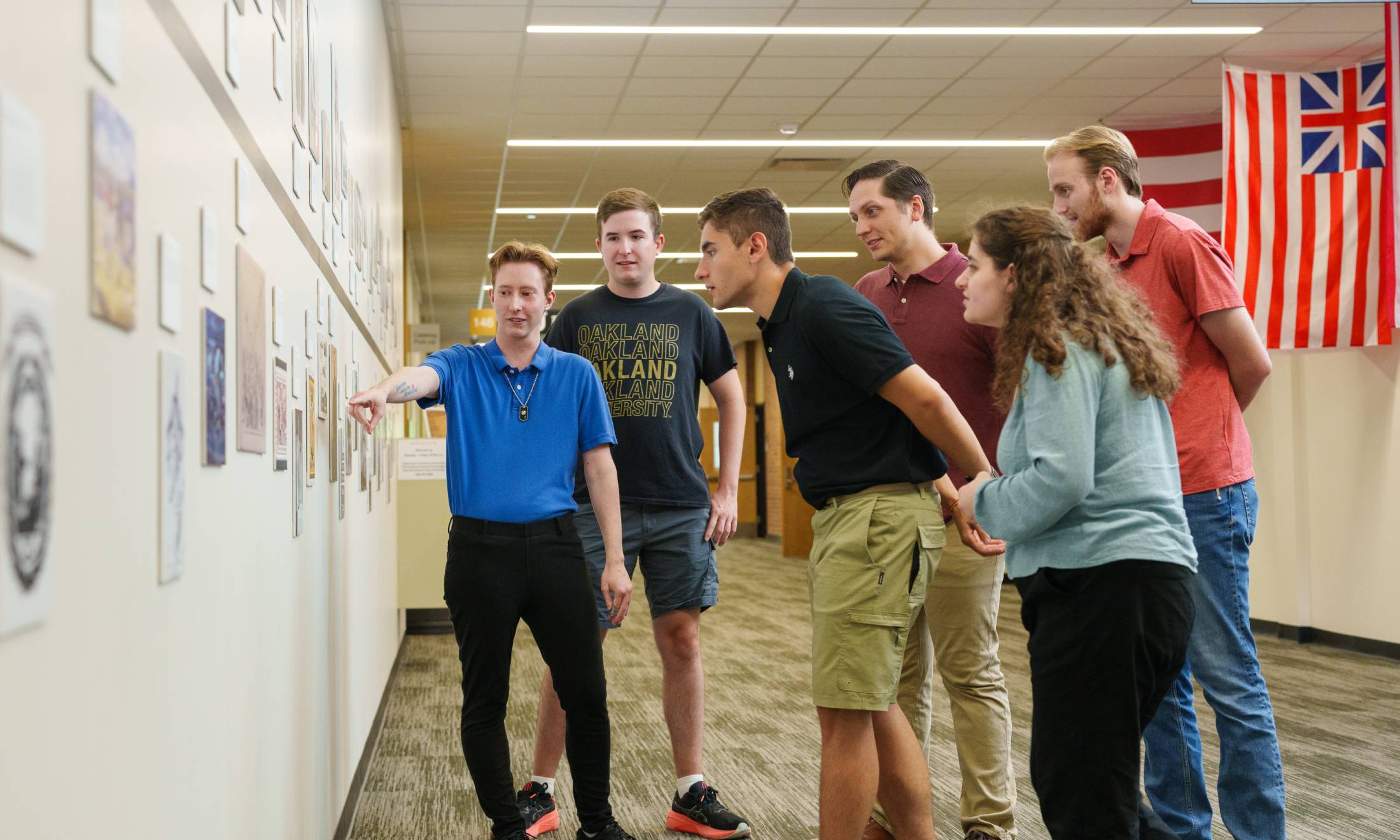
Through a special topics course co-taught by history professors Nick DiPucchio (pictured first from left), Erin Dwyer and Todd Estes, students created a 250-year timeline of American history that is on display in the Oakland Center.
As part of Oakland University’s continuing efforts to celebrate the nation’s 250th anniversary, students created a timeline showcasing people and events that have shaped the course of American history since 1776.
Displayed in the Oakland Center near the ID Card Office, the timeline features 54 dates spanning the nation's history — from the Revolutionary War to the modern era. Each date marks a moment students identified as important to understanding how the United States evolved into the country it is today.
The timeline was developed through “The Memory of the American Revolution,” a special topics course offered during the Winter 2026 semester and facilitated by OU history professors Nick DiPucchio, Erin Dwyer and Todd Estes.
“The idea for the timeline came from Dave Dulio, our chief community engagement officer on campus,” DiPucchio explained. “We were brainstorming ideas to plan the celebration of the country’s 250th anniversary, and he was really supportive of giving students, particularly history students, an opportunity to tell the story of America’s past.”
The students each researched three historical events and wrote essays explaining why those events deserved a place in the timeline. DiPucchio and his colleagues helped students distill their arguments into concise entries for public display.
The project reflects both the breadth of American history and the individual interests students brought to the classroom.
For Stephen Mihos, a student in OU’s Social Studies with History for Educators B.A. program, the project offered an opportunity to take a closer look at historical events he first learned about in elementary school. He chose to research the Battles of Lexington and Concord, Saratoga and Fort Sumter. The latter held special significance because his family had visited the site in 2022.
“It became sort of a passion project, because I had a personal connection to that event, instead of just an assignment,” Mihos said.
Catherine Recknagel, who recently graduated with a B.A. in history and a minor in theatre, researched events ranging from the nation’s early years to those within recent memory. Her selections included George Washington’s Farewell Address, the dedication of the Statue of Liberty and the 2015 Broadway opening of “Hamilton.”
Recknagel said she appreciated the challenge of translating historical research for an audience that might not have a background in history.
“How do we apply this to an audience that may not be made up of historians, and when we only have, say, 150 words to put on a plaque — how do we communicate that well?” she said. “I think those writing skills were really helpful.”
In deciding what to include in the timeline, students also recognized the complexity of history, highlighting achievements and innovations alongside episodes of tragedy and violence.
Grayson Athens, a master’s student in history, selected the signing of the Indian Removal Act, publication of “Captain America Comics #1” and the 1976 assassination of Chilean diplomat Orlando Letelier. His choices reflected a broader interest in how Americans have defined identity and belonging throughout the nation’s history.
“One thing I’ve thought about a lot is how our perception of ourselves has changed,” Athens said. “In many ways, my dates focus on identity and who counts as an American and how that framework has changed over the centuries. It’s sobering to see how far we’ve come, and how far we have yet to go.”
DiPucchio noted that the project also demonstrated the value of civility, bringing students from different backgrounds together to exchange ideas and perspectives. Their diverse experiences enriched classroom discussions and helped shape the project throughout the semester.
“What was really remarkable is that we had students of different backgrounds, interests and political leanings who were willing to work together and listen to each other,” DiPucchio said. “They recognized that the American story is not the story of one group, but of many groups with overlapping histories.”
Featuring a variety of images and corresponding captions, the timeline invites viewers not only to revisit the past, but also to consider what belongs in the story of America and what the nation’s history means to them.
“I think that’s one of the reasons why Oakland is such a great place to be,” DiPucchio said. “It offers so many wonderful opportunities for students to engage with the public. And, with the mission of community engagement being central to Oakland’s identity, I think we’re going to see more projects like this in the future.”
Find more OU activities and events to celebrate the nation’s 250th anniversary at oakland.edu/america250.