
Oakland University, EGLE study could shape Michigan’s approach to beaver coexistence
 September 02, 2026
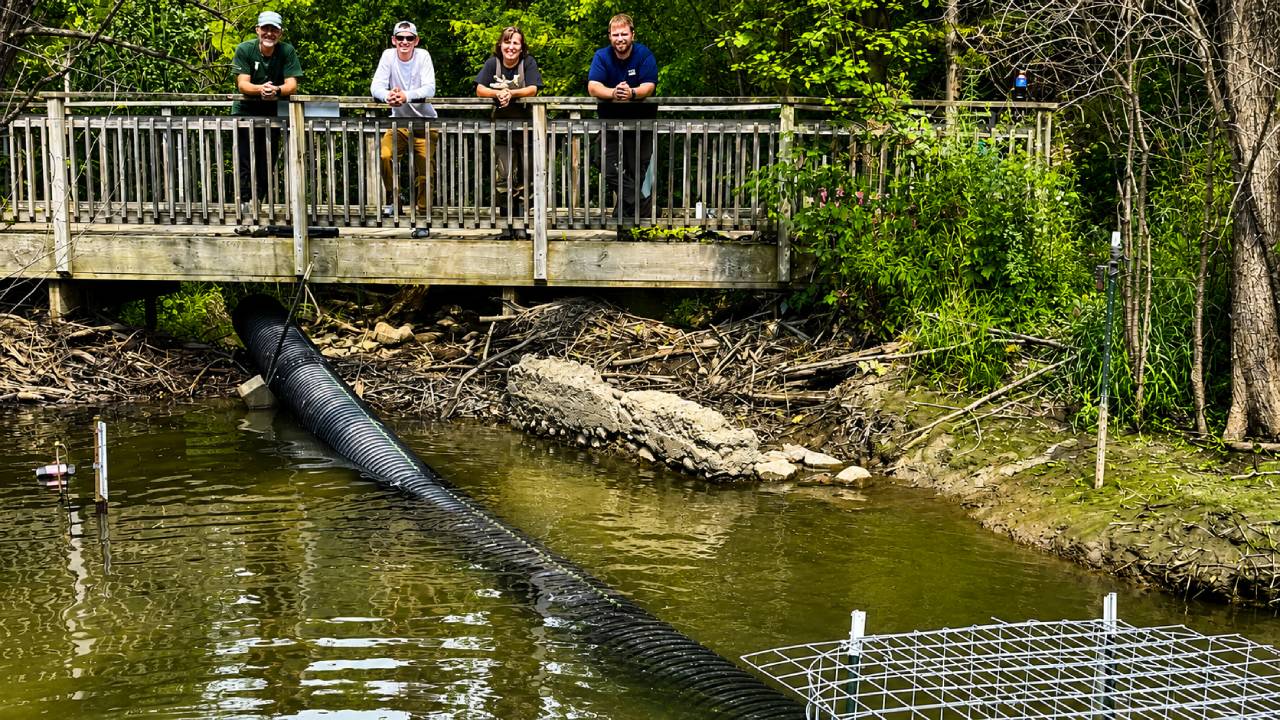
Oakland University researchers are partnering with the Michigan Department of Environment, Great Lakes, and Energy (EGLE) on a first-of-its-kind study that could help shape how Michigan manages flooding associated with beaver activity — without removing the animals or the habitat they create.
The collaboration brings together university research, sustainability and state environmental policy through a study of a pond leveler installed Aug. 12 in Galloway Creek, where beavers have created a pond along Oakland University's Alice R. Champion Trail. The project is the state's first stream study involving a pond leveler and is intended to provide EGLE with data that could help inform development of a new permit category for the devices.
The study reflects Oakland University's commitment to sustainability and its role as a steward of the natural environment on its 1,443-acre campus. Through its Strategic Vision 2030, OU identifies sustainability as a university-wide priority, including responsible management of natural resources, protection of biodiversity and green spaces, sustainability-focused research and community engagement.
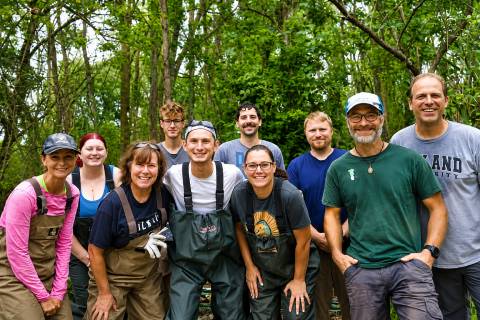
Sandra Troxell-Smith, Mena Booton, Andrea Knutson, Josh Liike, Luke Bechtell, Mario Prisciandaro, Jessica Kemp, Ryan Dinehart, Justin Jendza, and Thomas Raffel
The study is led by Oakland University researchers Thomas R. Raffel, Ph.D., principal investigator; Andrea Knutson, Ph.D., co-principal investigator; and Sandra Troxell-Smith, Ph.D., co-principal investigator. Known as "Team Beaver," the interdisciplinary research team brings together expertise in wetland ecology, animal behavior, animal welfare and human-beaver coexistence.
“This is an exciting opportunity to bring research and policy together to find new approaches to human-beaver coexistence,” said Knutson, associate professor of English at Oakland University.
Researchers will monitor the beaver pond and areas both upstream and downstream of the dam to examine the effects of the pond leveler on Galloway Creek and the surrounding ecosystem. They will collect data on habitat, stream morphology, water flow, water temperatures and wildlife biodiversity, while also monitoring the behavioral responses of beavers and other wildlife.
The goal is to provide Michigan landowners, land stewards and natural resource managers with another option for managing flooding associated with beaver activity while allowing the animals to remain part of the landscape.
The pond leveler was installed by Beaver Leavers LLC and USDA Wildlife Services following three years of planning, conversations and permitting. OU researchers began collecting baseline data in May 2026 before the device was installed.
The project has been several years in the making. In 2023, a pair of beavers moved into the stretch of Galloway Creek that passes through Oakland University's Biological Preserve, building a dam beneath a footbridge and flooding a popular trail. Rather than simply remove the beavers or their dam, OU faculty and staff began exploring ways to address the flooding while allowing the animals to remain in the preserve.
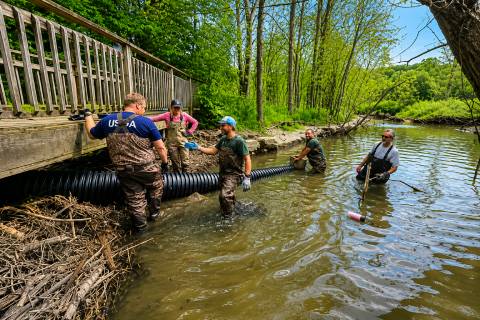
A pond leveler was installed Aug. 12 in Galloway Creek, where beavers have created a pond along Oakland University's Alice R. Champion Trail.
That effort led researchers to pond levelers, which are designed to regulate water levels behind beaver dams. OU soon discovered that Michigan did not have an established permitting mechanism for the devices. What began as a campus management issue developed into an opportunity to address a broader question about how Michigan communities can coexist with beavers.
In December 2025, representatives from EGLE and the Michigan Department of Natural Resources met with members of “Team Beaver” to discuss the project and the potential use of pond levelers in Michigan. The Galloway Creek site subsequently became a pilot for research that could help inform EGLE's permitting approach.
Beavers are considered ecosystem engineers because they can reshape streams and create wetlands and ponds that provide habitat for plants and wildlife, retain water and influence aquatic ecosystems. At the same time, their dams can contribute to flooding or alter waterways in ways that create challenges for property owners, land managers and public agencies.
A pond leveler offers a potential middle ground by regulating water levels while allowing beavers and the habitat they create to remain part of the ecosystem.
“Beaver damming activities reestablish native wetlands and provide key habitat for a wide range of species,” said Troxell-Smith, special instructor in Biological Sciences at Oakland University. “By monitoring the behaviors of the beavers and how their actions influence the abundance and biodiversity of other species in the area, we can better understand the impacts of beaver activity on the surrounding ecosystem.”
Trail cameras have captured great blue herons, black-crowned night herons, snapping turtles, muskrats, mink, mallards and wood ducks in areas around the beaver pond and lodge, in addition to woodland species such as coyotes, raccoons, skunks, turkeys, opossums, white-tailed deer, squirrels and chipmunks that continue to use the surrounding preserve. As part of the project, researchers are also surveying fish and macroinvertebrate communities in Galloway Creek to help document the broader ecological effects of the beaver dam.
At Oakland University, the Biological Preserve and other natural areas provide living laboratories where students and faculty can study ecological systems in the environment where they occur. The Galloway Creek project extends that approach beyond the classroom, using the campus landscape to generate research that could ultimately inform environmental policy and natural resource management throughout Michigan.
The project also provides hands-on research opportunities for OU students, including master's student Luke Bechtell, Honors College student Amie Lockwood and Biology major Jessica Kemp. Students can contribute to field research while gaining experience in areas including beaver ecology, freshwater systems, biodiversity and stream restoration.
The collaboration brings together Oakland University, EGLE, the Michigan Department of Natural Resources, the Clinton River Watershed Council, Beaver Leavers LLC and USDA Wildlife Services. Together, the partners bring research, environmental management and on-the-ground expertise to a project with implications beyond the OU campus.
The project is supported by funding from Oakland University Credit Union, Oakland University Student Congress and a Christine Stevens Wildlife Award from the Animal Welfare Institute.
For Oakland University, the project demonstrates how sustainability can extend beyond conservation to include research, collaboration and practical solutions to environmental challenges. By studying a real-world environmental management issue and sharing the results with a state regulatory agency, the project connects OU's sustainability and research priorities with a broader public need.
As monitoring continues, researchers will evaluate the pond leveler's effects on Galloway Creek and the surrounding ecosystem and share their findings with EGLE. If the approach proves effective, the research could help support broader use of pond levelers as a nonlethal option for managing beaver-related flooding in Michigan.
For those walking the Alice R. Champion Trail, the pond leveler provides a visible example of research in action — and of how a challenge that began with a flooded campus trail can become an opportunity to advance student learning, sustainability research and environmental policy across Michigan.
More information about Oakland University's Beaver Pond Leveler Project is available on the Biological Preserve Wildlife website.